
Prop Firm Evaluation Process: Navigating the Path to a Funded Account in 2026
 July 28, 2026
11 min read
July 28, 2026
11 min read

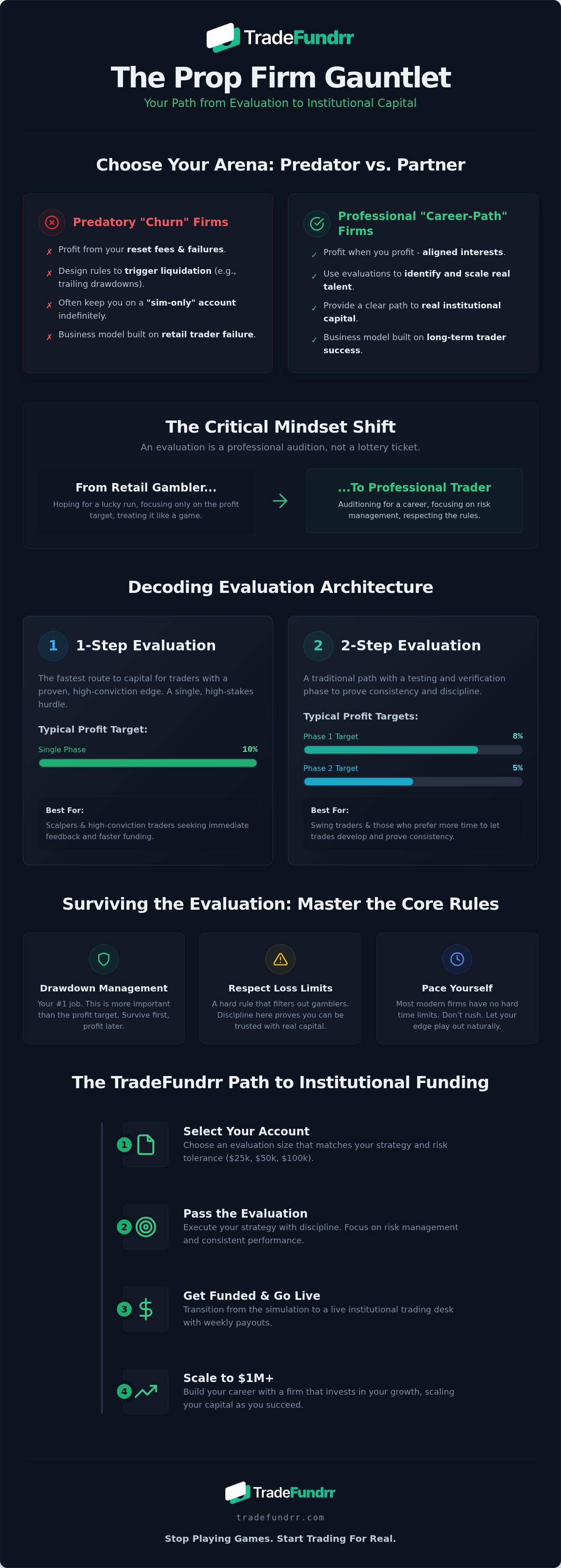
Most prop firms want you to fail. They design rules to trigger liquidation rather than identify talent. They profit from your reset fees, not your trading success. It's a business model built on retail failure. We're here to change that perspective. The prop firm evaluation process isn't just a hurdle to jump; it's a professional filter. If you treat it like a gamble, you've already lost. If you treat it like an institutional audition, the doors to a funded account finally swing open.
You're likely tired of predatory trailing drawdowns and payouts that never arrive. You want a partner, not a predator. You'll learn how to master the mechanics of these evaluations and bypass the common rule traps that sink most traders. We're breaking down the differences between 1-step and 2-step evaluations, providing a concrete strategy for max drawdown management, and mapping your path to institutional-grade infrastructure. It's time to stop playing games and start trading like a professional.
Key Takeaways
- Understand why the prop firm evaluation process is a professional audit of your discipline, not a retail lottery designed for you to fail.
- Decode the mechanics of 1-step and 2-step evaluations to determine which path best leverages your specific trading edge.
- Learn to navigate the "rule traps" that sink most traders, focusing on drawdown management rather than just hitting profit targets.
- Discover how to transition from the evaluation to a funded account with weekly payouts and professional-grade infrastructure.
The Anatomy of a Professional Prop Firm Evaluation Process
An evaluation isn't a hurdle. It's a professional audit of your risk management and psychological discipline. Most retail traders approach the prop firm evaluation process like a lottery ticket. They hope for a lucky run. Professional traders approach it as a business audition. The difference is fundamental. Retail firms want you to fail. They profit from your resets and recurring fees. Institutional firms want to find talent they can scale. They grow when you grow.
The evaluation process is a professional filter for funding that separates disciplined practitioners from high-stakes gamblers. It typically involves a profit target, a maximum loss limit, and specific time constraints. These parameters simulate the pressure of a real trading desk. In the world of Proprietary trading, these metrics are the industry standard for measuring alpha and risk-adjusted returns. If you can't respect a loss limit on a $50,000 account, you'll never be trusted with seven figures.
Filtering for Institutional Talent
Prop firms don't just hand out funded accounts. They use evaluations to mitigate tail risk. This screens out reckless risk-takers while identifying traders who can handle volatility without breaking their rules. There are "churn" firms and there are career-path firms. Churn firms use predatory rules like trailing drawdowns to force liquidations. Career-path firms use transparent rules to build longevity. We've built a model that provides institutional-grade buying power for retail traders. We don't want your reset fee. We want your skill on our desk.
The Scaling Reality Check
Many firms keep you at one account size forever. They call it "funded," but there is nowhere to go from there. This creates a false sense of security and stunts your professional growth. TradeFundrr focuses on the transition from the evaluation to a funded account. Whether you start with a $25,000, $50,000, or $100,000 evaluation, the goal is always the same: moving you toward the $1M+ scaling path. We provide the tools. You provide the discipline.
Decoding the 1 Step Evaluation Funded Account
The 1-step evaluation is the industry's response to the demand for speed. It collapses the traditional testing and verification phases into a single, high-stakes hurdle. For traders with a proven edge, it's the fastest route to a funded account. You don't wait months to prove your worth. You perform once, and you're in. However, this efficiency isn't free. The prop firm evaluation process for a 1-step account usually demands a higher profit target or enforces tighter drawdown limits to compensate for the reduced observation time.
Institutional desks use these compressed windows to identify specific types of alpha. While some regulations, like the Prohibition on proprietary trading for certain banking entities, have reshaped the landscape, the independent prop space remains a meritocracy. We offer several entry points, including the $25, 000 funded account challenge, designed for those who want to skip the bureaucracy and get to work.
Speed vs. Sustainability
1-step challenges reward high-conviction traders. If your strategy relies on catching specific, high-probability moves, a single phase makes sense. The danger lies in the temptation to over-leverage. Many retail traders treat the single step as a license to gamble. They trade for the "pass" instead of trading for the long term. Professional traders avoid this trap. They know that speed is useless if the account is liquidated a week later. They treat the single step with the same professional rigor as a multi-month audit.
Comparing 1-Step and 2-Step Architectures
The math changes depending on the path you choose. Here is how the structures typically diverge in 2026:
- Profit Targets: 1-step evaluations often require a 10% gain. 2-step versions usually split this into 8% for phase one and 5% for phase two.
- Time Constraints: Most modern evaluations have removed hard time limits. You can trade at your own pace, but the internal pressure to "get funded" remains a psychological factor.
- Style Fit: Scalpers often prefer 1-step paths for their immediate feedback. Swing traders may lean toward 2-step paths to give their trades more room to breathe.
Choosing the right format is about matching the rules to your personality. If you're ready to test your skills against a professional benchmark, you can explore the options at tradefundrr.com to find your fit.
Navigating Evaluation Rules: Beyond the Profit Target
Profit targets are the siren song of the industry. They're easy to quantify. They're exciting. But they aren't why you'll fail. Most traders flame out during the prop firm evaluation process because they don't respect the downside. Drawdown isn't just a number on a dashboard. It's a measure of your professional survival. If you focus only on the gain, you're ignoring the trap door beneath your feet.
Institutional firms look for a smooth equity curve, not a lucky lottery ticket. They want to see that your strategy is repeatable and your risk is contained. A hard breach is terminal. You hit the max loss, and the account is closed. End of story. A soft breach might just close your open positions or disable trading for the day. Understanding these distinctions is the difference between a career and a hobby. Most evaluations are governed by these core constraints:
- Maximum Drawdown: The total amount you can lose before the account is closed.
- Daily Loss Limit: A cap on how much you can lose in a single session.
- Profit Consistency: Rules that ensure your gains are distributed across multiple trades.
The Drawdown Trap: Trailing vs. Static
Trailing drawdown is a predator. It follows your high-water mark as you profit. If you make $2,000, your drawdown limit moves up $2,000. But it doesn't move back down when you lose. Trailing drawdown effectively locks in your losses as you profit, shrinking your room for error until it vanishes. It's a mechanic designed to force failure in a volatile market.
Static drawdown is the professional standard. It stays fixed at a specific floor. It's transparent. It's fair. As the industry faces increased regulatory oversight of prop trading firms, the shift toward these more transparent models is accelerating. Professional firms favor static limits because they allow you to trade your strategy without the goalposts moving every time you have a winning day.
Daily Loss Limits and Consistency
Consistency rules prevent "one-hit wonders." Many firms use a 50% rule. This means no single trade can account for more than half of your total profit target. If you need $5,000 to pass and you make $4,000 on one lucky earnings play, you haven't passed. You've just created a lot more work for yourself. You're forced to keep trading until that single gain is diluted by other, smaller wins.
Daily loss limits act as a psychological circuit breaker. They stop you from "revenge trading" your way into a hard breach. Think of them as a safety net. You need to read the prop firm evaluation rules with a fine-tooth comb before you place your first trade. Disqualification by technicality is a rookie mistake. Professionalism starts with reading the contract.
Strategies to Survive the Evaluation Phase
Your entry signal is not your edge. Risk management is your edge. Retail gurus sell the dream of a 90% win rate. They focus on where to buy and where to sell. They ignore the math that keeps you in the game. In a professional prop firm evaluation process, the market will eventually move against you. It's a mathematical certainty. Survival depends on how you handle that moment. You need a strategy that prioritizes capital preservation over profit targets. You aren't trading to get rich today. You're trading to stay in business tomorrow.
Managing your "R" (Risk-to-Reward) is the only way to ensure the math works in your favor. If you risk $1 to make $3, you only need to be right 30% of the time to stay afloat. Most traders flip this. They risk $3 to make $1, hoping for a high win rate to save them. It works until it doesn't. One bad day wipes out a month of progress. We teach a different approach, providing the psychological and tactical framework required to trade like an insider. Stop hunting for the perfect setup. Start hunting for positive expectancy.
Risk Management as the Primary Edge
Calculate your position size based on your daily loss limit. Do not base it on the total account balance. If you have a $100,000 account but a $3,000 daily loss limit, you aren't trading $100,000. You're trading $3,000. Risking more than 0.5% to 1% per trade is a gambler’s move. It leaves no room for a losing streak. Professional traders trade small until they build a cushion. They earn the right to increase their size through performance. If you hit half of your daily loss limit, walk away. The market will be there tomorrow. Your account might not be.
Trading Psychology under Pressure
Verification anxiety is real. In a 2-step process, the second phase often feels harder even though the target is lower. Traders get close to the finish line and stop trading their system. They start trading their P&L. This is the "Sim" trap. You change your behavior because the stakes feel higher. You hesitate on entries. You exit winners too early. You hold losers too long. At TradeFundrr, we provide real human support to help you navigate these mental blocks. We don't use bots. We use experienced practitioners who understand the pressure of the live market. If you're ready to stop gambling and start performing, you can view our professional evaluation paths today.
The TradeFundrr Path: From Evaluation to a Funded Account
Most prop firms operate on a "churn and burn" model. They want you to fail so they can collect reset fees. We want you to scale so we can grow. The TradeFundrr path isn't a game of luck; it's a professional bridge designed to take you from a retail environment to institutional-grade buying power. The prop firm evaluation process we've built serves as the foundation for this transition. It's the gate. Once you're through, the real work begins. We don't just offer challenges. We offer a career path.
You aren't just another number in a database. You're a potential partner. This distinction changes everything about how we provide support and infrastructure. We don't hide behind automated bots or generic FAQ pages. We provide real human support because professional trading is a human endeavor. If you have the talent, we provide the stability. If you provide the discipline, we provide the buying power. It's a straight-shooting arrangement built on mutual respect and professional rigor.
Institutional Infrastructure vs. Retail Dashboards
Retail firms give you a web-based dashboard and little else. We provide real infrastructure for funded stock trading accounts. This means access to professional tools and real market data. You're trading on live market data with institutional-grade resources at your fingertips.
Scaling to $1M+ and Weekly Payouts
Consistency is the only metric that matters in the long run. We've designed a roadmap that rewards traders who think in years, not days. You can start with a $25,000, $50,000, or $100,000 evaluation. As you prove your discipline, you move toward the $1M+ scaling path. This isn't a hypothetical goal. It's a structured progression for those who respect the prop firm evaluation process and the risk management rules that govern it.
We've also dismantled the industry standard "30-day wait" for compensation. We offer prop firm weekly payouts because professionals deserve sustainable cash flow. Our profit-sharing model rewards long-term consistency over short-term luck. If you're tired of the traps in retail challenges and ready to trade for real payouts, the infrastructure is ready. Join the insiders. Your path to a funded account starts here.
Securing Your Future on the Institutional Desk
The industry is full of noise. Most firms want your reset fee. We want your performance. The prop firm evaluation process isn't a game to be won; it's a standard to be met. You've seen the difference between predatory trailing drawdowns and static institutional risk limits. You understand that profit targets are secondary to psychological discipline. It's time to stop chasing high-leverage gambles and start building a sustainable trading career.
We provide the bridge. You provide the skill. TradeFundrr offers the infrastructure retail traders usually can't access. We provide weekly payouts for successful traders and real human support for every practitioner on our desk. No bots. No hidden traps. Just a professional environment designed for serious traders who are ready to get funded. Your talent deserves a real system.
Start your evaluation and secure your funded account now
The markets are moving. Your seat is waiting. Let's get to work.
Frequently Asked Questions
What is a 1-step evaluation funded account?
A 1-step evaluation funded account is a single-phase challenge that eliminates the secondary verification stage. It's built for traders who want to reach funded status quickly without jumping through multiple hoops. While it offers a faster path to a funded account, it usually requires a higher profit target or tighter risk limits to compensate for the shorter observation period.
How long does the prop firm evaluation process take?
The duration of the prop firm evaluation process depends entirely on your performance. We don't impose arbitrary time limits or force you to trade on a specific schedule. Some traders hit their targets in a matter of days; others take months of patient execution. Professionalism isn't about speed. It's about hitting targets while respecting your drawdown limits.
Can I lose more money than my initial evaluation fee?
No. Your personal financial risk is strictly capped at the cost of your evaluation fee. You aren't liable for any trading losses during the evaluation or once you're funded. You provide the trading talent and discipline. It's a clean split between our infrastructure and your skill.
What happens if I fail the evaluation Profit Target or Drawdown limit?
If you hit a hard breach on your drawdown limit, the account is closed immediately. Profit targets are goals you aim for, but drawdown limits are absolute floors you must respect. If you fail, you can choose to purchase a reset or start a new path. This filter ensures only disciplined traders get funded.
Are there any hidden consistency rules in the evaluation process?
Consistency rules aren't hidden, but retail traders often overlook them. The most common rule is the "50% rule," which ensures no single trade accounts for more than half of your total profit. We aren't looking for lucky gamblers who hit one big winner. We're looking for repeatable systems and a smooth equity curve.
Does TradeFundrr provide real capital or simulated funds after the evaluation?
We provide a simulated funded account after the evaluation, with real payouts. Top performers can apply to Pro at T3 Global, a separate trading company where they trade their own capital with leverage.
Can I trade stocks and crypto during the evaluation phase?
Yes. You have access to stocks, options, futures, and crypto throughout the evaluation. We don't limit you to a single asset class like many forex-only firms. If your edge is in the equities market or high-volatility crypto pairs, you can use those instruments to prove your profitability and secure funding.
How often can I withdraw my profits once I am funded?
You can withdraw your profit share on a weekly basis. We've dismantled the industry-standard 30-day wait because professional traders need consistent cash flow. If you perform, you get paid. We prioritize your liquidity and sustainable growth over the administrative convenience of long payout cycles.
Pass the evaluation with discipline
Prove your edge in a structured, simulated funding environment with clear, transparent rules.
Get Funded →