
Institutional Capital for Retail Traders: Bridging the Professional Gap in 2026


Your strategy isn't the problem. Your capital is. Most retail traders aren't failing because they lack skill; they're failing because they're fighting a war with a pocketknife while the institutions have heavy artillery. Accessing institutional capital for retail traders used to be a closed-door affair reserved for the Ivy League elite. It was a world of high barriers and zero transparency. That world is gone.
You likely feel the sting of undercapitalization every time you're forced to over-leverage just to make your time worth it. You've dealt with retail brokerages that provide poor execution and leave you isolated without professional support. It's an environment designed to keep you small. We agree that your talent deserves better than a sub-standard retail account. You shouldn't have to risk your life savings to prove you're a professional.
This guide reveals how to bypass these limitations and access the institutional-grade capital and infrastructure required to trade professionally in 2026. We'll break down the shift toward merit-based funding and the mechanics of securing a six or seven-figure account. You'll learn how to trade with real infrastructure and receive professional payouts for the skill you've already built.
Key Takeaways
- Break through the "Capital Ceiling" that forces skilled traders to over-leverage small retail accounts just to make a living.
- Learn how to access institutional capital for retail traders through professional ecosystems backed by industry leaders like T3 Global.
- Shift from risking 100% of your personal savings to trading with firm capital protected by professional drawdown limits.
- Discover a merit-based qualification path that rewards consistent discipline instead of one-off lucky trades.
- Scale your trading career from a $25,000 evaluation to a professional path exceeding $1 Million in institutional capital.
The Capital Ceiling: Why Retail Traders Struggle to Scale
Retail trading is often a battle of attrition against your own account balance. You have the strategy. You have the screen time. But if your balance is $3,000, your edge doesn't matter. To make a meaningful income, you're forced to over-leverage. One bad string of trades wipes you out. This is the "Capital Ceiling." It happens when your skill is professional, but your capital is amateur. You're trying to build a skyscraper on a foundation made of sand. It cannot hold.
Undercapitalization leads directly to revenge trading. When a small loss represents a large percentage of your net worth, you panic. You try to "win it back" immediately. This cycle of excessive risk-taking is the primary reason retail traders fail. Accessing institutional capital for retail traders provides the fuel needed to turn a proven strategy into a sustainable career. It removes the desperation. It replaces "hope" with "infrastructure."
Retail Brokerages vs. Institutional Environments
Retail brokers profit from your churn. They want you to click buttons. Your longevity is irrelevant to their bottom line. Institutional partners operate differently. They profit when you stay in the game. The hidden costs of retail trading are staggering. Slippage and wide spreads eat your edge before you even enter the trade. Many "commission-free" platforms use Pay-For-Order-Flow (PFOF). They sell your data to the highest bidder. In reality, commission-free trading is often the most expensive way to participate in the markets. You aren't the customer; you're the product.
Professional environments prioritize execution quality. They provide direct market access and stable systems. This is the hallmark of Proprietary trading (prop trading). The firm provides the capital and the tools because they want a share of your success. It's a partnership, not a predatory relationship. You get the tools to win, and the firm gets a skilled operator. Everyone's interests align.
The Psychological Shift from Hobbyist to Pro
There is a massive difference between trading $5,000 of your own money and $100,000 of institutional capital. When it's your rent money, every tick against you feels like a personal attack. This creates a scarcity mindset. You exit winners too early and hold losers too long. Professional backing removes this emotional weight. It allows you to focus on the process rather than the payout. Undercapitalization is the primary cause of retail failure in 2026, forcing talented individuals into a cycle of high-risk gambling instead of disciplined wealth building. When the capital is there, the scarcity disappears. You stop trying to "get rich quick" and start trying to trade well. That's when the real money shows up.
What is Institutional Capital for Retail Traders?
Institutional capital isn't a mysterious vault of cash. It's pooled money managed by professional entities like T3 Global. For the individual, it's the bridge between trading as a hobby and trading as a career. While retail traders are limited by their personal savings, institutional capital for retail traders provides the leverage needed to trade large blocks without the personal liability of a margin call. In a retail account, your losses are your own. In a professional agreement, the firm absorbs the downside risk beyond your initial evaluation fee. It's a fundamental shift in how risk is structured.
This capital is accessed through a Proprietary Trading agreement. This legal framework defines how you interact with the firm's balance sheet. It's not a loan. It's a performance-based partnership. You bring the alpha; the firm brings the liquidity. This arrangement is governed by specific industry standards, including FINRA rules for proprietary trading firms, ensuring that the relationship remains professional and transparent. You provide the talent. The firm provides the foundation.
Infrastructure: The Professional Edge
Most traders think they just need more money. They're wrong. They need better plumbing. Institutional capital is inseparable from institutional infrastructure. Retail brokers often send your trades to "wholesalers" who profit from the spread. This is the PFOF model. In contrast, professional environments provide Direct Market Access (DMA). Your orders go straight to the exchange. You see the real depth of the market. This is critical for executing order flow trading strategies for prop firms where every cent of slippage matters. You need professional-grade platforms for stocks, options, and futures that don't freeze when volatility spikes. If the system fails, the capital is useless.
The Role of the Funding Partner
A real funding partner doesn't want high-frequency turnover. They want longevity. They provide the balance sheet so you can focus on your edge. This partnership succeeds only when risk management is the priority. Many online platforms replace human interaction with automated bots and rigid scripts. This is where the professional gap widens. The importance of prop firm human support cannot be overstated. When a technical issue arises or a market event shifts the landscape, you need a professional on the other end of the line. You shouldn't be shouting into a void when real capital is on the line. If you're ready to move beyond the retail struggle, you can explore our evaluation programs to see where your skill fits.
Prop Firm vs. Retail Account: A Practical Comparison
Trading your own money is a heavy weight. Trading firm money is a powerful weapon. Retail accounts require you to put 100% of your personal capital at risk. If the market moves against you, your bank account bleeds directly. Proprietary firms shift that burden. You pay a small evaluation fee to prove your worth. The firm takes the risk on the capital. It's a fundamental difference in how you approach the market every morning.
Retail traders keep 100% of their profits, but 100% of a small account won't pay the bills. Funded traders typically keep 80% to 90% of the profits generated on accounts worth $100,000 or more. Understanding what are institutional investors helps clarify the sheer scale of the liquidity you're tapping into. It's better to have 80% of a professional payout than 100% of a hobbyist's pittance. Accessing institutional capital for retail traders isn't just about the money; it's about the leverage to trade at a professional scale.
The Cost of Doing Business
To trade $100,000 in a retail margin account, you need massive personal liquidity. To access that same power through a funded evaluation, you only need to demonstrate discipline. Retail is pay-to-play. Institutional is prove-to-earn. The evaluation fee isn't just a revenue stream for the firm. It's a filter. It ensures that only the traders with a repeatable process get the keys to the balance sheet. If you can't protect a small fee, you can't protect a million-dollar account.
Risk Management as a Service
Institutional drawdown rules aren't there to stop you. They're there to save you. Drawdown is the professional trader's most important metric, representing the maximum peak-to-trough decline in account value before a strategy is considered broken. Retail traders often blow their accounts because they have no hard stop on their emotions. Prop firms mandate that stop. Trailing drawdowns move with your profit, while static drawdowns stay fixed at a specific level. Both serve as a safety net. They keep you in the game long enough for your edge to play out.
Many firms start you in a simulated environment to verify your consistency. This "Sim-to-Live" transition is a critical part of the process. Understanding how prop firms work is essential because it reveals the path from simulation to real liquidity. Successful traders move into live environments where their skill is backed by the firm's real-world assets. It's the ultimate validation of your professional ability.
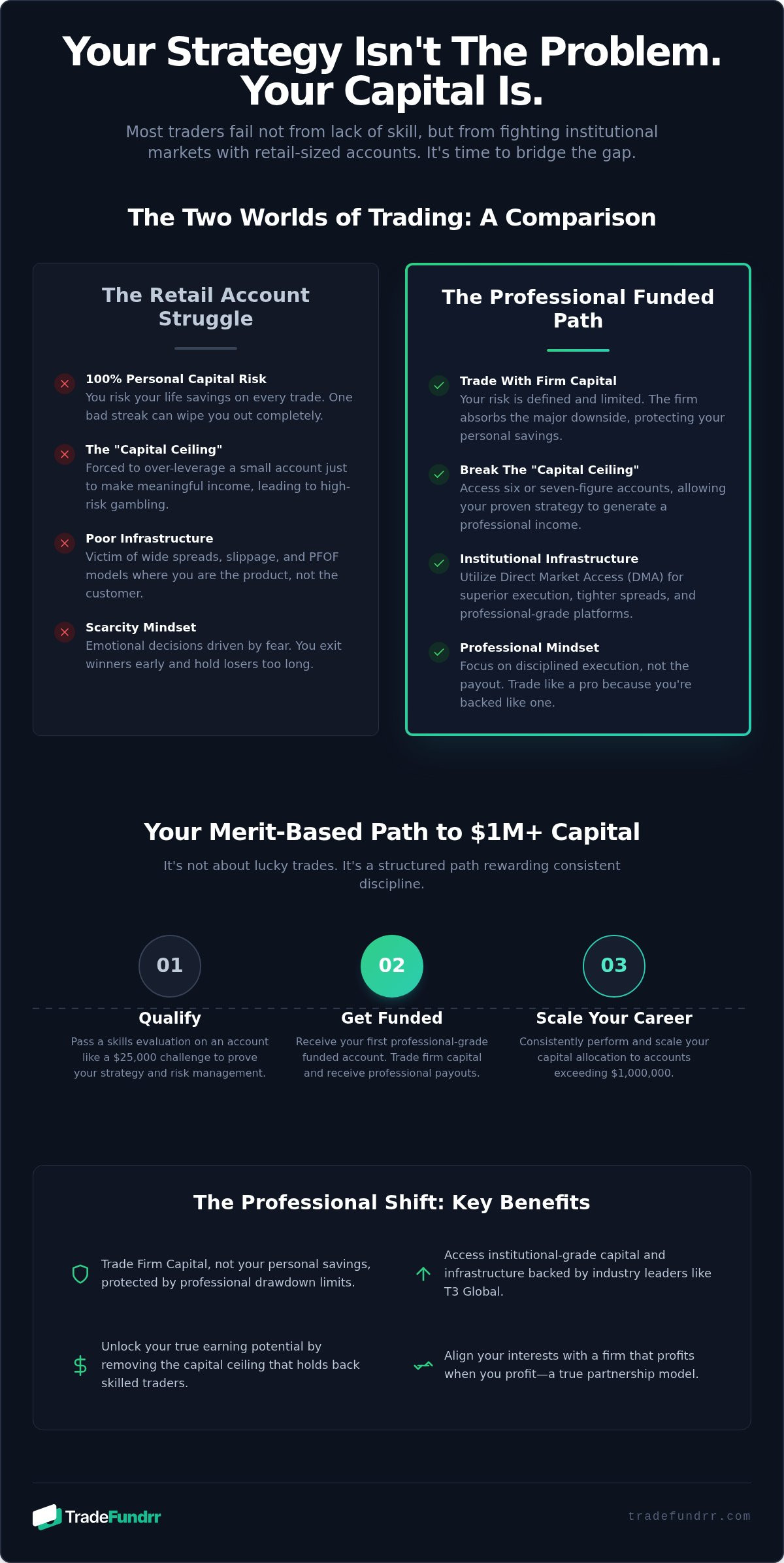
How to Qualify for Institutional Funding
Accessing institutional capital for retail traders isn't a gift. It's earned. You don't get the keys to the vault by being lucky; you get them by being disciplined. The path is structured to filter out gamblers and reward professionals. It's a methodical progression designed to protect the firm's assets while empowering your talent.
- Step 1: Select Your Tier. Choose an evaluation based on your strategy's average returns and risk profile. Don't overreach. Pick a level where your current edge can thrive.
- Step 2: Prove Consistency. Demonstrate a repeatable process over a set period. A single lucky trade is a red flag. Firms look for a smooth equity curve, not a vertical spike.
- Step 3: Manage the Downside. Adhere to strict risk parameters. You must respect Daily Loss Limits and Max Drawdown rules. If you can't manage risk, you can't manage capital.
- Step 4: Cross the Bridge. Pass the "Sim-to-Live" phase. This moves you from a simulated environment into real-world liquidity where your trades have actual market impact.
The Evaluation Phase: Proving Your Edge
Most traders fail because they treat the evaluation like a lottery ticket. They risk too much too fast. According to 2026 data from AquaFutures, industry-wide pass rates hover around 5% to 10%. This isn't because the rules are impossible. It's because most retail traders lack a professional framework. A disciplined, repeatable framework turns that chaotic approach into a methodical one. If you can't manage the rules of an evaluation, you'll never manage the responsibility of scaling to a 1 million dollar trading account. You need a plan, not a prayer.
From Evaluation to Weekly Payouts
Reaching "Funded" status is the beginning, not the end. This is where the transition from simulation to live market impact happens. In a professional environment, you move into a weekly payout cycle. This creates a consistent cash flow that retail accounts rarely provide. You stop looking for "moon shots" and start looking for base hits. The pressure of risking your own rent money is replaced by the rigor of managing firm capital. It's a different game. It's a better game. You provide the alpha, and the firm provides the stability.
If you're ready to prove your skill and move beyond retail limitations, start your funded account evaluation today.
TradeFundrr: The Institutional Bridge for Serious Traders
TradeFundrr isn't a retail broker. We don't want your deposit. We want your talent. We act as the gateway to T3 Global's institutional ecosystem, providing a direct bridge for those who have outgrown the limitations of retail trading. Our model is simple: you provide the strategy, and we provide the institutional capital for retail traders. This is a partnership built on transparency and professional rigor. We don't succeed unless you do.
We offer a clear path for growth. You can start with a $25,000 Funded Account Evaluation and scale your way into our $1M+ Institutional Capital Path. This isn't about "getting lucky." It's about merit. In an industry filled with artificial barriers, we focus on removing them. Real human support replaces automated bots. Professional stability replaces retail volatility. We provide the infrastructure and expect you to provide the discipline.
Why Our Infrastructure Matters
Most online prop firms are "Demo-Only" shops. They live on evaluation fees and hope you fail. We operate differently. We provide access to stocks, options, futures, and crypto on professional rails. This is the "Real Capital" approach. We move successful traders from simulated environments into live market liquidity where their trades have actual impact. When you trade with us, you're using the same infrastructure as professional desk traders. This isn't a game; it's a business. That's why we offer weekly payouts. You shouldn't have to wait a month to receive the rewards of your skill. If you're trading like a pro, you should be paid like one.
Start Your Institutional Journey
The gap between a hobbyist and a professional is often just a matter of resources. A $25,000 account is a starting point. The $1M+ scaling path is the destination. To help you navigate this transition, we focus on the professional fundamentals as your first step toward understanding the institutional mindset. It strips away the retail noise and focuses on what actually moves the needle in professional markets. Stop fighting the capital ceiling and start building a career on a foundation that can actually support your ambition. Your skill is the asset. We provide the leverage.
The doors to the professional world are open. You just have to walk through them. Your strategy deserves a balance sheet that matches its potential. Stop risking your own savings and start leveraging ours. Apply for your Institutional Evaluation at TradeFundrr and start trading at the level you deserve.
Step Into the Institutional Arena
The Capital Ceiling is a structural barrier designed to keep you small. It's a trap of undercapitalization and poor execution. But the landscape has shifted. Accessing institutional capital for retail traders is no longer about who you know; it's about what you can do. You've seen the difference between retail churn and institutional stability. You understand that real infrastructure, backed by our partnership with T3 Global, is the only way to scale a proven strategy.
Stop fighting the system with a retail account. TradeFundrr provides the balance sheet while you provide the alpha. With accounts scaling up to $1M+, weekly payouts, and real human support, you're no longer trading in isolation. You're part of a professional ecosystem built for longevity. We've removed the barriers. Now, it's time for you to do the work. The path is clear. The tools are ready. Your skill is the final piece of the puzzle.
The doors to the professional world are open. Your strategy deserves a foundation that can actually support your ambition. Secure Your Institutional Capital Path with TradeFundrr and start trading at the level you've earned.
Frequently Asked Questions
What is the difference between a retail broker and institutional capital?
A retail broker provides a platform for you to risk your own money; institutional capital provides the firm's money for your strategy. Brokers profit from your transaction volume and churn. Accessing institutional capital for retail traders means your interests are aligned with the firm's longevity. It's the fundamental difference between being a retail customer and a professional partner. You trade their balance sheet while keeping the majority of the profit.
Can a retail trader really trade a $1 million account?
Yes, a retail trader can absolutely manage a seven-figure account. Our $1M+ Institutional Capital Path is built specifically for this transition. It isn't a reward for having a high net worth; it's a reward for proving you have a professional edge. You start small, demonstrate consistency, and scale as your performance warrants. The capital is there for anyone who provides the discipline and follows the professional risk parameters.
Do I need a finance degree to access institutional funding?
You don't need a finance degree or a Wall Street pedigree. The market is the ultimate meritocracy. It doesn't care where you went to school or what your resume looks like. Firms care about your ability to follow a process and manage risk effectively. If you can pass our evaluation and protect the firm's capital, you're qualified. Your performance is your only credential that matters in this industry.
What are the common rules for institutional evaluations?
Most evaluations focus on two primary metrics: the daily loss limit and the maximum drawdown. These aren't arbitrary hurdles. They are professional risk management standards used by the world's top desks. You must also meet a profit target while maintaining a specific level of consistency. You can't gamble your way through the challenge. A single lucky day won't get you funded if the rest of your trades are chaotic.
How do weekly payouts work for funded traders?
Weekly payouts turn your trading skill into a professional income stream. Once you've moved past the evaluation and reached funded status, you can withdraw a share of your realized profits every week. This removes the scarcity mindset that plagues retail traders. You stop worrying about paying the bills and start focusing on executing your edge. It's about building a sustainable, long-term business rather than chasing a one-time windfall.
What markets can I trade with institutional capital through TradeFundrr?
You can trade stocks, options, futures, and crypto through our professional ecosystem. We provide the Direct Market Access (DMA) that retail brokers often hide behind wholesalers. This ensures you're trading on the same rails as the institutions. Whether you're scalping futures or hedging with options, you have the infrastructure required to compete at a high level. We provide the professional tools; you provide the individual talent.
Is institutional capital safer for retail traders than using their own money?
Trading institutional capital for retail traders is safer because it caps your personal financial risk. In a retail account, a sudden market gap can wipe out your entire life savings. In a funded environment, your maximum loss is limited to the cost of the evaluation. You get professional-grade leverage without the personal liability of a margin call. It's the smartest way to protect your personal wealth while scaling.
What is the 'Sim-to-Live' trap in proprietary trading?
The "Sim-to-Live" trap is a common issue with demo-only prop firms. These entities profit solely from evaluation fees and have no interest in your long-term success. They keep you in a simulated environment forever. A real partner uses simulation only as a temporary proving ground. The goal is to move you into live market liquidity where your talent can actually contribute to the firm's bottom line through real-world execution.
Prove your edge in a structured, simulated environment
Start a funded evaluation with published rules, defined payout schedules, and real market data.
Get Funded →