
Order Flow Trading Strategies for Prop Firms: The Institutional Deep Dive
 July 15, 2026
11 min read
July 15, 2026
11 min read
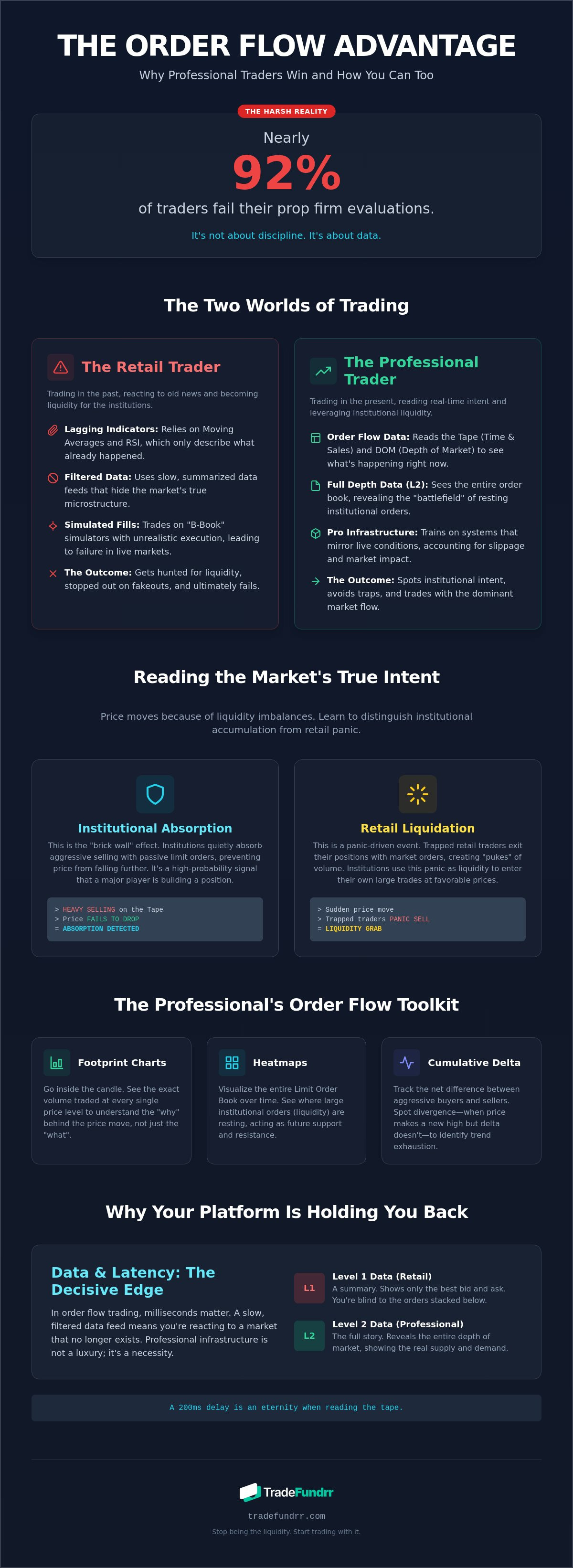
Why do nearly 92% of traders fail their evaluations while a small elite scales to seven figures? It isn't a lack of discipline. It's a lack of information. Most retail participants rely on lagging indicators that describe what happened ten minutes ago. Professional order flow trading strategies for prop firms focus on what is happening right now. They reveal the intent behind the price action.
You have likely felt the sting of a "perfect" breakout that instantly reversed into a stop run. You aren't imagining it; you are being hunted. Cheap platforms and retail charts hide the institutional absorption that turns your entry into their liquidity. It's time to stop guessing and start reading the tape. We are moving past the noise to find the signals that actually move markets.
This deep dive will teach you to master the microstructure signals that separate institutional accumulation from retail desperation. We will explore how to identify high-probability entries using the tape and distinguish big players from retail noise. By the end, you will know how to protect your evaluation account by spotting absorption before it wipes you out. This is how you stop being the liquidity and start trading with it.
Key Takeaways
- Stop trading blind with lagging retail data. Learn to read the Tape and DOM to see real-time institutional intent before price moves.
- Implement high-probability order flow trading strategies for prop firms to distinguish between genuine trend reversals and retail liquidation spikes.
- Master the art of spotting institutional absorption at key Value Area levels. This prevents you from being stopped out by common market fakeouts.
- Protect your evaluation account by using delta divergence and micro-sizing to find low-risk entries that fit within strict drawdown rules.
- Discover how to bridge the gap between retail struggle and institutional success through professional infrastructure and real payouts.
The Reality of Order Flow Trading in Prop Firm Evaluations
Order flow isn't a magic indicator. It's raw data. It's the real-time record of every buy and sell order hitting the exchange. Most retail traders spend their days squinting at lagging moving averages or "secret" RSI settings. Professional traders watch the auction. They focus on the Time & Sales (the Tape) and the Depth of Market (DOM). Understanding the order flow trading basics is the first step in moving beyond retail guesswork. It's about seeing the market as a continuous negotiation between buyers and sellers.
Retail traders fail because they use retail tools. Standard data feeds are filtered and slow. They are built for people who trade once a day, not those who need to see the microstructure. If you want to implement successful order flow trading strategies for prop firms, you need institutional-grade data. You need to see the full depth of the market. Without it, you are trading a ghost of the actual auction.
There's a dangerous trap in simulated trading: the sim-to-live disconnect. A simulator can fill your orders without accounting for market impact or real-world liquidity. You get a false sense of security. You get perfect fills that don't exist in reality. When you trade your own capital in the live market, slippage becomes real. You must plan for slippage from day one. Anything else is just a game.
Why Infrastructure Matters for Order Flow
Level 1 data is a summary; Level 2 is the story. Level 1 only shows the current bid and ask. Level 2 (Full Depth) reveals the battlefield. It shows the resting orders waiting to be filled. Latency kills microstructure strategies. A 200ms delay is an eternity when you are reading the tape. If your feed is slow, you are reacting to a past that no longer exists. We provide the live market data required for professional tape reading. You provide the talent.
Choosing the Right Order Flow Tools
Price action is a shadow. Order flow is the object casting it. To see clearly, you need the right lens. Professional traders use several key tools to navigate the auction:
- Footprint Charts: These show the volume executed at every price level within a candle. They reveal the "why" behind the move.
- Heatmaps (Bookmap): These visualize the Limit Order Book. They show you where the "big fish" are parking their liquidity.
- Cumulative Delta: This tool tracks the net difference between aggressive buyers and sellers. It is the ultimate tool for spotting trend exhaustion.
When you see aggressive sellers hitting the bid but price refuses to drop, you've found absorption. This is where the big players enter. It's where retail traders get trapped. High-probability order flow trading strategies for prop firms rely on identifying these imbalances before the rest of the market catches on. Don't trade the shadow. Trade the source.
Microstructure Signals: Distinguishing Institutional Flow from Liquidation
Price doesn't move because of "market sentiment" or technical patterns. It moves because of a liquidity imbalance. To master order flow trading strategies for prop firms, you must learn to read the velocity of the auction. Retail traders see a breakout. Institutional traders see a liquidity grab. The difference lies in the microstructure signals hidden within the tape.
Institutional accumulation often looks like nothing at all. Large players rarely chase price. Instead, they use passive limit orders to absorb aggressive retail selling. This is the "brick wall" effect. You see thousands of contracts hitting the bid on the Tape, yet price refuses to tick lower. This is absorption. Academic research on institutional order flow and stock returns confirms that these large-scale imbalances are the primary drivers of short-term price direction. If you aren't tracking this absorption, you're just guessing.
Retail liquidation is the opposite. It's loud, fast, and messy. When retail traders get caught on the wrong side of a move, they panic. They use market orders to exit, creating "pukes" on the footprint chart. These are high-volume clusters that result in massive slippage. This panic provides the liquidity institutions need to fill their own large positions. They fish for your stops because they have to. It isn't personal; it's just the mechanics of the auction.
Identifying Aggressive Institutional Participation
Watch the Time & Sales for block trades. These are massive single-print orders that often occur without moving the price immediately. They represent a "hidden" hand entering the market. Contrast this with "aggressive sweepers." These are market orders so large they consume multiple levels of the Limit Order Book in a single millisecond. Microstructure signals are the footprints of institutional intent. When you see a sweeper followed by a lack of retracement, the big money is committed. If you're ready to trade in an environment that respects this level of detail, consider how professional infrastructure changes your execution.
Spotting Retail Liquidation and Exhaustion
A "puke" is easy to spot on a Footprint chart. Look for a sudden surge in volume at the extreme end of a candle that fails to move the price further. This is exhaustion. The aggressive side has run out of ammunition, and the passive side has fully absorbed the pressure. You can verify this using Delta. If price makes a new low but the Cumulative Delta remains flat or ticks higher, the sellers are exhausted. The "smart money" has already moved in. Stop chasing the "slippage candles" and start looking for the quiet accumulation that precedes the real move.
High-Probability Order Flow Strategies for Prop Challenges
Most traders think strategies are about lines on a chart. They aren't. They're about people. Professional order flow trading strategies for prop firms focus on where those people are wrong. We look for the moment retail desperation meets institutional necessity. You don't trade the pattern. You trade the imbalance. Patterns fail. Order flow persists.
The Institutional Absorption Play happens at the edges. Value Area High (VAH) and Value Area Low (VAL) aren't just technical levels; they're decision zones. When price hits VAH and you see a massive surge in buy market orders on the footprint, but price refuses to break higher, you've found the wall. That wall is an institutional limit order. Large players are filling their shorts with retail FOMO. This mechanic is a core component of NBER analysis of institutional order flow, which highlights how sophisticated participants provide liquidity to aggressive, less-informed traders.
Auction Market Theory introduces the concept of "Unfinished Business." A candle with significant volume at the extreme high or low suggests the auction didn't reach a natural conclusion. Price will almost always return to "finish" that trade. Conversely, stacked imbalances show pure conviction. When you see three or more consecutive price levels where buyers overwhelm sellers by 300% or more, the big money has made its move. You don't fight that momentum. You join it.
The Absorption Play: Trading Against Desperation
Wait for price to test a major structural level. Don't front-run the entry. Look for high aggressive volume on the Footprint with zero price progression. This is the signature of a big player "sitting" on the bid or offer. You enter only when the absorbing side shows a shift in dominance. The aggressive sellers give up, and the passive buyer finally steps up the offer. It's a low-risk entry because your stop goes right behind the "brick wall."
Delta Divergence for Reversal Entries
Delta Divergence is your lie detector. Price makes a higher high, but Cumulative Delta makes a lower high. The move is hollow. There's no aggressive conviction supporting the new price level. This signal is critical when you're trying to pass evaluation programs. It keeps you out of the "trapped trader" category. Using divergence allows you to avoid chasing a move that's already exhausted. You wait for the market to prove itself before risking your evaluation account. If the Delta doesn't confirm the price, the move is a fakeout. Don't be the liquidity they're looking for.
Managing Order Flow Volatility within Prop Firm Risk Rules
Prop firm rules are rigid. Order flow is fluid. Most traders fail because they try to force a high-volatility strategy into a low-tolerance risk environment. Effective order flow trading strategies for prop firms aren't just about finding the entry. They are about surviving the drawdown. You must align your execution with the specific constraints of your evaluation, or the tape will chew through your drawdown before the move even starts.
The trailing drawdown is the silent killer of microstructure traders. If you catch a 20-tick move but wait for 40, the retracement often drags your maximum loss limit higher, trapping you in a losing position even if the trade is technically "green." You don't have the luxury of "giving the trade room." You must take profits at the next order flow wall. When the DOM shows a massive block of resting limit orders, that's your exit signal. Don't hope for a break. Secure the gain.
Micro-sizing is the only way to maintain sanity during high-flow events. Instead of loading up on contracts because you see a footprint imbalance, use the precision of the tape to find sniper entries with tight, logical stops. If the institutional absorption you identified fails, the trade is over. Get out. A two-tick loss based on broken logic is professional. A twenty-tick loss based on hope is a hobby. If you want to trade with this level of rigor, you need to access institutional-grade buying power that rewards precision.
Risk Management for Order Flow Traders
Stop setting stops based on arbitrary dollar amounts. Set them where the auction logic fails. If you enter because of a stacked buying imbalance, your stop goes one tick below that stack. If that level breaks, your thesis is dead. Discipline is the bridge between a retail dreamer and a funded professional. We recommend keeping a written log of your psychological triggers during fast markets. When technical lag or data spikes occur, having prop firm human support is vital. You need a partner who understands the microstructure, not a bot reading a script.
Scaling and Profit Taking
Identify "the wall" on the DOM and scale out. Order flow traders should prioritize high win rates over massive risk-to-reward ratios during evaluations. Consistency passes challenges; "home runs" hit max drawdowns. Whether you are navigating futures or looking into funded stock trading accounts, the mechanics remain the same. Price moves toward liquidity and bounces off exhaustion. Master the exit, and the funding will follow.
Executing Your Strategy: The Path to Getting Funded
Order flow isn't a hobby. It's a profession. You've mastered the signals and refined your strategies. Now you need the buying power to make it count. We offer you an institutional career path. Transitioning from theory to consistent execution is where most retail traders crumble. They have the skill but lack the infrastructure. We provide the tools; you provide the talent.
At TradeFundrr, we bridge that gap. We don't just provide a dashboard; we provide live market data and professional platforms. Professional order flow trading strategies for prop firms require professional execution. If your platform lags during a high-volume sweep, your edge vanishes. We ensure it stays intact. Professional infrastructure beats retail-only platforms every time because it respects the precision of the tape.
Scaling is the ultimate goal. You don't want to stay at the entry level forever. Our path allows you to grow from a modest start to a 1 million dollar trading account. This isn't a gamble. It's a structured progression based on your performance. We want you to manage more buying power because that's how we both win. It's a partnership built on transparency and results.
The TradeFundrr Evaluation Journey
Success starts with a single step. For many, that's the $25,000 Funded Account Evaluation. It's a proving ground. You show us your order flow edge, and we provide the buying power. We don't hide behind complex rules or hidden fees. We value transparency. Once you hit funded status, you don't wait months for your money. We offer weekly payouts. Real work deserves real compensation. You trade, you win, you get paid. It's that simple.
Final Steps for the Order Flow Trader
Knowledge is only half the battle. The other half is between your ears. Master the psychology of the tape. A written routine is what keeps you calm when the DOM gets chaotic. You aren't alone in this. You can review your logs with real human mentors who have seen the same signals you have. This isn't a bot-driven support system. It's a partnership of serious practitioners. Stop playing the retail game and start trading with the big players.
Apply for your funded account evaluation today and start trading like the insider you were meant to be.
Secure Your Seat at the Institutional Table
The difference between a retail dreamer and a funded professional is the data they trust. You've learned to distinguish institutional accumulation from panic-driven liquidation. You understand that absorption at the Value Area isn't a suggestion; it's a signal. Most traders will continue to chase lagging indicators. You now have the blueprints to read the auction in real time. This isn't about guessing direction. It's about witnessing intent.
Mastering order flow trading strategies for prop firms is only half the battle. The other half is the environment you trade in. You need a partner that offers Access to Institutional-Grade Buying Power and Weekly Payouts for Funded Traders. We provide the Human Support you need to navigate the complexities of the tape. No bots. No scripts. Just professional trading infrastructure for real practitioners.
The path to a seven-figure account is open. It requires precision, discipline, and the right infrastructure. Stop being the liquidity for the big players. Start trading alongside them. Master Institutional Order Flow with TradeFundrr today. Your career as a professional trader begins at the source.
Frequently Asked Questions
Is order flow trading allowed in prop firm evaluations?
Yes, order flow trading is fully permitted and often encouraged in professional evaluations. It's a manual skill set that proves you have a genuine edge in the auction. We value traders who use order flow trading strategies for prop firms because they rely on real-time data rather than lagging retail indicators. It shows you're reading the market, not just gambling on a pattern.
What is the best order flow platform for futures prop firms?
Professional traders favor Sierra Chart or QuantTower for their execution speed and stability. NinjaTrader remains a popular entry point, but it often struggles with high-density data feeds like MBO during high volatility. Bookmap is the gold standard for visualizing the Limit Order Book through heatmaps. Choose the tool that handles volume without freezing. Your platform is your primary tool; don't let it be your bottleneck.
How do microstructure signals distinguish institutional flow from liquidation?
Microstructure signals reveal the "how" behind a price move. Institutional flow is typically passive; large players sit on the bid or offer and let the market come to them. Liquidation is aggressive and panic-driven. You see this on the Footprint as massive market orders that fail to move price. That's absorption. One side is entering a position; the other side is being forced out of one.
Can I trade order flow on a Mac for prop firms?
It's difficult. Most professional order flow platforms like Sierra Chart and NinjaTrader are built exclusively for Windows. Mac users often rely on Parallels or a high-performance VPS to run these tools. While some web-based platforms exist, they lack the low-latency execution required for professional tape reading. If you're serious about this, use a dedicated Windows machine. Don't trade a professional environment on a compromise.
Do I need Level 2 data to trade order flow in a funded account?
Yes, Level 2 data is mandatory for any serious order flow strategy. Level 1 only shows the current best bid and offer. Level 2 reveals the full depth of the Limit Order Book. Without it, you are trading blind to the resting institutional orders that act as support and resistance. It's the difference between seeing a wall and walking into one. Serious tape reading requires real-world data.
How does the trailing drawdown affect order flow scalping strategies?
Trailing drawdowns turn small retracements into account-killing events. If you catch a move but don't take profit at the next order flow wall, the unrealized gains move your drawdown limit higher. A 50% retracement can blow your account even if the trade is still in profit. Order flow scalpers must be aggressive with profit-taking. Secure the gain when the tape shows absorption. Don't wait for a miracle.
Is order flow more effective for stocks or futures in a prop firm?
Futures are generally more effective because the data is centralized on a single exchange like the CME. Stock data is fragmented across dozens of different venues and dark pools, making the tape harder to read. Using order flow trading strategies for prop firms in the futures market provides a clearer view of institutional intent. Centralized data means a centralized truth.
What is the "Unfinished Business" signal in order flow trading?
Unfinished Business occurs when a candle ends with volume at the extreme tick rather than tapering off to zero. In Auction Market Theory, this suggests the price hasn't yet found a level where buyers and sellers agree to stop trading. The market has a high probability of returning to that level to "finish" the auction. It's a magnet for price. Identify it on your footprint and wait for the retest.
Read the tape in a structured, simulated environment
Practice order flow reading with clear, simulated risk limits and defined rules.
Get Funded →