Pay $1,499 to get funded. Make your first payout. Get the full $1,499 rebated. Keep 80% of everything after that.
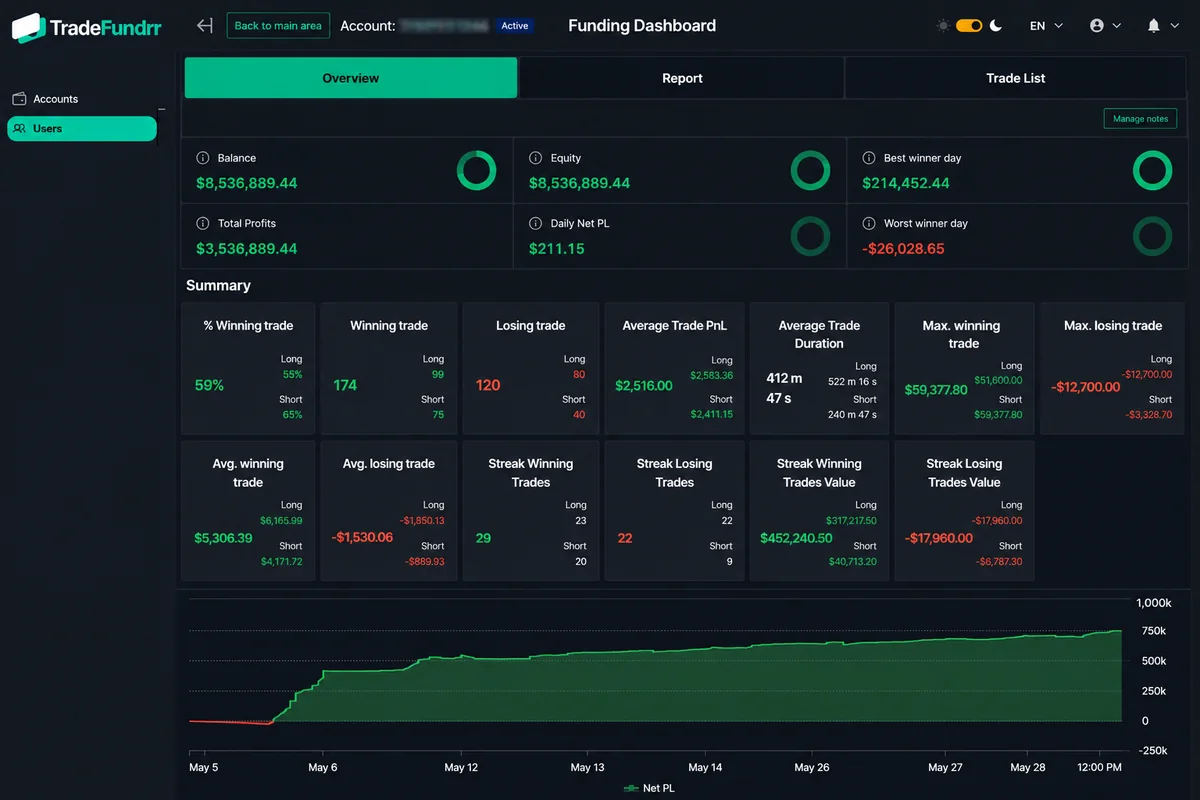
Your funded account dashboard: track performance, request payouts, and trade with institutional capital.
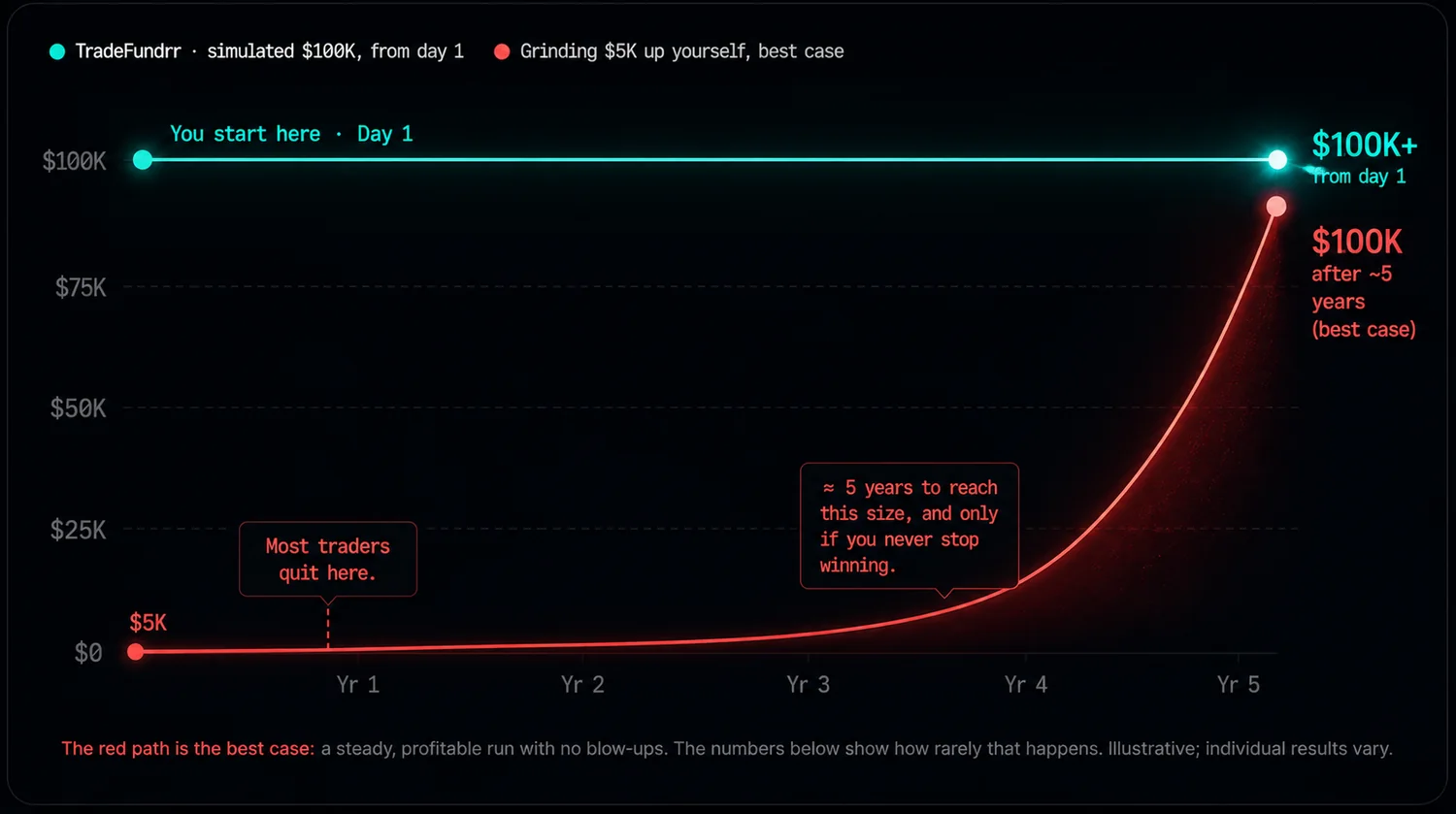
And to make $5,000 in profit, you need to double your account.
100% returns. Just to put $5,000 in your pocket. Even a strong year rarely doubles an account.
It's not your emotions. Not your strategy. Not your experience. The single biggest thing holding most retail traders back is something almost nobody talks about, and it has nothing to do with skill.
You trade a simulated $100,000 account. The buying power is simulated. The money you take out is real.
Institutions don't trade scared. Not because they can stomach bigger losses, but because the money on the line was never their own savings.
Same edge. Real size. Your savings stay home.
It's not just about capital. It's about time.
The slow grind doesn't have to be your only path.
Most talented traders don't fail for lack of skill. They run out of runway before their edge can compound.
Every month spent growing a small account is another month of capped upside.
Every great setup you skip because the account's too small is money left on the table.
TradeFundrr doesn't just give you capital.
It gives you back your time.
Start day one with $100K of simulated buying power, skipping the years most traders spend growing a small account up to that size. Payouts run on a weekly schedule, and you never put your own trading capital on the line, just a one-time evaluation fee.
And almost no one comes close. Here's what actually happens.
Barber, Lee, Liu & Odean — study of 130,000+ Taiwanese day traders (1992–2006). A separate Brazilian study (Chague, De-Losso & Giovannetti, 2020) found 97% of those who kept trading past 300 days still lost money.
TradeFundrr doesn't just hand you capital. It hands you back the years you'd spend grinding to reach this size.
It gives you back your time.
The question that keeps you up at night isn't "what could I make?"
It's "what happens if I lose it all?"
Trade your own account and a bad stretch isn't just a red number on a screen. That $5,000 was supposed to go toward a down payment. Your kid's braces. The car you've been putting off. Now it's sitting in a trading account, where one bad week could wipe it out.
And even if you grind it up to $50K, you're trading with everything on the line, your savings and your safety net, where a single bad month can erase years of work.
Put up a $1,499 evaluation fee, trade a simulated $100K starting now, and your own trading capital never goes on the line.
The evaluation fee is rebated on your first qualifying payout. Standard platform and data fees apply.
Same trade. One downside has no bottom. The other, you'd already measured.
You put up the evaluation fee. Pass, reach your first payout, and every dollar comes back, with your 80% split on top. Watch it net out to zero.
The $1,000 payout request is an illustrative example, not a guarantee; payouts depend on your trading and you keep 80% under the standard split. Net cost is $0 only if you pass and reach your first qualifying payout. The evaluation fee is retained only if you don't pass and choose not to retake it. Standard platform and data fees apply. Funded accounts are simulated.
Pass once, reach your first payout, and the full fee comes back, plus your 80% split on top. TradeFundrr exists to remove the capital barrier, not add to it.
You've been trading stocks on $5K to $25K of personal capital.
The edge is there.
The capital isn't.
Most retail traders never escape that gap.
The strategy is identical, only the account size changed. That's the gap TradeFundrr closes, with simulated capital you don't have to risk to access.
Your edge works. Your $25K doesn't.
Illustration of how account size affects the same percentage return. Hypothetical and for illustration only, not a performance claim or guarantee; returns depend on your trading. Funded accounts are simulated.
Two ways in. Pick the path that fits how you want to start, both put you on a simulated $100K account.
Express funds you immediately. You're trading a simulated $100K account from day one, no evaluation to clear.
Growth is the two-step route. You prove you can manage risk and execute consistently through a structured evaluation, then you're funded.
Either way, once you're trading your edge finally has room to breathe, on institutional-grade infrastructure, not your savings. Make profitable trades and you keep 80%. This is your business, you keep the lion's share.
Three plain-English steps:
It looks and behaves like a real brokerage screen, with live market data and institutional fills. The capital is simulated, so you're not risking your own savings to access it.
Hit the published profit target without breaking the loss limits, then request a payout against your P&L. Up to 80% of profits, paid weekly.
Sustained, risk-managed performance earns a path to T3 Global: real firm capital, real institutional routing, real fills. Audition-based, not the default.
Simulated funding pays you real money right away, but staying there isn't the finish line. The traders who prove a sustained, risk-managed edge earn something rare: a personal invitation to trade real capital at the T3 Global desk. Not automatic. Not for everyone. Reserved for the few who earn their seat.
The T3 desk path is reserved for top-performing traders and is subject to T3 Global review and audition. Not all traders qualify.
Every program below, so you can compare and decide with full information. No hidden tiers. No bait pricing.
What's rebated, what isn't, and the one condition that matters.
Both give you $100K of simulated buying power and pay 80/20 every week. These are the only five things that actually differ between them.
*Rebated on your first qualifying payout; the $99/mo platform fee is not rebated. Earning a qualifying payout depends on your trading performance and is not guaranteed.
If the pricing or the rules left a question open, it's probably here.
If you want the lowest upfront cost and don't mind a hard breach on the daily loss limit, start with Growth ($399, plus a $149 activation after you pass). If you'd rather skip the evaluation, trade the funded account from day one, and have a softer safety net on rough days, choose Express ($1,499). Growth is cheaper but stricter. Express costs more but is more forgiving and pays out fastest.
A hard breach (Growth) means hitting the daily loss limit ends the account for that evaluation; you'd pay $99 to restart from Stage 1. A soft breach (Express) means hitting the daily loss limit just pauses your session for the day. Your account stays open, you come back tomorrow, no reset, no starting over. Picture a rough morning where you hit the limit: on Growth the eval is over; on Express you're simply done for the day and back at it tomorrow.
No single trading day can account for more than 30% of your total profit when you request a payout. So if you've made $2,000 total, no one day can have contributed more than $600 of it. It confirms you're trading consistently, not getting lucky once and cashing out.
Payouts start smaller and rise as you prove consistency, up to a ceiling of $25,000 per request. The progression is automatic. Once you're consistently hitting that ceiling, you've outgrown the sim, and that's exactly when the path to a real-money seat at T3 Global opens, where the cap comes off.
Growth and Express are simulated funded accounts. The buying power is simulated and you trade on a professional platform with live market data, but the capital itself isn't real money. Your payouts, however, are real, paid against your simulated P&L. Pro Trader Funding is different: you contribute your own capital (from $100K+) and trade real money with institutional leverage and infrastructure through T3 Global.
Yes, but it's earned, not automatic. The T3 path is reserved for traders who show sustained, risk-managed performance over time. T3 Global operates within the T3 group, which includes a regulated SEC broker-dealer and FINRA/SIPC member. This isn't a marketing line; it's a real desk for traders who prove a real edge, and it's invite-only by design.
Fair question, and asking it means you're thinking clearly. TradeFundrr is a real company with a real address (88 Pine St, 23rd Floor, New York, NY 10005), real reviews on Trustpilot, and real payouts documented publicly. The business model is on this page in plain sight: eval fees fund the payouts, and the real upside is graduating top traders to T3's institutional desk. The simulated-capital model is standard in prop trading; what's different here is the real T3 partnership with real regulatory credentials.
You can't lose $100K the way you're picturing, because the $100K is simulated buying power, not your money. If you breach the account rules (like the max drawdown), the account pauses or closes depending on your plan, but your personal savings are completely unaffected. The only money at stake is the fee you paid to start, not your trading capital.
With Express, the earliest you can request a first payout is after 5 trading days that meet the profit target. With Growth, you first pass the 2-stage evaluation, then the same payout timeline applies.
If we're paying real money against simulated trading, where's it coming from? The honest answer has two parts.
Some traders pass, some don't. Those fees cover the infrastructure, platform, market data, support, and the payouts going to the traders who make it through. Straightforward.
When a trader proves a sustained edge and earns a seat at T3 Global, they trade real firm capital and we share in the long-term performance. One good trader is worth more to us than a hundred who don't make it.
The eval fees fund the payouts. Our real upside is graduating traders to the institutional desk. We win when you win, scaled. That's why the rules are strict, the targets are real, and the T3 path exists. We're looking for the traders who'll earn firm capital.
"Earn your way to a T3 seat" only means something if you know who T3 is, and how the pieces fit together.

T3 Global is the institutional trading firm and live-capital path for top-performing TradeFundrr traders. This is the desk you earn your way to, by invitation.

T3 Trading Group is the T3 group's registered broker-dealer, one of the largest active-trader desks in the U.S. T3 Global is built on the same technology, platforms, and compliance. We leverage that foundation; it just isn't where you graduate to.
T3 Global and T3 Trading Group are separate business units within the T3 group of companies. The SEC, FINRA, and SIPC registrations belong to T3 Trading Group only and do not apply to T3 Global, the entity TradeFundrr traders graduate to. T3 Global is not itself a registered broker-dealer.
When a TradeFundrr trader proves a sustained, risk-managed edge, the path to a real-money seat runs through T3 Global's infrastructure: real firm capital, real fills, real desk oversight. By invitation, reserved for top performers.
Sim is sim. Live is live. T3 is live.
Reserved for top-performing traders. Subject to T3 Global review. Not all traders qualify. SEC, FINRA, and SIPC registrations refer to T3 Trading Group, a separate entity within the T3 group of companies, and do not apply to T3 Global or to TradeFundrr's simulated funded accounts.
Real names. Real reviews. Verified on Trustpilot, we don't curate them.
Reviews are real and shown verbatim from Trustpilot. Individual results vary. Trading outcomes described are not typical and are not a guarantee of future performance.
Trade your funded account straight from the charts, built for technical traders who read the tape.
Built for technical traders who live in the charts. Everything you need to read the tape and execute straight from it.
Your simulated $100K account, traded on TradeFundrr Trader.
The funded account doesn't change your watchlist or your playbook. Same names you pull up every morning, same strategy you already run, just with simulated $100K of buying power behind it instead of your own savings.
Most NYSE and Nasdaq US-listed stocks and ETFs are available in the stock program.
If it's listed and liquid, it's on the table. The same market you trade today, nothing exotic to learn.
Trade the move whichever way it goes. We publish the one constraint up front, the way we publish every rule.
Bottom line: you can trade the tickers you trade today, with the intraday strategy you already run. The rules are simple and published up front: a 15-second minimum hold, intraday positions only (no overnight), plus the daily loss limit and drawdown.
And that's by design. Be honest with yourself, here's who this is built for, and who it isn't.
If the left column sounds like you, you're in the right place.
Get funded today →Three things most funded-trader programs can't say, and back up.
Drawdown limits, profit targets, and payout cycles are all published before you pay, and they don't change after you pass.
Prove your edge and you graduate to a real-money seat at T3 Global, with real firm capital and real fills. Most firms just hand you a bigger simulated account and call it "live capital." We don't. Sim is sim. Live is live.
Real people on phone and email who know the platform, the rules, and your account, not a tier-1 ticket queue.
"Your edge is real. Our job is to make sure your account size doesn't stop you."
For the first time in 25 years, the Pattern Day Trading (PDT) rule and its $25,000 day-trading minimum are going away. It's the biggest shift in retail day trading in a generation, and it still doesn't solve the thing that actually holds you back.
The PDT rule and its $25,000 day-trading minimum end June 4, 2026 (phased in by broker through 2027). Sub-$25K accounts can finally day-trade without restriction, on real-time intraday margin.
Your account is still your account. A $5,000 balance, even unrestricted, is still small, and it's still your own money on every trade. The barrier was never just the rule. It was the capital.
The rules got easier. The math didn't.
FINRA's amended day-trading margin rules take effect June 4, 2026, with broker implementation phased through October 2027; timing varies by broker. The $2,000 minimum to open a margin account is unchanged.
Keep grinding a small account the slow way, or give yourself $100K of buying power and trade at the level you're already capable of.
$100K of buying power · keep 80% of profits · your savings never on the line.