More markets. Bigger accounts. Funded crypto. Welcome to the new TradeFundrr. Explore funding →
Your edge works. Your 2 contracts don't.

$25K options account.Up to 20 contracts.

Trade a simulated $25K options account on DXTrade with up to 20 contracts per leg. Keep 80% of profits, paid weekly. Your savings never on the line.

Up to 20 contracts per leg 80% profit split Weekly payouts T3 Global institutional partnership
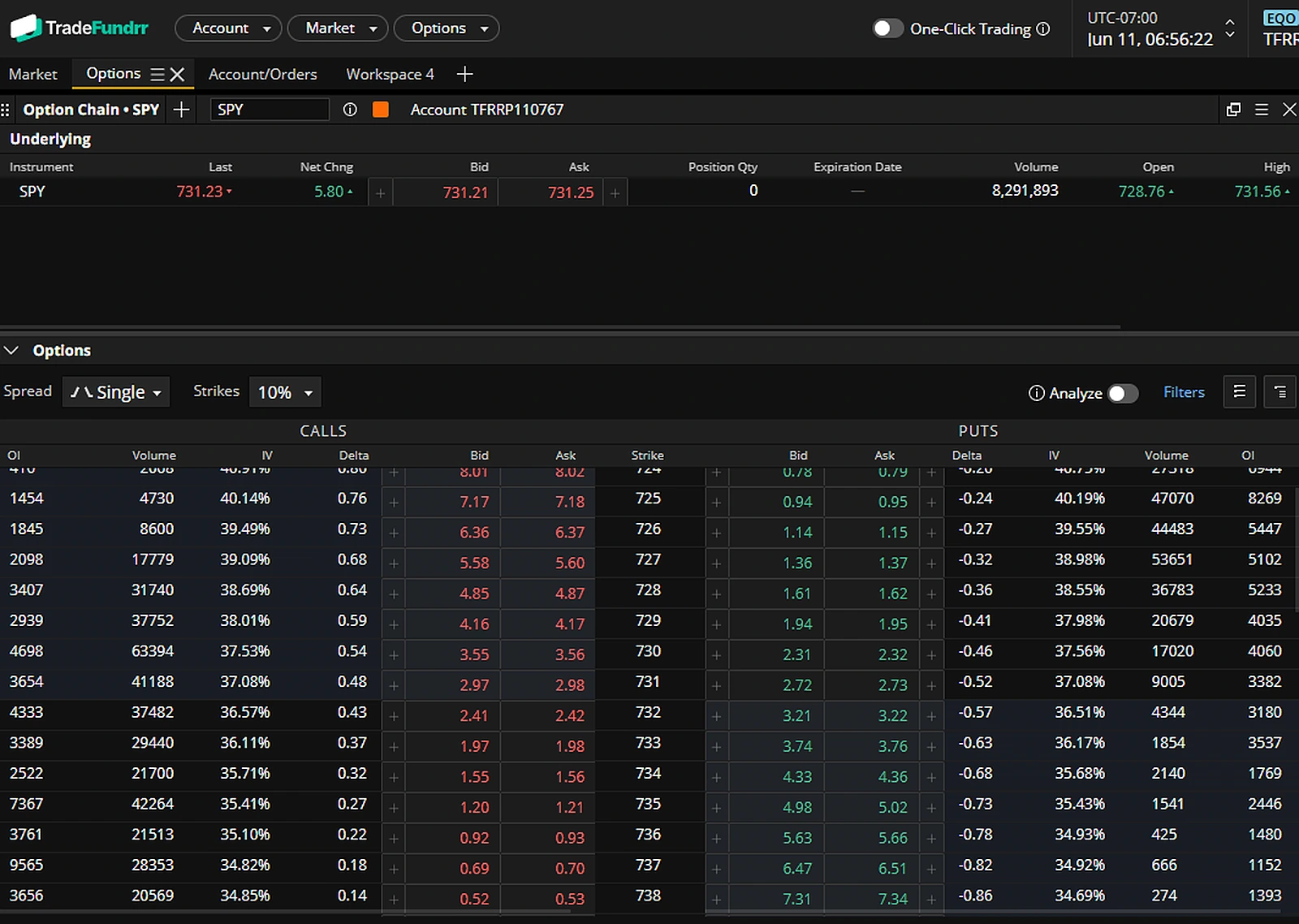
Funded options trading on DXTrade: the TradeFundrr-branded SPY option chain with calls, puts, strikes, deltas, and implied volatility

Your funded options account on DXTrade: live chains, institutional routing, and weekly payouts against your simulated P&L.

$25K simulated options account Up to 20 contracts per leg 80 / 20 profit split Weekly payouts every Friday Built on DXTrade T3 Global institutional partnership Rated on Trustpilot $25K simulated options account Up to 20 contracts per leg 80 / 20 profit split Weekly payouts every Friday Built on DXTrade T3 Global institutional partnership Rated on Trustpilot
New here? Start with this.

What "funded trading" actually means.

If you've only traded your own brokerage account, this is the part most prop firms don't bother to explain. Three plain-English sentences:

01

You trade a $25K simulated options account.

It looks and behaves like a real brokerage screen, with live options data and institutional fills. The capital is simulated, so you're not risking your savings to access it.

02

The payouts are real money.

Hit the published profit target without breaking the loss limits, and you can request a real-money payout against your simulated P&L. Up to 80% of profits, paid weekly.

03

Top performers earn real desk capital.

Sustained, risk-managed performance earns a path to T3 Global, a real institutional desk with real firm capital and real fills. Audition-based, not the default.

The point: you prove you can trade with someone else's risk, then we put real firm capital behind you when you do.

The truth most options traders figure out too late

You're trading 2 contracts.
Maybe 3 on a good day.

A $0.50 winner on 2 contracts is $100. The exact same read, same timing, same setup, on 20 contracts is $1,000.

Your edge isn't the problem. Your contract count is. And a retail account will never give you the size to make the math matter.

01So you size up too aggressively to force the numbers.
02You pile into setups that "feel right" to chase the win.
03And one bad fill erases weeks of careful work.
Not because you're a bad trader.
Because you're running a real edge at a size that can't pay you.
The retail options trader's hidden handicap, exposed

Something is quietly capping your gains.

It's not your reads. Not your strategy. Not your screen time. The single biggest thing holding most retail options traders back is something almost nobody talks about, and it has nothing to do with skill.

Your reads Your strategy Your screen time
It's not a skill gap.
It's a size gap.
The size gap · same $0.50 move 10× the size
$100 2 CONTRACTS retail account 10× same edge $1,000 20 CONTRACTS $25K funded account

Same read, same timing, same $0.50 move. The only variable is contract count. Hypothetical, for illustration only, not a performance claim. Funded accounts are simulated.

Here's the deal

You trade a simulated $25,000 options account with up to 20 contracts. The buying power is simulated. The money you take out is real.

Desk traders don't size down out of fear. Not because they can stomach bigger losses, but because the capital on the line was never their own savings.

Same edge. Real size. Your savings stay home.

The retail trader's time tax, exposed

Most traders quit before it gets good.

It's not just about size. It's about time.

The slow grind doesn't have to be your only path.

Most talented options traders don't fail for lack of skill. They run out of runway before their edge can compound into real contract size.

×

Every month spent grinding 2 contracts up is another month of capped upside.

×

Every clean setup you under-size because the account's too small is money left on the table.

TradeFundrr doesn't just give you size.

It gives you back your time.

Start day one with a simulated $25K options account and up to 20 contracts, skipping the years most traders spend grinding a retail account up to that size. Payouts run on a weekly schedule, and you never put your own trading capital on the line, just a one-time evaluation fee.

No grinding No waiting No wasted years
TradeFundrr · 20 contracts, from day 1 Grinding 2 contracts up yourself, best case
20 ctr 15 ctr 10 ctr 5 ctr 0 Yr 1 Yr 2 Yr 3 Yr 4 Yr 5 You start here · Day 1 most quit around here ≈ 5 years to reach this size, and only if you never stop winning

The red path is the best case: a steady, profitable run with no blow-ups. The numbers below show how rarely that happens. Illustrative; individual results vary.

Trading your own money
2 contracts, retail account
⚠  The multi-year grind
  • Years 1-3: the account is too small to size up, so even a clean edge barely pays.
  • Years 4-5: it can take years of uninterrupted compounding just to trade real size, if it ever gets there.
  • The reality: most traders quit long before that, and every dollar of loss is their own.
VS
TradeFundrr funded account
$25K account · up to 20 contracts, day 1
✓  Skip the grind
  • Day 1: you trade up to 20 contracts on a simulated $25K account, no years of compounding required.
  • Every week: payouts run on a weekly schedule, and your only cost is a one-time evaluation fee, not your savings.

And almost no one comes close. Here's what actually happens.

40%
of day traders quit within the first month
80%
have quit within two years
93%
are gone within five years

Barber, Lee, Liu & Odean — study of 130,000+ Taiwanese day traders (1992–2006). A separate Brazilian study (Chague, De-Losso & Giovannetti, 2020) found 97% of those who kept trading past 300 days still lost money.

20 contracts from day 1 Skip the multi-year grind Your edge matters now

TradeFundrr doesn't just hand you size. It hands you back the years you'd spend grinding to reach this contract count.

It gives you back your time.

The real cost of trading your own money

Your downside, capped.

The question that keeps you up at night isn't "what could I make?"

It's "what happens if I lose it all?"

Trade your own account and a bad stretch isn't just a red number on a screen. That account was supposed to go toward a down payment. Your kid's braces. The car you've been putting off. Now it's funding your contracts, where one bad week could wipe it out.

And even if you grind it up, you're trading with everything on the line, your savings and your safety net, where a single bad month can erase years of work.

And the fear of trading like that makes you worse, not better.
  • You hesitate on the good setups.
  • You exit winners too early.
  • You overtrade to make losses back.
Or

Put up an evaluation fee, trade a simulated $25K options account with up to 20 contracts starting now, and your own trading capital never goes on the line.

Your only cost is the one-time evaluation fee. Standard platform and data fees apply.

Trading your own money
Everything
Your whole account is exposed. There's no floor.
VS
Trading a funded account
$1,499
The Options Express evaluation fee you put up, set before you ever place a trade. That's the only number at risk, never your savings.

Same trade. One downside has no bottom. The other, you'd already measured.

The honest math

Most prop firms make you pay to get funded.
Your net cost here is zero.

On Options Express, you put up the evaluation fee. Pass, reach your first payout, and every dollar comes back, with your 80% split on top. Watch it net out to zero.

The math · Options Express NET $0
You put up the evaluation fee
Rebated on your first qualifying payout
−$1,499
You pass and reach your first payout
Full fee rebated, every dollar
+$1,499
Your first $1,000 payout request
You keep 80% under the standard split
+$800
Net cost to get funded
$0
Total on your first payout
+$0
$1,499 fee back  +  $800 your 80% split

The $1,000 payout request is an illustrative example, not a guarantee; payouts depend on your trading and you keep 80% under the standard split. Net cost is $0 only if you pass and reach your first qualifying payout. The evaluation fee is retained only if you don't pass and choose not to retake it. Standard platform and data fees apply. Funded accounts are simulated.

Zero Net
Cost
The deal

Pass once, reach your first payout, and the full fee comes back, plus your 80% split on top. TradeFundrr exists to remove the capital barrier, not add to it.

Built for the options day trader

You've proven you can trade.
You haven't proven you can scale.

You've been trading options 1 or 2 contracts at a time on a retail account.

The edge is there.

The size isn't.

Most retail options traders never escape that gap.

The contract problem · same edge. different scale.
2 contracts
a $0.50 move is
$100
vs
20 contracts
the same $0.50 move is
$1,000

The strategy is identical, only the contract count changed. That's the gap TradeFundrr closes, with simulated size you don't have to risk your savings to access.

Your edge works. Your 2 contracts don't.

Illustration of how contract count affects the same per-contract move. Hypothetical and for illustration only, not a performance claim or guarantee; returns depend on your trading. Funded accounts are simulated.

The path that didn't exist
Until TradeFundrr.
How it works

Here's what happens when you join.

Two ways in. Pick the path that fits how you want to start, both put you on a simulated $25K options account.

Express funds you immediately. You're trading a simulated $25K options account with up to 20 contracts from day one, no evaluation to clear.

Growth is the two-step route. You prove you can manage risk and execute consistently through a structured evaluation, then you're funded, trading up to 10 contracts per leg.

Either way, once you're trading your edge finally has room to breathe, on institutional-grade infrastructure, not your savings. Make profitable trades and you keep 80%. This is your business, you keep the lion's share.

Three plain-English steps:

1

You trade a $25K simulated options account

DXTrade looks and behaves like a real brokerage screen, with live options chains and institutional fills. Up to 20 contracts per leg, and the capital is simulated, so you're not risking your own savings to access it.

2

The payouts are real money

Hit the published profit target without breaking the loss limits, then request a payout against your P&L. Up to 80% of profits, paid weekly.

3

Top performers earn real desk capital

Sustained, risk-managed performance earns a path to T3 Global: real firm capital, real institutional routing, real fills. Audition-based, not the default.

Earned, by invitation

Simulated funding pays you real money right away, but staying there isn't the finish line. The traders who prove a sustained, risk-managed edge earn something rare: a personal invitation to trade real capital at the T3 Global desk. Not automatic. Not for everyone. Reserved for the few who earn their seat.

The T3 desk path is reserved for top-performing traders and is subject to T3 Global review and audition. Not all traders qualify.

Three programs · pick your path

Simulated options funded accounts, laid out in full.

Every program below, so you can compare and decide with full information. No hidden tiers. No bait pricing.

Eval path · lowest upfront
Options Growth
Prove yourself through a structured 2-stage evaluation at the lowest upfront cost.
$399
+ $99/mo · + $149 activation after you pass
$25K simulated options account · up to 10 contracts per leg
  • 2-stage evaluation: Stage 1 → Stage 2 → Funded
  • Hard breach on the $1,000 daily loss limit
  • $3,000 max drawdown (hard breach) · $1,250 profit target
  • 80 / 20 split · weekly payouts · first payout in as few as 10 days
  • $99 reset to restart if you fail a stage
✗ Not eligible for the rebate Choose Growth
● Most popular · skip the eval
Options Express
Skip the evaluation entirely. Trade the funded account from day one, with a softer safety net.
$1,499
+ $99/mo · funded from day one
$25K simulated options account · up to 20 contracts per leg
  • Direct to funded, trade from day one
  • Soft breach: hitting the daily loss limit pauses the session, not the account
  • $3,000 max drawdown (hard breach) · $1,250 profit target
  • 80 / 20 split · weekly payouts · first payout in as few as 5 trading days
✓ $1,499 rebated on your first payout Choose Express
Smaller account · lower cost
Options Express 10k
Instant funding at the lowest entry point. A $10K account with the same soft safety net.
$999
+ $99/mo · funded from day one
$10K simulated options account · up to 10 contracts per leg
  • Direct to funded, no evaluation
  • Soft breach: hitting the daily loss limit pauses the session, not the account
  • $1,500 max drawdown (hard breach) · $625 profit target
  • 80 / 20 split · weekly payouts · first payout in as few as 5 trading days
✓ $999 rebated on your first payout Choose Express 10k
Full specs · side by side

Every rule, all three programs.

The complete parameter sheet. Everything is published before you pay, and it doesn't change after you pass.

Scroll the table sideways to see every column →

Parameter Options Growth Options ExpressPopular Express 10k
Account & fees
Account size (simulated)$25,000$25,000$10,000
Initial fee$399$1,499$999
Activation fee (after you pass)$149
Reset fee$99
Monthly fee$99$99$99
Risk rules
Max contracts102010
Max drawdown (hard breach)$3,000$3,000$1,500
Daily loss limit$1,000$1,000$500
Breach ruleHard breachSoft breachSoft breach
Profit target$1,250$1,250$625
Trading rules
Min hold time15 seconds15 seconds15 seconds
Max position10 contracts20 contracts10 contracts
Consistency rule30%30%30%
Consistency days5 days @ $2505 days @ $2505 days @ $125
Min trading days (eval)5 days
Min trading days (funded)5 days5 days5 days
Payouts
Minimum time to first payout10 days5 days5 days
Payout cycleWeeklyWeeklyWeekly
Profit split80 / 2080 / 2080 / 20
Payout cap (% of overall profit)*50%50%50%
Minimum payout$250$250$250
Payout caps (per cycle → max)$1,000 → $1,500 → $2,000 → $5,000
up to $25,000
$2,000 → $2,500 → $3,500 → $5,000
up to $25,000
$500 → $750 → $1,000 → $2,500
up to $15,000

*Payout cap is a percentage of overall profit per request; the full 100% of profit becomes payable from payout cycle 7 onward. All three programs are simulated funded accounts; standard platform and data fees apply. Earning a qualifying payout depends on your trading performance and is not guaranteed.

New to funded trading? Start here.

The trader's dictionary.

Plain-English definitions for every term used on this page. Click any term to expand.

Eval / Evaluation
A paid trial period. You buy access to a simulated account, trade under published rules, and "pass" by hitting the profit target without violating the loss limits. Express and Express 10k skip the eval, you start trading day one.
Simulated capital
The funded account ($25K on Growth and Express, $10K on Express 10k) is simulated, so you're not risking your savings to access it. The payouts earned against that simulated trading are real money, paid weekly.
Drawdown / Max drawdown
The peak-to-trough loss in your account. Max drawdown is the largest loss allowed before the account is suspended, $3,000 on the $25K programs and $1,500 on Express 10k.
Daily loss limit
The most you can lose in a single day before the day ends. On a hard breach (Growth) it ends the evaluation; on a soft breach (Express, Express 10k) it just pauses your session until tomorrow.
Defined-risk options
Multi-leg options strategies where the maximum loss is known upfront and capped by the structure itself, verticals, iron condors, butterflies, and calendars. Naked short options are not defined-risk. Defined-risk structures tend to fit the program rules cleanly because the max loss is baked into the position. Note that risk controls can still force-liquidate open positions, and in fast markets positions may be flattened at losses exceeding the theoretical max of the structure.
PFOF (Payment for Order Flow)
When a retail broker sells your order flow to a market maker who pays for it, often filling at a spread slightly worse than direct institutional routing. Most commission-free retail brokers use PFOF; TradeFundrr's funded accounts don't.
Consistency rule (30%)
No single trading day can make up more than 30% of your total profit when you request a payout. It confirms steady trading rather than one lucky day. Trade normally and you'll never feel it.
Sharpe ratio
A measure of risk-adjusted return. A high Sharpe means strong returns relative to volatility, you make money without huge swings. T3 Global weighs Sharpe (among other metrics) when reviewing graduates for live capital.
Profit split
The percentage of profits you keep. TradeFundrr's split is 80/20: you keep 80%, the firm keeps 20%. Same across Growth, Express, and Express 10k.
Contract limit / buying power
On options accounts your exposure is gated by the contract limit, 10 contracts on Growth and Express 10k, 20 on Express, rather than a raw buying-power figure.
Audition path / Graduation
The process by which a trader earns a real-capital seat at T3 Global. Triggered by sustained Sharpe, disciplined drawdown, and consistent profitability over multiple months. Not automatic; reviewed case by case.
The questions traders actually ask

Straight answers. No fine print.

If the pricing or the rules left a question open, it's probably here.

Growth, Express, or Express 10k, which should I pick?

If you want the lowest upfront cost and don't mind a hard breach on the daily loss limit, start with Growth ($399, plus a $149 activation after you pass). If you'd rather skip the evaluation, trade the funded account from day one, and have a softer safety net, choose Express ($1,499) for the full $25K account and up to 20 contracts. Want instant funding at the lowest entry point? Express 10k ($999) is the same soft-breach setup on a smaller $10K account with up to 10 contracts.

Which means: Growth is cheapest if you'll clear an eval; Express is the full-size instant account; Express 10k is the low-cost way to start funded today.
What's a "hard breach" vs a "soft breach," and why does it matter?

A hard breach (Growth) means hitting the daily loss limit ends the account for that evaluation; you'd pay $99 to restart from Stage 1. A soft breach (Express) means hitting the daily loss limit just pauses your session for the day. Your account stays open, you come back tomorrow, no reset, no starting over. Picture a rough morning where you hit the limit: on Growth the eval is over; on Express you're simply done for the day and back at it tomorrow.

Which means: on Express, one bad day pauses you. On Growth, it can end the whole run.
What does the 30% consistency rule actually mean for me?

No single trading day can account for more than 30% of your total profit when you request a payout. So if you've made $2,000 total, no one day can have contributed more than $600 of it. It confirms you're trading consistently, not getting lucky once and cashing out.

Which means: trade normally and you'll never feel it. It only catches one-lucky-day cash-outs.
How do the payout caps work, and what happens at the ceiling?

Each payout request is capped, and the cap rises as you complete more payout cycles, from $1,000 early on up to $5,000 per request from cycle 7+ on the $25K programs (lower on Express 10k). There's also a lifetime ceiling per account: $25,000 on the $25K programs, $15,000 on Express 10k. Once you're consistently hitting those, you've outgrown the sim, and that's exactly when the path to a real-money seat at T3 Global opens, where the cap comes off.

Which means: caps step up automatically as you prove consistency, and hitting the ceiling is the signal you're ready for a real T3 seat where the cap disappears.
What's the difference between simulated funding and real capital?

All three options programs are simulated funded accounts. The buying power is simulated and you trade on DXTrade with live options data, but the capital itself isn't real money. Your payouts, however, are real, paid against your simulated P&L. Graduating to T3 Global is different: proven traders earn a real-money seat with institutional leverage and infrastructure through T3 Global's desk.

Which means: Growth, Express, and Express 10k are simulated with real payouts. The T3 desk is real money at real size, earned by your track record.
Can I really graduate to live capital at T3 Global?

Yes, but it's earned, not automatic. The T3 path is reserved for traders who show sustained, risk-managed performance over time. T3 Global operates within the T3 group, which includes a regulated SEC broker-dealer and FINRA/SIPC member. This isn't a marketing line; it's a real desk for traders who prove a real edge, and it's invite-only by design.

Which means: the live desk is real and reachable, but the invitation is earned, not handed out.
Is this a scam?

Fair question, and asking it means you're thinking clearly. TradeFundrr is a real company with a real address (88 Pine St, 23rd Floor, New York, NY 10005), real reviews on Trustpilot, and real payouts documented publicly. The business model is on this page in plain sight: eval fees fund the payouts, and the real upside is graduating top traders to T3's institutional desk. The simulated-capital model is standard in prop trading; what's different here is the real T3 partnership with real regulatory credentials.

Which means: every claim here is checkable, the address, the reviews, the regulated T3 desk. Read them and call support before you pay. That's exactly what you should do.
What if I lose the whole account?

You can't lose the account balance the way you're picturing, because the account is simulated buying power, not your money. If you breach the account rules (like the max drawdown), the account pauses or closes depending on your program, but your personal savings are completely unaffected. The only money at stake is the fee you paid to start, not your trading capital.

Which means: the worst case is losing the fee you paid. Never your savings.
How long until my first payout?

With Express and Express 10k, the earliest you can request a first payout is after 5 trading days that meet the profit target. With Growth, you first pass the 2-stage evaluation, so a first payout takes a bit longer, as few as 10 days.

Which means: the instant programs are the fastest route to a first payout (as few as 5 trading days); Growth is as few as 10.
The business model · transparent on purpose

Where the payouts actually come from.

If we're paying real money against simulated trading, where's it coming from? The honest answer has two parts.

Part 1

The eval fees fund the winners.

Some traders pass, some don't. Those fees cover the infrastructure, platform, market data, support, and the payouts going to the traders who make it through. Straightforward.

Part 2

The real business is graduating top performers.

When a trader proves a sustained edge and earns a seat at T3 Global, they trade real firm capital and we share in the long-term performance. One good trader is worth more to us than a hundred who don't make it.

In plain terms

The eval fees fund the payouts. Our real upside is graduating traders to the institutional desk. We win when you win, scaled. That's why the rules are strict, the targets are real, and the T3 path exists. We're looking for the traders who'll earn firm capital.

The math of staying small

Your edge has one ceiling.
We move it. Twice.

The same strategy at three different sizes. Same edge. Wildly different math.

Trading your own money
$25,000
your ceiling
Every loss is your money, and every win is capped by the 1 to 2 contracts a retail account lets you size, no matter how clean your edge.
Funded options account
20
contracts simulated
A simulated funded account with up to 20 contracts per leg. Keep up to 80% of what you make, with no personal capital tied up.
Earned
T3 Global desk
$1M+
desk capital
Top performers earn a seat: institutional infrastructure, real fills, real firm capital.
Reserved for top-performing traders. Subject to T3 Global review and audition. Not all traders qualify.

Start at 20 contracts. Earn your way to live desk capital.

The institutional partner · T3 Global

Built on real institutional infrastructure.

"Earn your way to a T3 seat" only means something if you know who T3 is, and how the pieces fit together.

Where you graduate
T3 Global

T3 Global is the institutional trading firm and live-capital path for top-performing TradeFundrr traders. This is the desk you earn your way to, by invitation.

T3 Global is not itself a registered broker-dealer.
Built on the same infrastructure
Same trading platforms Same compliance team Same system-ops team
The foundation

T3 Trading Group is the T3 group's registered broker-dealer, one of the largest active-trader desks in the U.S. T3 Global is built on the same technology, platforms, and compliance. We leverage that foundation; it just isn't where you graduate to.

SEC-registered · FINRA / SIPC member
Traders do not graduate to this entity. Its registrations do not extend to T3 Global.
The important distinction

T3 Global and T3 Trading Group are separate business units within the T3 group of companies. The SEC, FINRA, and SIPC registrations belong to T3 Trading Group only and do not apply to T3 Global, the entity TradeFundrr traders graduate to. T3 Global is not itself a registered broker-dealer.

When a TradeFundrr trader proves a sustained, risk-managed edge, the path to a real-money seat runs through T3 Global's infrastructure: real firm capital, real fills, real desk oversight. By invitation, reserved for top performers.

Sim is sim. Live is live. T3 is live.

Reserved for top-performing traders. Subject to T3 Global review. Not all traders qualify. SEC, FINRA, and SIPC registrations refer to T3 Trading Group, a separate entity within the T3 group of companies, and do not apply to T3 Global or to TradeFundrr's simulated funded accounts.

Real traders · real payouts

Don't just take our word for it.

Real names. Real reviews. Verified on Trustpilot, we don't curate them.

Verified payout stories
★★★★★
So glad I took the chance
"I was skeptical this was going to be as good as the other reviews state. Nevertheless I took the leap. I passed the evaluation phase, moved seamlessly to the funded account phase, and then requested my first payout on 3 accounts. Within no time the money was in my account. This is the real deal."
Chad Tillbrook · United States · Jan 12, 2026
★★★★★
My first payout after six trading days
"I really had a great experience with TradeFundrr as I just started my journey in December and got my first payout approved just after six trading days. The rules are very clear. The support team is amazing with prompt responses and clear answers."
Hassan · Saudi Arabia · Jan 9, 2026
★★★★★
One of the best prop firms I've worked with
"Clear rules, fast execution, and a professional environment that actually supports long-term success. The payouts are fast and reliable, and customer support is responsive when you need help. Highly recommended."
Parker B. · United States · Dec 23, 2025
★★★★★
I received my payout today
"I received my payout today, it is the 3rd great experience so far. We have the choice among ETFs and stocks, nothing to complain about so far. Customer service replies fast, and not AI agents, which is great."
Mohamed El-Brahmi · France · Apr 11, 2026
★★★★★
Top two in the sim stock world
"I have been a member of TradeFundrr for several months and have been happy throughout. In my opinion, they are in the top two in the sim stock world, and I give them the #1 spot because of their straight-to-funded option."
Eric · United States · Apr 30, 2026
★★★★★
Got my first payout in 7 days
"Can't say enough about this program. Enrolled into the instant funding program and got my first payout in 7 days."
Caleb · United States · Oct 8, 2025
★★★★★
A very good experience with TradeFundrr
"I've had a very good experience with TradeFundrr so far. It really helps teach discipline and consistency in trading rather than rushing into things unprepared. I'm also very satisfied with their payout service — reliable and smooth, which builds a lot of trust."
Kajal Prakash · United States · Apr 4, 2026
★★★★★
Fast payout
"I met criteria for payout and made my request — money hit my account in a few hours."
Joyce · United States · Nov 22, 2025
★★★★★
Finally got my first payout
"I have been with TradeFundrr since January of 25 and finally got my first payout this October. Their dashboard is so user friendly — the other prop firms were so confusing I had no clue what stage I was in. I've received my first payout and it feels amazing."
Lisa · United States · Oct 6, 2025
Read all verified reviews on Trustpilot →

Reviews are real and shown verbatim from Trustpilot. Individual results vary. Trading outcomes described are not typical and are not a guarantee of future performance.


Platform · built for options

One platform. Built for options flow.

Your funded options account runs on DXTrade, the same institutional execution stack a professional desk uses, with live chains and real fills.

The execution stack
DXTrade

Built by the same development team behind tastyworks and thinkorswim. The pro-grade options order ticket, with institutional routing instead of payment for order flow.

  • Real-time options chains and quotes
  • Greeks, deltas, and implied volatility
  • Single-leg and multi-leg order entry
  • Fast, keyboard-driven execution
  • Multi-monitor support
DXTrade, TradeFundrr-branded: the SPY option chain with calls, puts, strikes, deltas and implied volatility
DXTrade · TradeFundrr-branded

The real workspace: live chart, the full option chain with strikes, deltas and IV, and one-click order entry, with institutional routing and real fills, not payment for order flow.

One funded options account on DXTrade. Real chains, real fills, real size.

What you can trade

Trade the options you already trade.

The funded account doesn't change your watchlist or your playbook. Same underlyings you pull up every morning, same setups you already run, just with real contract size behind them instead of your own savings.

The underlyings you already watch
SPX SPY QQQ AAPL NVDA TSLA AMD META AMZN MSFT IWM + many more

Hundreds of the most liquid US symbols are available in the options program, including SPX, SPY, QQQ, IWM, TSLA, and NVDA.

The universe
Hundreds of symbols

Both sides of the chain on the most liquid names you already follow. Nothing exotic to learn, the same options you trade today.

  • Calls and puts on hundreds of liquid US symbols
  • Index options including SPX, plus SPY, QQQ, IWM
  • Single names like TSLA and NVDA
  • Up to 20 contracts per leg on Express
How you structure it
A full suite of strategies

Trade outright or build the structure. We publish every constraint up front, the way we publish every rule.

  • Outright long calls and puts
  • Spreads, iron condors, and butterflies
  • Credit-based positions allowed, up to account buying power
  • 15-second minimum hold, intraday positions
Whatever strategy you run
Day trading
In and out same session, no overnight risk.
Scalping
Fast entries for small, repeatable edges, with a 15-second minimum hold.
Directional calls & puts
Express a clean read with outright long premium.
Spreads, condors & butterflies
Defined-risk multi-leg structures, debit or credit.
Momentum
Ride the underlyings moving on volume.
Breakout / ORB
Opening-range and key-level breaks on the underlying.
VWAP & mean reversion
Fade the extremes back to the average.
News & catalyst
Earnings, upgrades, and headline-driven moves.
Your own system
Any intraday system that respects the loss limit and drawdown.

Traders get a full suite of strategies, such as spreads, iron condors, and butterflies, and credit-based positions are allowed up to the account buying power. Bottom line: you can trade the options you trade today, with the intraday strategy you already run, under simple published rules, a 15-second minimum hold, intraday positions only (no overnight), plus the daily loss limit and drawdown.

Is this right for you?

TradeFundrr isn't for everyone.

And that's by design. Be honest with yourself, here's who this is built for, and who it isn't.

✓ This is for you if
You have a proven strategy but lack the capital to scale it
You're tired of risking your own savings on every trade
You want to trade at size without the multi-year grind
You're disciplined enough to respect a daily loss limit and drawdown
You'd rather risk a fixed, known cost than your savings
You're ready to trade funded, starting now
✗ This isn't for you if
You're still learning the basics of trading
You expect to get funded and immediately blow the account
You can't follow a daily loss limit or a drawdown rule
You're looking for a get-rich-quick shortcut
You want to trade without accountability or structure
You need to hold positions overnight

If the left column sounds like you, you're in the right place.

Get funded today
What separates TradeFundrr

Built on substance. Not marketing.

Three things most funded-trader programs can't say, and back up.

Real rules.
Not vague promises

Drawdown limits, profit targets, and payout cycles are all published before you pay, and they don't change after you pass.

Real graduation.
Not sim forever

Prove your edge and you graduate to a real-money seat at T3 Global, with real firm capital and real fills. Most firms just hand you a bigger simulated account and call it "live capital." We don't. Sim is sim. Live is live.

Real support.
Not a chatbot

Real people on phone and email who know the platform, the rules, and your account, not a tier-1 ticket queue.

"Your edge is real. Our job is to make sure your account size doesn't stop you."
Christian Bose
Christian Bose
Co-founder · TradeFundrr
Why now
Effective June 4, 2026 · FINRA

The rules just changed. The capital gap didn't.

For the first time in 25 years, the Pattern Day Trading (PDT) rule and its $25,000 day-trading minimum are going away. It's the biggest shift in retail day trading in a generation, and it still doesn't solve the thing that actually holds you back.

What's changing

The PDT rule and its $25,000 day-trading minimum end June 4, 2026 (phased in by broker through 2027). Sub-$25K accounts can finally day-trade without restriction, on real-time intraday margin.

What isn't

Your account is still your account. A small balance trading 1 or 2 contracts, even unrestricted, is still small, and it's still your own money on every trade. The barrier was never just the rule. It was the size.

The rules got easier. The contract count didn't.

FINRA's amended day-trading margin rules take effect June 4, 2026, with broker implementation phased through October 2027; timing varies by broker. The $2,000 minimum to open a margin account is unchanged.

It's time to make your move

Stop risking your savings.
Start trading our capital.

Keep grinding 2 contracts the slow way, or give yourself a simulated $25K options account with up to 20 contracts and trade at the level you're already capable of.

01
Choose your program
Growth, Express, or Express 10k, all put real contract size behind you.
02
Get set up
Your funded options account is ready quickly, on DXTrade.
03
Trade funded
Hit the targets, respect the loss limit and drawdown.
04
Get paid
Request your payout and keep 80%, weekly.

$25K simulated options account · up to 20 contracts · keep 80% of profits · your savings never on the line.