
How Prop Firms Work: The Institutional Guide to Professional Trading in 2026
 July 16, 2026
10 min read
July 16, 2026
10 min read

Most traders believe prop firms are in the business of funding winners. They aren't. In 2026, the industry acts as a high-speed filter for institutional talent. If you don't understand the underlying plumbing, you're just subsidizing someone else's payout. Understanding how prop firms work is the difference between being a customer and being a professional. You've likely felt the sting of undercapitalization. You've seen the "easy funding" traps. You've dealt with drawdown rules that feel like a rigged game. It's a frustrating cycle that keeps skilled practitioners on the sidelines.
It's a reality we're going to dismantle. This guide pulls back the curtain to reveal how the money flows, how evaluations function as professional filters, and how to spot real institutional infrastructure. We'll explore the shift from unregulated models to the stable, transparent environments that define the current market. You'll get a clear path to weekly payouts and the specific steps required to reach the $1M+ scaling path. Stop guessing. Start trading with a professional firm behind you.
Key Takeaways
- Most firms sell dreams; real firms provide infrastructure. Understand exactly how prop firms work by shifting your focus from retail "challenges" to institutional partnerships.
- Stop trading in a vacuum. Learn the critical link between simulated balances and the real payouts that drive your long-term stability.
- Treat your evaluation as a professional audition. Discover how to navigate drawdown rules as a risk management exercise rather than a fee-generating trap.
- Infrastructure is your edge. Learn to identify the red flags of "reset casinos" and prioritize firms that offer professional platforms and institutional data feeds.
- Master the scaling roadmap. See how consistent performance leads from a $25,000 evaluation to the $1M+ scaling path.
What is a Proprietary Trading Firm?
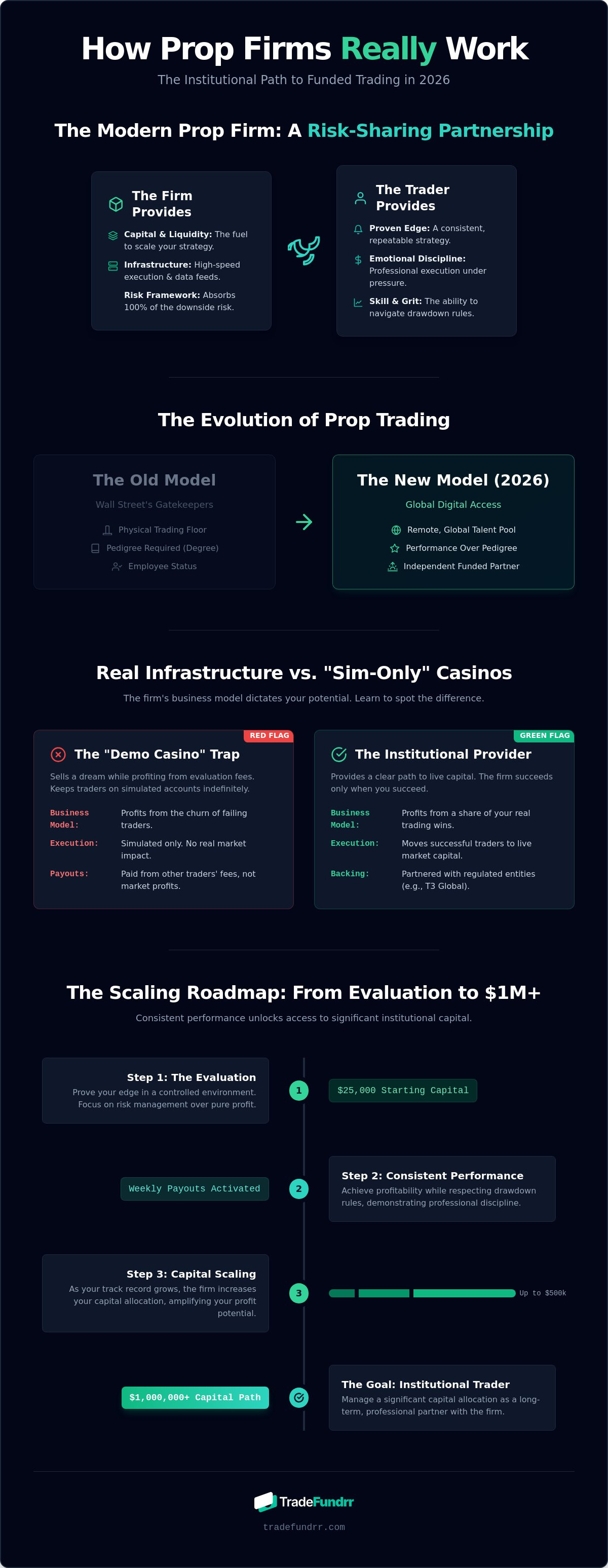
Most retail traders think of the market as a solo sport. It isn't. At its core, Proprietary trading occurs when a firm trades its own capital to generate profit rather than managing funds for outside clients. Modern funded programs adapt this model: you trade a simulated funded account, and the firm pays you a real share of the profits. This creates a fundamental shift in the relationship between the trader and the entity providing the buying power. A prop firm is a risk-sharing partnership between institutional resources and individual talent.
To understand how prop firms work, you have to look at the exchange. The firm provides the high-performance infrastructure, the data feeds, and the buying power. The trader provides the edge and the emotional discipline. In this environment, the firm isn't looking for customers. It's looking for partners who can manage risk with professional rigor. You provide the strategy; the firm provides the fuel to scale it.
The Evolution of the Prop Trading Model
The industry has moved from mahogany desks on Wall Street to high-speed digital environments. Historically, you needed a specific degree and a seat on a physical trading floor to trade at scale. Technology changed the gatekeeper. Modern firms now evaluate talent globally through remote programs, focusing on performance over pedigree. This shift democratized access to institutional-grade tools. You're no longer an "employee" tied to a desk; you're an independent funded partner. This evolution is central to how prop firms work in 2026, where the "office" is wherever you find a stable connection and a quiet room.
Why Firms Hire External Traders
Why would a firm pay you a cent? It's about finding consistent talent. No single strategy works in every market condition. By evaluating external traders, firms can find skill across thousands of unique strategies simultaneously. If one trader's scalp strategy hits a dry spell, another trader's trend-following system might be peaking.
Firms also use the "filter" model to ensure stability. Evaluations aren't just hurdles; they are professional auditions. They identify the top 1% of traders who possess the rare combination of technical skill and psychological grit. This allows firms to focus their payouts on proven talent. Legitimate firms want you to succeed. They aren't looking for account resets; they're looking for the disciplined few who can turn a $50,000 evaluation into a long-term professional career.
The Mechanics of Buying Power: How Firms Fund Traders
Buying power is a tool for execution, not a trophy on a dashboard. In the retail world, you're limited by your personal savings. In the prop world, you're limited only by your skill. This is the core of how prop firms work. You provide the strategy; the firm provides the buying power. It's a trade-off that lets a disciplined individual trade at professional scale.
The industry is split between "reset casinos" and institutional providers. Many firms keep you in evaluations indefinitely, paying profits out of the registration fees of failing traders. Real firms seek to move you from the evaluation to a funded account. TradeFundrr focuses on this transition, providing institutional-grade buying power for retail traders. The buying power is simulated, but the payouts are real money. The profit split reflects this partnership. You never owe the firm for trading losses. You keep the majority of the reward. It's a lopsided deal in your favor, provided you can maintain the required rigor.
The Role of Institutional Infrastructure
Stability isn't accidental. It's structured. Reliable payouts are the backbone of long-term viability. Volatility can strain weaker firms, but well-run firms plan for it. Traders benefit from studying retail momentum and specialized order flow trading strategies for prop firms. Regulation also plays a part. Recent Volcker Rule modifications have clarified how institutional entities manage their own capital. A firm that pays from its own funds ensures that when you hit a major payout, the money is there to meet it.
Risk Management: The Firm’s Safety Net
Rules are often viewed as hurdles. They're actually guardrails. Daily loss limits and maximum drawdowns aren't designed to make you fail; they're designed to protect the account from catastrophic errors. A firm with no rules is a firm that won't be around to pay you next month. Strict risk parameters are the hallmark of a legitimate operation. They force you to trade with professional longevity in mind.
Aligning your personal risk with institutional standards is the final step in understanding how prop firms work. Our published rules and human support serve as the guide for this transition. It helps you stop thinking like a gambler and start trading like a fund manager. If you're ready to move beyond retail limitations, you can explore our professional evaluations to see where your skill fits.
The Evaluation Process: Proving Your Edge
An evaluation is a professional audition. It is not a game of chance. To truly grasp how prop firms work, you must view the evaluation as a high-stakes filter designed to separate the disciplined from the reckless. Most retail traders approach these challenges as a lottery. They hope for a lucky streak to hit a profit target. Professional firms don't want lucky traders. They want repeatable systems. The evaluation process is your opportunity to prove that your edge is real and your risk management is bulletproof.
The process typically splits into two distinct phases. Phase 1 focuses on profitability. Can you extract value from the market within a defined set of rules? Phase 2 shifts the focus to consistency. It's about proving that your Phase 1 performance wasn't a fluke. It's a test of psychological stamina. Once you navigate these stages, you transition from an applicant to a funded partner. This is where the evaluation ends and the funded account begins. You've proven you can manage risk. Now, the firm gives you the keys to the engine.
Evaluation Rules You Must Master
Rules are the foundation of professional trading. Profit targets are often the first thing traders look at, but they are the least important part of the equation. A realistic target for a professional is about steady growth, not doubling an account in a week. The real differentiator is the drawdown. Many firms use trailing drawdowns that move with your profit, effectively tightening the noose as you win. TradeFundrr prioritizes transparency by focusing on static drawdowns or clear parameters that don't shift the goalposts. We also enforce consistency requirements. If 90% of your profit comes from a single lucky trade during a news event, you haven't proven a strategy. You've proven a gamble. We require a track record of disciplined, daily execution.
Why Human Support Matters During Evaluation
Technology is a tool, but it shouldn't be a barrier. Most firms hide behind automated "violation" emails and rigid scripts. When a technical glitch occurs or a rule is misunderstood, a bot won't help you. This is where prop firm human support becomes a critical asset. Real-world feedback is vastly different from an automated rejection. A human partner understands the nuance of the market. They can provide clarity when a data feed lags or an execution error occurs. Building a relationship with the firm from day one creates a partnership. It moves the experience from a cold transaction to a professional mentorship. In 2026, understanding how prop firms work means recognizing that the best infrastructure still requires a human touch to function at an elite level.
Real Infrastructure vs. "Reset" Casinos
The industry has a dirty secret. Many firms are just "reset casinos" disguised as funding partners. They don't want you to succeed. They want you to fail, reset, and pay another fee. Understanding how prop firms work in the professional tier requires looking past the flashy marketing. Real firms provide a clear path to real payouts. Fake firms provide a loop of resets. A firm that profits from your failure is a broker; a firm that profits from your success is a partner.
Spotting a casino is easy if you know where to look. They focus on high leverage and low barriers to entry. They thrive on the "reset" button. If a firm's primary revenue comes from traders failing their evaluations, they have a vested interest in your liquidation. Institutional partners operate on the opposite side of that coin. They invest in your talent because your success is how they grow. They provide the tools, the buying power, and the support to keep you in the game, not kick you out of it.
Platform and Technology Standards
Professional trading requires professional tools. You can't compete in the futures or options markets using a laggy retail interface. Institutional-grade infrastructure is the standard. We provide access to platforms like Sterling and LightSpeed. These aren't toys. They are high-performance engines built for professional traders. Live market data keeps your practice honest about real price action. It forces you to respect liquidity. If your firm doesn't offer tools used by the top 1% of traders, they aren't treating you like a professional.
The Transparency Test
The ultimate transparency test is simple. Ask where the money originates. If the firm relies on user fees to pay out winners, it's a zero-sum game against the house. This distinction is vital to understanding how prop firms work in practice. Legitimate operations pay winners from their own funds, not from the next trader's registration fee.
This is why the $1M+ Scaling Path is clearly defined. It's a professional progression. Weekly payouts also signal strength. A firm that makes you jump through monthly hoops is often just managing its own cash flow issues. You deserve a partner that pays as fast as you trade. Stop playing around and start trading on professional infrastructure today.
Scaling Your Career: From Evaluation to Institutional Trader
Most traders treat the "funded" email as the finish line. It isn't. It's the baseline. If you want to understand how prop firms work at an elite level, you have to stop thinking about the evaluation as a destination. Real professionals view it as the entry point into a multi-year partnership. In the retail world, you're capped by your own savings. In the institutional world, your buying power scales as fast as your discipline. The goal isn't just to get funded; it's to stay funded and grow your account into seven figures.
Sustainability is built on cash flow. This is why weekly payouts are a non-negotiable part of a professional infrastructure. Waiting a month for your share of the profits creates unnecessary pressure. It forces a "scarcity" mindset that leads to overtrading. By providing weekly access to your earnings, we help you create a sustainable professional income stream. This allows you to focus on the process rather than the bills. When your basic needs are met by consistent trading income, the path to $1M+ becomes a matter of patience, not desperation.
The Scaling Plan
You don't just wake up with a million dollars in buying power. You earn it through performance milestones. Our scaling plan is designed to bridge the gap between a $25,000 Funded Account Evaluation and the $1M+ Scaling Path. As you hit specific profit targets while maintaining strict risk standards, your position sizing and total buying power increase. This incremental growth is vital. Managing the psychology of larger buying power is a skill in itself. Trading a $100,000 account feels different than trading a $25,000 account. We provide the guardrails to ensure your mental game keeps pace with your balance. This methodical progression is the core of how prop firms work to develop long-term institutional talent.
Joining the Institutional Inner Circle
Moving beyond retail limitations means entering a professional environment. When you trade with an institutional partner, you aren't just another retail account at a broker. You're part of a professional program. A clean track record with an institutional partner is the most valuable asset a trader can own. It opens doors to higher buying power and more sophisticated tools that retail brokers simply cannot provide.
This is the final transition. You stop being an outsider trying to "beat" the market and start being a practitioner who works within it. The infrastructure is ready. The buying power is waiting. The only variable left is your ability to follow the plan. If you're tired of the retail cycle and ready for a professional environment, it's time to take the first step. Start your professional evaluation with TradeFundrr today.
Your Path to Institutional-Grade Buying Power Starts Here
The retail trading cycle is a trap of undercapitalization and artificial limits. Breaking out requires a fundamental shift in your perspective. Understanding how prop firms work in 2026 means recognizing the difference between an endless reset hurdle and a legitimate bridge to real payouts. You've seen the mechanics of buying power. You understand the rigor of professional evaluations. Now, the choice is simple. You can stay stuck in the reset cycle, or you can trade with the support of an institutional partner.
TradeFundrr isn't just another platform. It's a gateway to the professional infrastructure and stability required for an elite career. We prioritize your cash flow with weekly payouts and offer a clear $1M+ scaling path for those who prove their discipline. Stop fighting the market with limited resources. Start your TradeFundrr evaluation today. Your talent provides the edge. We provide the fuel. It's time to trade like you mean it.
Frequently Asked Questions
How do prop firms make money?
Funded-account prop firms earn revenue primarily through program fees, which cover the costs of high-performance infrastructure and institutional data feeds. Professional firms prioritize the profit split because it signals a sustainable partnership. "Reset casinos" rely almost exclusively on account resets and evaluation fees. If a firm doesn't care if you win, they aren't a partner; they're a vendor.
Is prop trading legal in 2026?
Proprietary trading is legal, but the regulatory landscape in 2026 is more rigorous. Regulators like the CFTC and FCA are closely examining business models to ensure transparency and fair execution. The industry is shifting toward a "Regulated Reality" where transparent firms are the standard. This maturation is a net positive for serious traders. It flushes out bad actors and protects the integrity of institutional-grade firms that offer real payouts.
Do I have to pay for a prop firm evaluation?
Yes. An evaluation fee acts as a professional filter to ensure only serious practitioners get funded. It covers the overhead of providing institutional data feeds, platform licenses, and real human support. Think of it as an audition fee for a high-stakes role. Without it, the system would be flooded with noise. It ensures that the firm's resources are reserved for those who have a documented edge and the discipline to execute it properly.
What happens if I lose money in a funded account?
Losses in a funded account are simulated, so no real money is lost. You never owe the firm for trading losses. If you hit a maximum drawdown or daily loss limit, the account is typically closed. You lose the funded account, not your own money. This is why risk management rules are so strict. They protect your account while allowing you to trade without the fear of personal financial ruin.
Can I trade crypto and stocks in the same prop firm?
It depends on the firm's specific technological infrastructure. Professional firms often specialize in regulated markets like futures, stocks, and options to ensure transparency and reliable execution. While some firms offer crypto CFDs, institutional-grade partners usually prioritize assets with deep liquidity and centralized exchanges. Understanding how prop firms work involves checking if their platform supports the specific asset classes required for your strategy. We focus on providing a professional environment for diverse market participants.
How long does it take to get a payout from a prop firm?
Payout frequency is a major differentiator between firms. Some firms require a 30-day waiting period or a minimum number of trading days before releasing funds. We prioritize trader cash flow by offering weekly payouts for those who meet their targets. Fast payouts reduce the psychological pressure on the trader and build trust. If a firm makes you jump through monthly hurdles, they might be managing their own liquidity issues rather than supporting your career growth.
Is the capital in a prop firm real or simulated?
At TradeFundrr, the funded account is simulated and the 80% profit share is paid in real money from the firm's own funds. Many retail-focused firms pay out only from new user fees. This is a critical detail in how prop firms work for long-term professionals. Simulated buying power is for trading; real payouts are the reward. You want a firm that has the infrastructure to pay you reliably.
What is the best prop firm for beginners?
The best firm for a beginner isn't the one with the lowest fee. It's the one that provides the most robust support and clear, static rules. Beginners need clear, published guardrails to develop professional habits. Look for a firm that offers real human support instead of automated bots. You need a partner that treats your first $25,000 evaluation with the same professional rigor as a million-dollar account. Starting with the right infrastructure prevents bad habits from the beginning.
See how a funded account works
Learn how a structured, simulated funded account operates under clear, written rules.
Get Funded →