
Mastering the Prop Firm Evaluation: The 2026 Institutional Playbook
 July 22, 2026
13 min read
July 22, 2026
13 min read

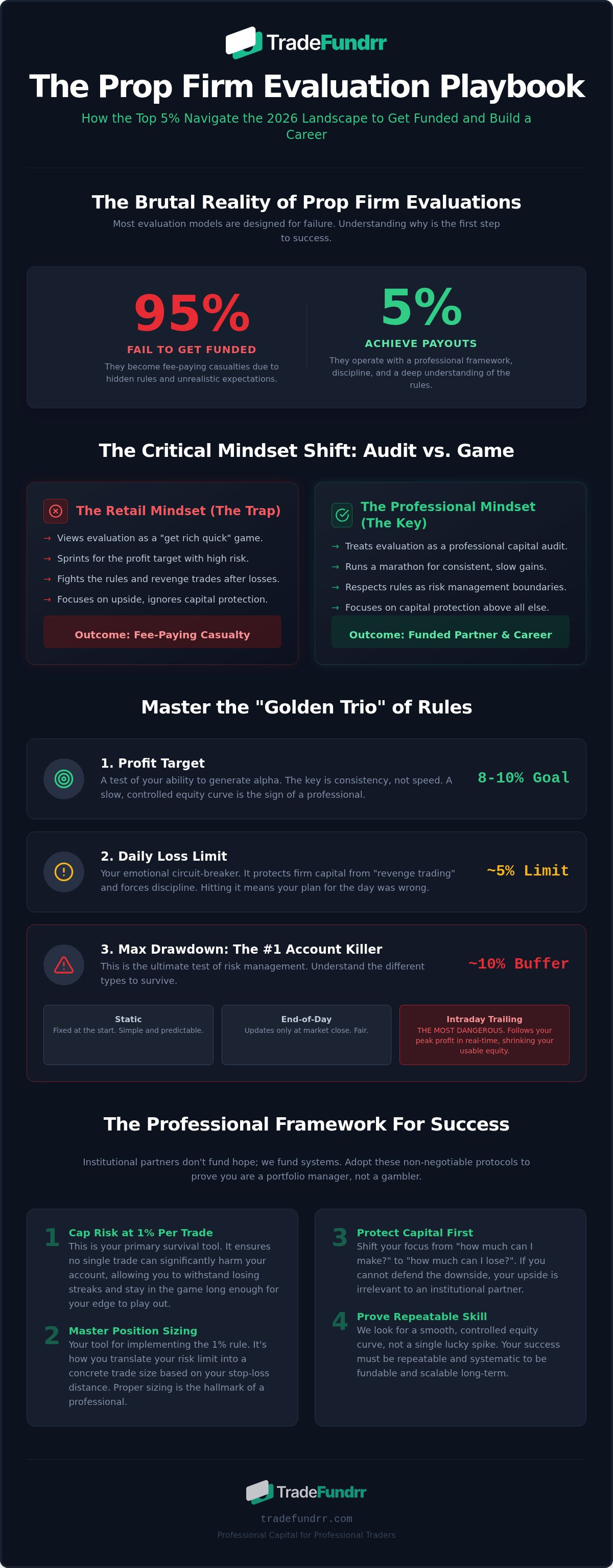
Statistics show that 95% of retail traders fail their prop firm evaluation before they ever see a single payout. It is a brutal reality of the 2026 market. Most firms aren't looking for partners; they are looking for fee-paying casualties. You have likely experienced the sting of a hidden drawdown rule or the silence of a support bot during a technical glitch. It feels like the deck is stacked against you. It usually is.
We are here to change that narrative. This institutional playbook strips away the industry fluff to show you how the top 5% actually navigate these hurdles. You'll learn to identify the traps that sink most accounts and how to implement the risk management protocols used by professionals. We're moving past the "get rich quick" noise. This is about building a career with access to $100k+ in real capital and an infrastructure that supports weekly payouts. Let's look at the rules of the game from the inside.
Key Takeaways
- Shift your mindset from winning a game to passing a professional capital audit that tests your discipline.
- Navigate the "Golden Trio" of rules by treating profit targets as a marathon instead of a high-risk sprint.
- Uncover the difference between fee-churning demo firms and institutional partners that provide real infrastructure.
- Secure your prop firm evaluation success by capping risk at 1% per trade and choosing the right account size for your equity.
- Build a long-term career with professional weekly payouts and a clear scaling path to $1M+ in institutional capital.
What is a Prop Firm Evaluation? (Stress Testing vs. Marketing Challenges)
Retail marketing sells you a dream. We sell you a reality check. To the average person, a prop firm evaluation looks like a video game level. You hit a specific number, you win the prize. That's a trap. For an institutional partner, this process is a rigorous audit of your psychological and technical fitness. It is a filter designed to separate the signal from the noise. Most firms want you to fail so they can pocket the fee. We want you to pass so we can deploy capital. This is the fundamental divide in the industry.
Why do you pay to play? It's about skin in the game. A fee filters for serious intent and covers the high cost of professional infrastructure. It pays for the real-time data feeds and the human support teams that back your trades. Your primary objective isn't just winning. It's proving you can protect the firm's capital while generating consistent alpha. If you cannot defend the downside, your upside is irrelevant to us. We don't fund hope; we fund systems.
The Institutional Stress Test Explained
Professional firms don't want gamblers. They want portfolio managers. To understand the foundation of this business, you should look at What is Proprietary Trading? beyond the retail buzzwords. A prop firm evaluation is a data-driven vetting process for professional capital allocation. It is a stress test. It measures how you handle drawdown and whether you stick to your plan under pressure. We aren't looking for the trader who gets lucky once. We are looking for the serious practitioner who manages risk like a business owner. Gambling is for the casino; managing a portfolio is for the professional.
Why 2026 Evaluators Look Beyond the Profit Target
In 2026, the profit target is the least interesting part of your data. We look at consistency scores and distribution. If you hit your target on one lucky news spike, you haven't proven skill; you've proven you're a gambler. Institutional-grade firms analyze your equity curve for luck versus skill. We examine trade frequency and duration to ensure your strategy is scalable. A jagged equity curve is a red flag. A smooth, controlled ascent is a sign of a professional. We look for repeatable logic that works across different market regimes. If your success isn't repeatable, it isn't fundable.
Decoding Evaluation Rules: Profit Targets, Drawdown, and Risk Limits
Rules aren't suggestions. In a prop firm evaluation, they are hard boundaries. Most retail traders treat these rules as obstacles to overcome. We treat them as the parameters of a professional business. To succeed in 2026, you must master the "Golden Trio": the Profit Target, the Max Drawdown, and the Daily Loss Limit. These aren't just numbers on a dashboard. They are the structural pillars of your trading career. If you ignore them, the market will ignore you.
The profit target is a marathon. It isn't a sprint. Many traders fail because they try to hit an 8% or 10% target in a single week. They over-leverage. They gamble. They lose. The Evolving Landscape of Prop Trading highlights how sophisticated firms now prioritize stability over raw speed. If you can't reach the target slowly, you won't reach it safely. Use position sizing for prop firm challenges to ensure your risk stays below 1% per trade. This is your primary tool for staying in the game.
Daily loss limits are your circuit breaker. They exist to stop the "revenge trading" spiral that kills accounts in minutes. When you hit that limit, the platform shuts you down. It's a mercy rule. It protects your capital from your own emotions. If you find yourself frequently hitting this limit, your strategy is broken. Professionalism means walking away when the math says stop. We don't want traders who fight the tape; we want traders who respect the limit.
The Math of Max Drawdown
Drawdown is the #1 trader killer in 2026. Not all drawdown is created equal. Static drawdown stays fixed at the bottom. End-of-day (EOD) drawdown updates when the market closes. Intraday trailing drawdown follows your peak profit in real-time. This last one is the most dangerous. It shrinks your "real" trading room as you win, trapping you in a corner. You can't manage what you don't measure. Read our prop firm max drawdown rules survival guide to understand how to protect your equity curve from these mechanics.
Time Limits vs. No-Time-Limit Models
Unlimited time sounds like a luxury. It can be a curse. Without a deadline, many traders become passive. They lose their edge. Conversely, time limits simulate the pressure of institutional quarterly reporting. They force you to perform. The "last-minute rush" trap happens when traders realize they are behind and start taking reckless setups. Pace yourself. If you are looking for a platform that respects your timeline and provides a fair environment, explore our professional evaluation paths today. Consistency is the only metric that matters.
The Sim-to-Live Reality: Why Most Evaluation Models are Designed for Failure
Most prop firms are built on a lie. They sell you a "challenge," but they're really selling you a failure. It's called the fee-churn model. In this setup, the firm doesn't need you to be profitable. They need you to blow up and hit the reset button. A typical prop firm evaluation in the retail space is often just a simulation designed to harvest entry fees. TradeFundrr operates on a different frequency. We are an institutional partner, not a retail arcade. We succeed when you succeed. Our model is built on deployment, not destruction.
Real trading requires real infrastructure. If you're trading on a platform that lags or uses delayed data, you aren't being tested; you're being sabotaged. Professional traders demand Level 2 data and direct market access. They need to see the order book to make informed decisions. Most firms hide behind bots and automated support tickets to save on overhead. When your platform freezes during a high-volatility event, a bot won't help you. Real human institutional expertise will. We provide the tools of the trade because we expect you to provide the talent. It's a partnership of mutual respect.
Identifying "A-Book" Institutional Backing
You need to know where the money comes from. Transparency is the only currency that matters in this industry. If a firm can't name its capital provider, run. We're backed by T3 Global. This isn't just a marketing claim. It's a professional pedigree that connects you to the heart of the market. Securing institutional capital for retail traders is the only way to move from "playing the markets" to a legitimate career. Red flags are everywhere. Look for vague payout terms or firms that operate exclusively in the shadows. If it looks like a black box, it probably is.
The "Trailing Drawdown vs Static" Debate
The drawdown debate is often misunderstood by those who haven't traded professional capital. In a simulation, firms use aggressive trailing drawdown to force quick failures. They want to maximize reset fees. In a live environment, drawdown mechanics must reflect real-world risk management. Our rules are built to transition you from the prop firm evaluation phase to the live market without a shock to your system. Check our guide on trailing drawdown vs static drawdown prop firms to see the math. We don't use "gotcha" rules. We use institutional standards that protect the firm and the trader alike. It's about longevity, not luck.
Strategic Preparation: Building a Professional Framework for Success
Most traders spend their time looking for "loopholes." Professionals spend their time building frameworks. A prop firm evaluation isn't a puzzle to solve. It is a business plan to execute. If you approach this with a "get rich quick" mindset, you have already lost. Success in 2026 requires a methodical, step-by-step preparation that mirrors how institutional desks onboard new talent. We don't want to see how fast you can make money. We want to see how well you can follow a system.
Step one is choosing the right scale. Don't let your ego pick your account size. A $25,000 Funded Account Evaluation is the ideal entry point for mastering the mechanics without the psychological weight of a massive balance. Step two is defining your risk. The institutional standard is risking less than 1% per trade. If you are risking more, you aren't trading; you're hoping. Step three requires testing your strategy in a high-fidelity simulator. Do not pay for an evaluation until you have data proving your edge works in real-time conditions. Finally, step four is robotic execution. The evaluation is about the process. The payout is just the score at the end of the game.
The Risk-First Methodology
We built our methodology to bridge the gap between retail habits and institutional discipline. It is a professional blueprint for risk-first trading. Most failures happen because of "Evaluation Anxiety." This is the internal pressure to perform that leads to over-trading and rule-breaking. Our methodology focuses on removing the emotional weight of the trade. By following a rigid, data-backed plan, you replace anxiety with a checklist. If the setup isn't in your written plan, you don't take the trade. It's that simple.
Market Selection: Stocks, Futures, or Crypto?
Your asset class should fit your lifestyle and your edge. Don't force yourself into Forex just because it's popular. A funded crypto trading account offers 24/7 opportunity and high volatility for those who can't trade during standard market hours. However, many professionals prefer the structural transparency of stocks and futures. Multi-asset access is superior to Forex-only firms because it allows you to move where the actual volume is. If you're ready to trade like a professional, view our evaluation options and choose the path that fits your strategy.
Beyond the Challenge: Scaling to Institutional Capital with TradeFundrr
Passing your prop firm evaluation is not the finish line. It is the starting block. Most traders treat the certificate like a trophy. We treat it like a job offer. The transition from the evaluation phase to a funded account is where the real work begins. You've proven you can follow the rules. Now, you must prove you can manage the capital. We move you from a simulated environment to a professional desk where your performance has real-world impact. This is the shift from retail hobbyist to institutional practitioner.
Our infrastructure is built for those who intend to stay. We offer a clear scaling path that starts with a $25,000 Funded Account Evaluation and reaches toward the $1M+ Institutional Capital Path. This isn't a marketing gimmick. It is a career trajectory. As you hit your consistency targets, we increase your buying power. We don't expect you to double your account every week. We expect you to protect the downside while we provide the ammunition. If you run into a technical issue or a complex market event, you don't talk to a bot. You talk to a human. Our support is handled by people who understand the markets, providing the stability you need when things get real.
The Payout Process: Speed and Transparency
Waiting 30 days for a payout is a retail relic. It creates unnecessary psychological stress. At TradeFundrr, we use a weekly payout structure. This frequency changes your relationship with profit. It turns trading into a consistent income stream rather than a monthly gamble. We don't hide behind complex withdrawal windows or opaque consistency traps that prevent you from accessing your share. You trade, you profit, and you receive your split. It's a transparent partnership. We handle the logistics; you handle the execution.
Becoming a Career Trader
A professional trading career is built on longevity. It is not built on a single lucky challenge pass. View your prop firm evaluation as the first day of your new life. TradeFundrr isn't just a service provider; we are a long-term partner in your professional growth. We provide the institutional-grade tools and the capital. You provide the discipline and the talent. If you are tired of the retail churn and ready for a professional environment, the door is open. Start your $25,000 evaluation today and trade real institutional capital.
Step Into the Institutional Arena
The retail market is designed to keep you small. It's built on simulation and endless resets. Professional trading is built on infrastructure and integrity. You now have the playbook to navigate your prop firm evaluation by focusing on risk-first discipline and institutional standards. Remember that profit is a byproduct of a sound process. You've seen the difference between fee-churning demo firms and a true capital partner. This isn't about beating a game. It's about securing a future.
TradeFundrr provides the bridge to a legitimate career. You get access to the T3 Global institutional infrastructure and the stability of weekly payouts. We don't hide behind bots. We offer real human support for serious practitioners. The market doesn't care about your excuses; it only cares about your execution. It's time to stop playing the game and start managing the capital. Your talent deserves a professional environment.
Join TradeFundrr and Access Institutional Capital Today
Frequently Asked Questions
What is the most common reason traders fail a prop firm evaluation?
Traders fail because they lack risk discipline. Most hit their daily loss limit or max drawdown before they ever reach the profit target. It isn't usually a bad strategy that kills an account; it is emotional over-leveraging. They try to "win" the market instead of managing the trade. A professional prop firm evaluation filters for those who can protect capital first. If you can't defend the downside, you won't survive the process.
Can I use automated trading bots during the evaluation phase?
TradeFundrr does not allow the use of automated trading bots in their evaluations. We are looking for human talent and discretionary skill. While bots are popular in retail circles, they often hide a lack of understanding of market mechanics. We provide the infrastructure for serious practitioners to trade manually. This ensures that the traders we fund have the intuition and discipline required for high-level institutional capital management.
How long does it typically take to complete a prop firm evaluation?
The timeline depends on your chosen path. Our Express Funding accounts provide instant access with no evaluation period. For standard evaluation accounts, you must trade for a minimum of 10 days while meeting a 30% consistency requirement. This prevents "one-hit wonders" from passing on a single lucky trade. Most disciplined traders complete the process within two to four weeks. Speed is less important than showing a repeatable, professional process.
Do I have to pay a monthly fee after I pass the evaluation?
TradeFundrr rebates your first month's plan fee with your first qualifying payout. This applies to our Stocks, Futures, and Options Express plans. While you don't pay a recurring "membership" fee to keep your funding, you are responsible for ongoing costs like data feeds and platform activation fees. We aim for a partnership where the firm's revenue comes from your profitable trading, not from recurring subscription charges. It is about performance, not fees.
What happens if I violate a rule during the evaluation?
A rule violation results in the immediate termination of the account. There are no "second chances" in a live institutional environment, so the evaluation reflects that reality. If you hit a hard stop like the daily loss limit, the account is closed. You can choose to reset and try again, but we recommend reviewing your risk framework first. Consistency is the goal. Rule breaks are a sign that your system needs adjustment.
Is the prop firm evaluation conducted on a demo or live account?
The initial prop firm evaluation is conducted in a high-fidelity simulated environment. This allows us to verify your skills without risking live capital immediately. Once you pass and move to a funded account, you transition toward a professional environment backed by T3 Global infrastructure. This model ensures you are fully prepared for the psychological and technical demands of managing real institutional money. We provide the bridge from simulation to reality.
Can I trade news events during the evaluation?
You can trade news events, but you must do so with extreme caution. Professional traders understand that news spikes often cause slippage and wide spreads that can trigger a max drawdown violation. We don't forbid news trading, but we do expect institutional-grade risk management. If your strategy relies on "gambling" on a CPI print, you are likely to fail the consistency requirements. Trade the reaction, not the anticipation. Discipline is everything.
How much capital can I actually manage after passing the evaluation?
You can manage anywhere from $25,000 to over $1,000,000 depending on your performance and scaling path. Most traders start with a $25,000 or $100,000 account to prove their consistency. As you show profitable results and hit specific milestones, we provide the path to institutional capital levels. This is a career move. We provide the ladder; you just have to keep climbing with disciplined execution and professional rigor.
Take on your evaluation with a plan
Prove your process in a structured, simulated evaluation with clear, written rules.
Get Funded →