
Prop Firm Max Drawdown Rules: The 2026 Survival Guide for Funded Traders
 July 5, 2026
10 min read
July 5, 2026
10 min read
Your profit target doesn't matter if your risk math is broken. Most traders don't lose their funded accounts because they can't read a chart; they lose them because they fail to respect the prop firm max drawdown rules that govern the game. It's a professional environment that demands institutional discipline, yet most participants approach it with a retail mindset.
We know the frustration of losing an account on a technicality while your PnL is still green. It feels like the rules were designed for you to fail. This guide changes the narrative by giving you the mechanics to protect your capital and secure consistent payouts. We'll examine the 2026 shift toward end-of-day trailing models, identify the "trailing traps" that liquidate the vast majority of traders, and provide a clear strategy to navigate pullbacks without anxiety. You provide the talent; we provide the framework to keep it.
Key Takeaways
- Understand the "invisible wall" of risk management. Max drawdown isn't just a hurdle; it's the professional safety net that protects institutional capital.
- Identify the trailing drawdown trap. Learn why peak equity models can liquidate your account even during a winning trade and how to avoid this common pitfall.
- Decode prop firm max drawdown rules to choose the right model. We'll show you how to differentiate between equity-based and balance-based calculations to fit your strategy.
- Master a tactical 4-step risk management framework. Stop guessing and start calculating your daily loss limits and position sizes with institutional precision.
- Bridge the gap to professional trading. Realize why human-centric support and institutional-grade access provide more stability than automated retail bots.
What is Max Drawdown? The Invisible Wall of Prop Trading
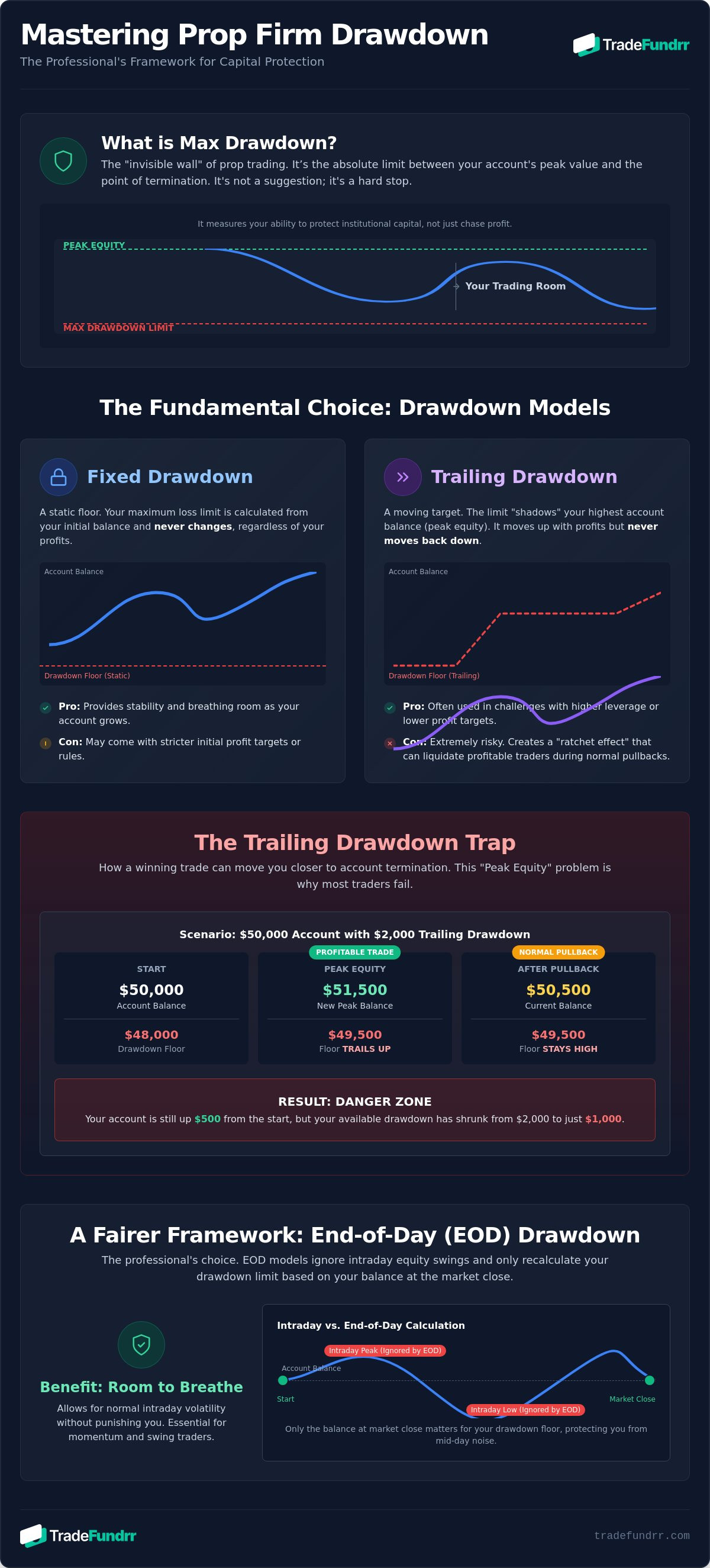
Max drawdown is the ultimate boundary. It is the distance between your account's highest value and the point where the firm pulls the plug. In the broader context of Drawdown (economics), the term refers to the maximum loss an account sustains from a peak before a new peak is achieved. In prop trading, it is your hard stop. Hit it once, and the account is terminated. No second chances. No excuses. It doesn't matter if your technical analysis was perfect or if the market moved on a freak news event. The rule is absolute.
At TradeFundrr, we view these limits as more than just "rules." They are a test of your ability to manage institutional capital. Retailers chase percentages; professionals protect principal. When you trade a $50,000 or $100,000 Funded Account Evaluation, you aren't just trying to hit a profit target. You are proving that you can operate within a professional risk framework. If you can't protect a small account, you'll never handle the $1M+ Institutional Capital Path.
The Purpose of Drawdown in Professional Trading
Capital providers prioritize capital preservation over high returns. It's a simple reality. A firm can always find another trader to make money, but they cannot easily replace lost capital. Drawdown rules distinguish the lucky gambler from the disciplined professional. Gamblers look at what they can make on a single trade. Professionals look at how many "bullets" they have left in the magazine. These limits also dictate your maximum leverage. Your true trading size isn't based on your total account balance; it's based on the distance to your drawdown limit. Respect the limit, or the market will respect it for you.
Fixed vs. Trailing Drawdown: The Fundamental Choice
Understanding prop firm max drawdown rules starts with the model you choose. It is a binary choice that determines your entire strategy.
- Fixed Drawdown: This is a static floor. If you start a $100,000 account with a $5,000 limit, your floor is $95,000. It stays there forever. This model allows for breathing room as your account grows. It's a "this, not that" scenario: you get stability, but often at the cost of stricter initial terms.
- Trailing Drawdown: This is a moving target. The limit "shadows" your highest account balance. If you go up $2,000, your floor moves up $2,000. It never moves back down. It is a one-way ratchet that demands perfection.
Your choice of model is the most important decision you'll make before placing a single trade. A trailing model can catch you in a "peak equity" trap where a winning trade that pulls back can still breach your limit. A fixed model gives you the structural integrity needed for long-term survival.
The Trailing Drawdown Trap: Why Most Traders Fail
Trailing drawdown is a one-way street. It moves up with your success. It stays put during your failures. This creates a "ratchet effect" that slowly suffocates your trading account. Most retail firms use this because it's the most effective way to liquidate accounts. It isn't about risk; it's about turnover. If you don't understand the nuance of prop firm max drawdown rules, you're just a donation to the firm's balance sheet. You are trading against a moving floor that never gives back the ground it gains.
The math is brutal. Imagine you have a $50,000 account with a $2,000 trailing drawdown. Your floor starts at $48,000. You make a great trade and gain $1,500. Your account balance is $51,500, but your floor is now $49,500. Then, you hit a normal pullback. You lose $1,000. In a fixed model, you'd have $1,000 of room left. In a trailing model, you're only $500 away from termination. You are winning, yet you are closer to death. This is the "Peak Equity" problem. It turns your best trades into your biggest liabilities.
End-of-Day (EOD) Drawdown: A Fairer Framework
Professional traders look for EOD models. This framework only recalculates your drawdown limit based on your balance at the market close. It ignores the noise in between. This allows for intraday volatility. You can be down $500 at noon and up $1,000 by 4 PM without your drawdown floor moving an inch. It provides the breathing room momentum and swing traders need to survive. If you want to see how this works in a professional setting, check out the funded account evaluation options that prioritize trader longevity over quick fees.
The Unrealized P/L Trap Explained
Most traders focus on closed trades. Trailing drawdown focuses on "ticks." If your trade is up $3,000 but you haven't closed it, your drawdown limit has already moved up $3,000. If the market retraces and you close for a $500 gain, you have "lost" $2,500 of your drawdown buffer. You gave back profit, and the firm punished you for it.
Unrealized P/L risk is the danger of a trailing drawdown limit rising based on open trade profits, which remains elevated even if those profits are subsequently lost during the trade's duration.
This creates a massive psychological toll. You stop trading the chart and start trading your drawdown. You exit early to "save" your buffer. You hesitate on the next setup because your margin for error has vanished. It's a mental game designed to make you fail. Professionals don't play that game; they choose environments that respect the reality of market movement and human psychology.
Equity-Based vs. Balance-Based Rules: Choosing Your Battle
Balance is what you have. Equity is what you could have. Navigating prop firm max drawdown rules requires knowing which one you're fighting. Balance-based drawdown is the professional standard. Equity-based drawdown is the retail trap. One measures your actual performance; the other monitors your every heartbeat. Choosing between these two isn't just a preference. It's a survival strategy.
Balance-based rules only trigger when a trade is closed. Your realized profit or loss is all that matters. Equity-based rules are different. They monitor your account value in every tick. If you're up $2,000 and the market pulls back $500, an equity-based rule sees that as a $500 loss against your limit. It's significantly harder for beginners to manage because it punishes the natural "breathing" of a profitable trade. TradeFundrr provides real-world infrastructure that mirrors institutional desks. We don't use retail gimmicks to liquidate accounts.
Which Model Fits Your Strategy?
Scalpers often tolerate equity-based rules. Their trades are fast. They're in and out before a pullback can trigger a breach. Speed is their protection. Swing traders are the opposite. They need balance-based rules. Holding a position overnight or through a session transition requires a buffer that doesn't disappear the moment price fluctuates. If your strategy involves catching large moves, an equity-based model will likely terminate your account before you hit your target. Before you pay an evaluation fee, read the fine print. If a firm doesn't clearly state their model, they're likely hiding an equity-based trap.
The Institutional Perspective on Risk
T3 Global and TradeFundrr approach drawdown as a scaling metric. It's a tool for growth, not a reason for termination. The transition from a simulation to live capital is where most traders fail. They've learned to trade "sim rules" that don't exist in the real world. We bridge that gap by providing institutional-grade stability from day one. We don't want you to just pass; we want you to scale. If you're ready to move past retail games, The $25,000 Funded Account Challenge offers a professional entry point to genuine institutional capital. It's about building a career, not just chasing a payout.
How to Manage Max Drawdown: A Tactical 4-Step Guide
Understanding the rules is theory. Executing them is survival. Most traders approach prop firm max drawdown rules as a passive constraint. Professionals treat them as an active risk framework. If you don't have a tactical plan to stay above the floor, the market will eventually find a way to put you under it. Here is the institutional blueprint for protecting your funded account.
- Step 1: Calculate your Daily Loss Limit. Never risk your entire drawdown in one session. If your total drawdown is $5,000, set a hard daily limit of $1,000. This gives you five "lives" before the account is terminated.
- Step 2: Define your Max Position Size. Your stop loss isn't just a line on a chart. It's a mathematical calculation. Reverse engineer your lot size from the dollar amount you are willing to lose on that specific setup.
- Step 3: Implement a Hard Stop. Use the platform-level risk settings. If your platform allows an auto-liquidate threshold, set it. This isn't a sign of weakness; it's a professional fail-safe against emotional overtrading.
- Step 4: Reduce size after a winning streak. This is the most counterintuitive step. When you are in profit, your trailing floor is at its highest point. Your buffer is actually more fragile. Scale back your risk to protect the new, higher floor until you've built a significant cushion.
Position Sizing for Drawdown Protection
The 0.5% Rule is the industry standard for a reason. Risking 1% or 2% on a retail account might be acceptable, but on a funded account, it's a death sentence. You aren't trading the $100,000 balance; you are trading the $5,000 or $10,000 drawdown buffer. Risking more than 0.5% of that buffer per trade leaves you no room for a normal losing streak. When your buffer narrows, your size must shrink proportionally.
Drawdown-adjusted position sizing is the process of dividing your maximum dollar risk per trade by the point value of your stop loss to ensure no single trade can compromise more than a fraction of your remaining buffer.
The Psychology of the Drawdown Buffer
Stop looking at the starting capital. That number is irrelevant. If you have a $50,000 account with a $48,000 drawdown limit, then $48,000 is your "zero." You only have $2,000 of real money. Treating the drawdown limit as your absolute zero changes how you perceive risk. It removes the illusion of having a large account and forces you to respect the actual capital at your disposal.
Staying calm when you're "in the red" relative to your starting balance is the hardest part of the game. It requires a shift in identity from a gambler to an asset manager. If you are ready to trade with a firm that respects your skill, choose a funded account evaluation that provides the infrastructure you need to succeed.
Beyond the Rules: Trading with Institutional Capital
Mastering the mechanics of prop firm max drawdown rules is only half the battle. The other half is the environment in which you trade. Most retail prop firms are built on a "churn and burn" model. They want your evaluation fee, not your long-term success. They hide behind automated bots and rigid, opaque systems. This creates a barrier between you and the professional career you're trying to build. We do things differently.
TradeFundrr isn't just another platform. We are a gateway to genuine institutional access through our partnership with T3 Global. This isn't about playing games in a simulated sandbox. It is about preparing you for a $1M+ Institutional Capital Path. When you follow a professional risk framework, you aren't just avoiding a breach. You are building the track record necessary to manage significant wealth. Discipline is the currency of the institutional world. Weekly payouts are the reward for that discipline.
Why Human Support Matters for Risk Management
Rules are easier to follow when you have real human support. Bots don't understand context. They don't provide feedback. They simply terminate. At TradeFundrr, we prioritize human connection and integrity. Real-time feedback helps you understand the nuances of prop firm max drawdown rules before you reach a critical breaking point. Having an institutional partner in your corner during a drawdown can be the difference between a temporary setback and a permanent account loss. We provide the infrastructure for you to transition from a $25,000 Funded Account Evaluation to professional-grade accounts with institutional-grade stability.
Ready to Trade Real Capital?
Stop fighting "trailing traps" designed by retail firms to make you fail. Start trading within professional frameworks designed by insiders. The industry is full of artificiality, but your skill is real. We respect that talent. Our evaluation programs are a "tough but fair" filter for serious practitioners who want more than just a quick payout. They want a career.
If you're ready to master risk and scale your trading, keep sharpening the advanced risk strategies that go beyond basic tutorials. It is time to move past the retail noise and enter a professional environment built on transparency and mutual respect. Join the TradeFundrr Evaluation and Prove Your Skill. The capital is ready. The question is whether you are ready to manage it.
Secure Your Professional Future
The retail era of prop trading is fading. The professional era is here. Understanding prop firm max drawdown rules isn't about memorizing a handbook; it's about adopting a mindset of capital preservation. You've seen how trailing traps and equity-based triggers are designed to liquidate talent rather than foster it. Now, you have the tactical framework to fight back and protect your funded account.
TradeFundrr offers a different path. We don't hide behind automated bots or opaque rules. We provide real human support and institutional stability through our partner, T3 Global. This partnership ensures you aren't just trading against a screen; you're trading within a professional ecosystem that rewards consistency with weekly payouts. Your skill deserves a foundation that doesn't move the goalposts.
Stop guessing your risk and start scaling your career. See the TradeFundrr funding programs to secure your edge and step onto a $1M+ institutional capital path. The infrastructure is ready. Bring your talent. Let's build something real together.
Frequently Asked Questions
Does trailing drawdown ever go away once I am funded?
In most retail environments, the trailing drawdown continues until the threshold reaches your starting account balance. Once the floor hits that initial value, it typically becomes a static minimum balance rule. It doesn't usually vanish entirely. You must verify if your specific provider continues to trail into your profits or locks the floor at "break-even" to ensure your capital is actually yours to keep.
What happens if I breach the daily drawdown but my total account is in profit?
Your account is terminated immediately. Prop firm max drawdown rules treat the daily loss limit as a hard breach, regardless of your overall PnL or total account balance. It's a test of session-level risk control. If you lose $1,000 on a day where your limit is $900, the account is closed even if you're up $5,000 for the month. There are no exceptions for "good" traders.
Is equity-based drawdown better than balance-based drawdown for day traders?
No, balance-based drawdown is superior for almost every trading style. It only accounts for closed trades, whereas equity-based drawdown tracks unrealized profits and losses in real-time. For a day trader, equity-based rules turn every tick of market noise into a potential breach. Balance-based rules allow you to manage the trade based on the chart rather than the fluctuations of an unrealized equity curve.
How much should I risk per trade to stay within prop firm drawdown rules?
Risk no more than 0.5% of your total drawdown buffer per trade. If you have a $100,000 account with a $3,000 drawdown limit, your risk per trade should be $150 or less. Many traders make the mistake of risking a percentage of the total account balance. This is a fatal error. Your "real" capital is the distance to your drawdown floor, not the number at the top of the screen.
Can I reset my account if I hit the max drawdown limit?
Most firms allow you to reset your account for a fee, but this only applies during the evaluation phase. Once you're in a funded or live environment, a breach usually results in permanent termination of that specific account. You would then need to start a new evaluation from scratch. We view resets as a retail trap that encourages poor habits; professional traders focus on never needing one.
Why do prop firms use trailing drawdown instead of fixed drawdown?
Firms use trailing drawdown to minimize their risk exposure as your account grows. It forces the trader to maintain a high win rate and tight risk management. From a business perspective, it also increases the failure rate for traders who "give back" open profits. Fixed drawdown is a fairer model for the trader, but trailing models are the industry standard for firms prioritizing high account turnover.
Does TradeFundrr use intraday trailing drawdown traps?
We avoid the predatory "tick-by-tick" trailing models common in retail firms. Our focus is on professional risk frameworks that mirror institutional desks at T3 Global. We provide the infrastructure for $25,000, $50,000, and $100,000 Funded Account Evaluations without the gimmicks designed to force a breach. Our goal is to find talent we can scale to the $1M+ Institutional Capital Path, not collect reset fees.
How is max drawdown calculated on a $100,000 funded account?
On a $100,000 account, a 6% max drawdown means your account is terminated if the balance or equity hits $94,000. If the rule is trailing, that $94,000 floor moves up as your account balance reaches new peaks. Understanding these prop firm max drawdown rules is critical before placing your first trade. Always calculate your distance to the floor in dollars, not percentages, to maintain absolute clarity on your risk.
Trade under clear, defined rules
Develop your trading in a structured, simulated environment with transparent risk and drawdown rules.
Get Funded →