
Position Sizing for Prop Firm Challenges: The 2026 Risk Management Checklist
 July 18, 2026
14 min read
July 18, 2026
14 min read

Most traders fail their first prop firm challenge because they treat a $100,000 account like it actually has $100,000 in liquidity. It doesn't. In 2026, risking 1% per trade isn't "safe" management; it's high-leverage gambling that ignores the reality of tight daily loss limits. Retail traders focus on the entry. Professionals focus on the math that keeps them in the game.
You've likely seen a single volatile wick trigger a drawdown violation on a simulated account. It's the "volatility trap" where slippage ruins your calculations and ends your evaluation before it truly begins. Mastering position sizing for prop firm challenges is the only way to bridge the gap between being a talented chart reader and becoming a funded professional. This isn't about guessing lot sizes. It's about structural integrity and institutional-grade risk management.
This guide provides a repeatable checklist to help you calculate risk based on your actual drawdown buffer, not just your account balance. You'll learn the exact formulas required to pass your evaluation without stress and secure a path to a simulated funded account. We're moving past the noise to focus on the numbers that actually matter.
Key Takeaways
- Adopt the 0.5% risk standard used by institutional insiders to create a sustainable buffer against tight drawdown limits.
- Master the exact math for position sizing for prop firm challenges by basing your lot size on your remaining daily loss limit rather than the total account balance.
- Understand how to adjust your sizing across different asset classes like stocks and futures to account for specific volatility and tick values.
- Implement a pre-trade checklist to verify your risk parameters before every entry, ensuring you never blow an account on a single volatile move.
The Math of Failure: Why Strategy Fails Without Professional Sizing
Most traders believe they have a strategy problem. They spend months chasing the perfect entry signal or a higher win rate. They're looking at the wrong variable. In reality, they have a sizing problem. Position sizing is the tactical allocation of capital designed to survive variance. It's the difference between a professional operation and a retail gamble. Strategy gets you into the trade; sizing keeps you in the seat.
Mastering position sizing for prop firm challenges requires a shift in perspective. You aren't trading a $100,000 account. You're trading a $4,000 or $5,000 drawdown buffer. When you risk 1% of the total balance, you're actually risking 20% or 25% of your account's "life" on a single move. In the volatile markets of 2026, traditional 1% risk rules are obsolete. They're a fast track to a failed evaluation. Institutional protocols demand more precision.
The "Perfect-Fill Trap" is where many promising traders meet their end. Many simulations assume slippage is non-existent and liquidity is infinite. If you calculate your size based on these perfect fills, your math will crumble the moment volatility hits. Real markets have friction. Real markets have gaps. If your sizing doesn't account for the "hidden" costs of execution, you're building a career on a foundation of fake data.
Strategy vs. Risk Management
A strategy with a 60% win rate is a statistical winner. However, a 60% win rate still allows for five or six consecutive losses. This is the reality of variance. If your sizing is too aggressive, that natural losing streak will trigger a drawdown violation before the win rate can normalize. Professional risk management is about surviving the clusters of bad luck so you're still present for the clusters of good luck. We don't trade for the home run; we trade for the right to play the next inning.
The Psychology of the Drawdown Limit
Fear changes the math. When a trader approaches their daily loss limit, they often fall into "revenge sizing." They increase their lot sizes to win back losses in a single trade. This is a direct violation of the prop firm max drawdown rules that protect the account. To pass, you must move from a "how much can I make" mindset to a "how much can I lose" framework. Your position size should be a reflection of the distance to your stop loss and the remaining buffer in your daily limit. Nothing else matters.
- Retail Mindset: Maximizing lot size to hit the profit target faster.
- Institutional Mindset: Minimizing lot size to ensure the drawdown limit is never touched.
TradeFundrr provides the infrastructure to support this professional approach. We don't want gamblers; we want disciplined practitioners who understand that capital preservation is the only path to scaling toward $1M+ in simulated funding capital. The checklist starts with the math.
The 0.5% Standard: Calculating Risk Under Strict Evaluation Rules
The industry standard of risking 1% per trade is a retail myth. For most traders, it's a death sentence. When you're tackling position sizing for prop firm challenges, you aren't managing a full account balance. You're managing a narrow window of permissible drawdown. Institutional traders don't risk 1% during an evaluation phase. They use the Rule of 0.5%. This provides a 200% larger buffer against the natural variance of the market. It's the difference between surviving a three-trade losing streak and hitting a hard breach violation.
The 0.5% standard isn't about lack of confidence. It's about mathematical survival. Most evaluations fail not because the strategy was wrong, but because the sizing was too aggressive for the drawdown limit. By cutting your risk in half, you double your "lives" in the challenge. This allows you to trade through the noise of the 2026 markets without the constant threat of a single volatile wick ending your career. Professionals prioritize staying in the game over hitting the target in record time.
The Universal Position Sizing Formula
Precision requires math, not intuition. To calculate your lot size, use this formula: (Account Balance * Risk %) / (Stop Loss in Ticks/Pips * Value per Tick/Pip). Let's look at a 25k funded account challenge. If you risk 0.5%, your maximum dollar risk is $125. If your stop loss on a futures contract is 10 points and each point is worth $5, your position size is exactly 2.5 units. Since you can't trade half a contract, you round down to 2.
Always leave a "buffer" for slippage and commissions. If your math says you can risk $125, size for $110. Real-world execution in 2026 is rarely perfect. A slightly late fill or a spread widening during a news release can easily push a "perfect" 0.5% risk into a 0.6% loss. That small discrepancy is how "Hard Breach" violations happen on accounts that were supposedly managed well. If you want to trade with a professional-grade setup, you must account for real-world friction. You can start your path to simulated funding by adopting this conservative, professional math today.
Compounding vs. Fixed Sizing
Compounding is a mathematical trap during the evaluation phase. Increasing your risk because your balance grew by 2% sounds logical, but it's actually dangerous. During the challenge, your goal is a fixed profit target. Your risk should remain a fixed dollar amount based on your starting equity. Compounding increases your risk right as you approach the finish line. One loss at a compounded size can wipe out multiple wins at the base size. Stay fixed until you pass. Transition to compounding only after you've secured your initial payout and built a cushion of realized profit.
Multi-Asset Nuance: Sizing for Stocks, Options, and Futures
Generic guides focus almost exclusively on Forex pips. They're useless in a professional multi-asset environment. If you're managing a funded stock trading account, pips don't exist. You have to deal with share prices, varying volatility, and the constant threat of overnight gaps. A one-size-fits-all approach to position sizing for prop firm challenges is a recipe for a hard breach. Each asset class has its own mechanical DNA. You must adapt your math to the specific instrument on your screen.
Futures traders face the unique challenge of tick values and margin requirements. A single tick in the S&P 500 E-mini is worth $12.50. In the Micro E-mini, it's $1.25. If your stop loss is too wide for the E-mini, you don't skip the trade. You downshift to Micros. This granular control is how you maintain the 0.5% risk standard discussed earlier. Retail traders force the asset to fit their ego. Professionals force their sizing to fit the asset's volatility.
The Leveraged Asset Framework
Leverage is a tool, not a strategy. When trading futures, your position size is dictated by the tick value multiplied by your stop distance. If the math exceeds your $125 risk limit on a 25k account, you're over-leveraged. Period. Stock traders must also account for "Gap Risk." A stock can close at $100 and open at $90, bypassing your stop loss entirely. This is why institutional-grade sizing for stocks often requires smaller absolute positions than intraday futures.
Managing a funded crypto trading account introduces 24/7 tail risk. Crypto doesn't sleep. A liquidity crunch at 3:00 AM can trigger slippage that ruins a perfect calculation. In these markets, position sizing must be even more conservative. We recommend a "volatility-adjusted" size where the higher the ATR, the lower your total exposure. You're trading to survive the outliers, not just the averages.
Options Sizing for Prop Traders
Options sizing is frequently misunderstood. Most retail traders look at "Buying Power" as their risk metric. This is a trap. Buying power is just the collateral required to hold the position. Your real risk is the Delta-adjusted exposure and the Gamma risk as expiration approaches. Gamma can accelerate your losses faster than you can manually exit the trade, especially near the daily loss limit.
- Buying Power: The capital blocked by the broker.
- Real Risk: The Max Loss of the spread or the Delta-weighted exposure of the naked position.
Always size based on the "Max Loss" of the structure. If you're buying a call, your risk is 100% of the premium. If you're selling a vertical spread, your risk is the width of the strikes minus the credit received. Never let the Greeks dictate your drawdown. Check your Gamma exposure before every entry to ensure a small move in the underlying won't cause a massive, unmanageable swing in your account equity.
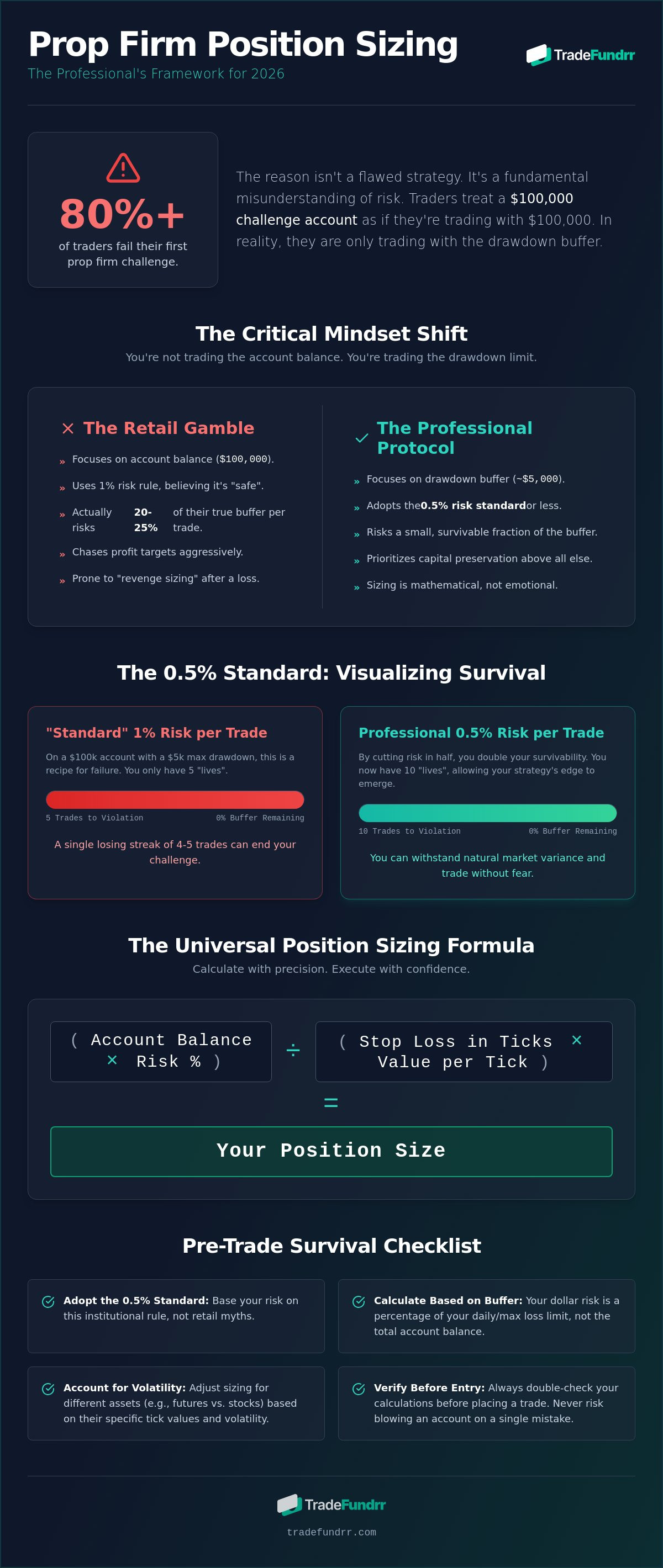
The Prop Firm Survival Checklist: 2026 Edition
A professional strategy is useless without a professional workflow. Most traders blow their accounts because they skip the boring steps. They see a setup, get excited, and click "buy" without checking their remaining daily buffer. In 2026, the speed of the market doesn't allow for mental math. You need a rigorous process for position sizing for prop firm challenges that removes emotion from the equation. The checklist is your armor against the natural variance of the evaluation cycle.
Before you look at a chart, you must look at your dashboard. Your daily loss limit is your real ceiling. If you've already lost $100 in a session, your next position must be sized smaller to avoid a hard breach. Professionals calculate the stop-loss distance first and the lot size second. If the required stop is too wide for your 0.5% risk limit, you don't take the trade. You wait for a tighter setup or a different instrument. This disciplined approach to position sizing for prop firm challenges ensures you never hit a violation on a single volatile move.
The 5-Minute Pre-Trade Protocol
Before every entry, you must clear three hurdles. First, check the economic calendar. High-impact news events are no-trade zones where slippage can double your intended risk in milliseconds. Second, calculate the "Max Allowable Lot" for the current setup based on your remaining drawdown. Third, confirm the "Kill Switch" level on your platform. Knowing exactly where the firm will lock you out prevents the temptation of revenge sizing after a loss. These steps turn a chaotic activity into a repeatable business process.
Managing Multiple Positions
The "Correlation Trap" is a silent killer of funded accounts. If you're long the S&P 500 and long the Nasdaq, you aren't diversified. You've simply doubled your risk on the same move. Professional risk management requires keeping the sum of all open stops under 1.5% of your account equity. Hedging often adds more in commissions and complexity than it provides in actual protection. If you feel the need to hedge, your initial position was likely too large for the environment.
Execution is where the math meets the market. Never use market orders. They invite slippage inflation, where a "safe" risk calculation becomes a violation before the trade even moves. Use limit orders to ensure your entry price matches your math. After the trade closes, document the R-multiple. Did you risk 1 to make 2? Update your risk log immediately. This level of operational rigor is what separates retail gamblers from the professionals who get funded at TradeFundrr. We provide the infrastructure; you provide the discipline.
- Pre-trade: Verify the current daily loss limit remaining.
- Trade Entry: Calculate stop-loss distance before looking at the entry.
- Execution: Use limit orders to avoid slippage inflation of risk.
- Post-trade: Document the R-multiple and update the risk log.
Institutional Infrastructure: How TradeFundrr Protects Your Account
Most prop firms are built on a "reset-loop" business model. They profit when you fail. They survive on a constant cycle of evaluation fees from traders who treat the markets like a video game. TradeFundrr is different. We operate as a straight-shooting insider, providing the infrastructure you need to transition from a retail mindset to an institutional desk. Mastering position sizing for prop firm challenges is the entry fee for this professional environment. We don't want gamblers; we want partners who understand that capital preservation is the only path to longevity.
Our model emphasizes human connection and radical honesty. While other firms hide behind automated bots and opaque rules, we provide real human support to help you navigate complex risk parameters. This partnership ensures you aren't just passing a test; you're building a career. We provide the tools, advanced risk templates, and the exact institutional math required to handle 2026 volatility. You provide the discipline.
Real Payouts vs. Reset Loops
There is a massive difference between "never-pay" firms and professional programs. Many traders build habits in a world of perfect fills and zero slippage. When you finally trade under realistic market conditions, your strategy falls apart because your sizing was built on a lie. TradeFundrr trains you to size for real-world friction. Our profit split is 80% of simulated profits. We reward disciplined sizing because it protects your account and your payouts. Lucky gambles are a dead end; professional math is the only way forward.
Your Path to $1M+ in Simulated Funding
Securing a funded account is the start of the journey, not the destination. Once you pass, the goal shifts toward a prop firm weekly payouts mindset. You stop trading for the "home run" and start trading for sustainable cash flow. This shift requires even tighter control over position sizing for prop firm challenges as your account balance grows. We don't just offer a one-time evaluation; we offer a $1M+ scaling path.
As your simulated funding scales toward that million-dollar mark, Financial Mentors Wealth Management can assist in developing the sophisticated wealth creation strategies needed to manage your growing professional income.
As you demonstrate consistency, we scale your buying power. Your lot sizes will increase, but your risk percentage remains anchored to institutional standards. This methodical scaling allows you to grow your income without increasing your stress. We remove the barriers to high-level resources so you can focus on the trade. If you're ready to move beyond the artificiality of retail prop firms and join a professional, simulated funding environment, the path is clear. Start your evaluation with TradeFundrr today.
- Evaluation Phase: Prove your discipline on a $25,000, $50,000, or $100,000 account.
- Funded Phase: Secure weekly payouts and build your realized profit cushion.
- Scaling Path: Grow your career toward $1M+ in simulated funding capital.
- Support: Access real human expertise and professional risk templates.
Trade Like an Insider, Not a Gambler
Retail traders chase the profit target. Professionals protect the drawdown buffer. Passing an evaluation isn't about finding a "holy grail" indicator; it's about the math of survival. By adopting the 0.5% risk standard and a rigorous pre-trade protocol, you've already outperformed the majority of traders who fail due to emotional lot-sizing. Precision in position sizing for prop firm challenges is the only bridge between trading for "sim" credits and earning real payouts.
You provide the talent. We provide the infrastructure. Move beyond the artificiality of retail prop firms and step into an environment built on integrity and realistic execution. With weekly payouts, institutional-grade buying power, and real human support, we're here to back the practitioners who respect the numbers. The door to the $1M+ scaling path is open. It's time to trade with a professional firm behind you.
See the TradeFundrr funding programs today. Your professional career starts with the first correctly sized lot.
Frequently Asked Questions
What is the best risk percentage for a $100k prop firm challenge?
Aim for a risk of 0.25% to 0.5% per trade. While retail guides often suggest 1%, that's a mathematical trap for accounts with tight drawdown limits. Risking 0.5% on a $100,000 account gives you a $500 risk per trade. This provides a wider buffer against the $5,000 maximum drawdown typical of these evaluations. Lower risk ensures you survive the natural variance of the market without hitting a hard breach.
How do I calculate position size for futures in a funded account?
Divide your dollar risk by the product of your stop loss in ticks and the tick value. For example, if you risk $250 on an E-mini S&P 500 trade with a 5-point (20-tick) stop, the math is $250 divided by 250. This equals 1 contract. Always round down to the nearest whole contract to maintain your risk ceiling. Precision is the difference between a funded professional and a retail gambler.
Should I use a fixed lot size or a percentage of my balance?
Use a fixed dollar risk based on your starting equity until you pass the evaluation. Compounding your risk as the balance grows is a dangerous trap. It increases your exposure right as you approach the profit target. One loss at a compounded size can wipe out multiple wins at the base size. Keep your position sizing for prop firm challenges static until you've secured your initial payout and built a profit cushion.
Does the daily loss limit include unrealized (floating) profit?
Yes, most modern prop firm rules calculate the daily limit based on your peak equity for the session. If your trade is up $1,000 and pulls back to $0, the firm views that as a $1,000 loss against your daily limit. This is why trailing stops and active management are essential. Never let a winning trade turn into a daily breach violation because you ignored floating equity.
How many trades should I take per day during an evaluation?
Limit yourself to 1 to 3 high-conviction setups. Overtrading is the fastest way to hit your daily loss limit through "death by a thousand cuts." Each trade carries the hidden costs of slippage and commissions. Focus on quality over quantity. If your first two trades are losses, walk away to protect your drawdown buffer for the next trading day.
What happens to my position size if the market gaps past my stop loss?
Your loss will exceed your initial calculation because you'll be filled at the next available price. This is negative slippage. In the 2026 markets, high-volatility gaps are a constant threat. To manage this, professionals reduce their position size before major news events or overnight sessions. Your calculation is a defensive plan, but the market's liquidity is the final judge of your exit price.
Can I use position sizing calculators provided by third parties?
You can use them, but always verify the contract specifications manually first. Many third-party tools use outdated tick values or don't account for the specific leverage of futures and options. Trust the math, but verify the inputs. A small error in a calculator can lead to a hard breach that no support ticket can fix. Discipline starts with verifying your own numbers.
How does TradeFundrr support traders with risk management?
We provide institutional-grade infrastructure and real human support instead of automated bots. Traders gain access to professional risk templates that cover the exact math used by professionals to manage position sizing for prop firm challenges. We don't just provide buying power; we provide the structural framework to help you keep it. Our goal is a long-term partnership on the $1M+ scaling path.
Trade with a professional firm behind you
Prove your discipline in a structured, simulated environment with clear rules and a defined path to a funded account.
Get Funded →