
How to Improve Trading Psychology: The Institutional Insider's Guide
 July 12, 2026
9 min read
July 12, 2026
9 min read

Most traders think psychology is about mastering their emotions. They're wrong. Professional trading isn't about feeling nothing. It's about building a system that makes those feelings irrelevant to your execution. If you're searching for how to improve trading psychology, you've likely realized that a "perfect" strategy won't save you from a revenge trade or the urge to close a winner too early. You're fighting your own biology. It's time to stop fighting and start re-engineering.
You've felt the sting of a red morning turning into a blown account. You've experienced the paralysis that sets in during a high-stakes evaluation. It's frustrating, but it's also predictable. This guide will show you how to shift from emotional retail habits to systematic institutional performance. We're going to strip away the fluff and focus on the structural shifts that allow for total emotional detachment. We will cover the exact steps to build consistency, navigate the current risk-based margin environment, and finally secure the buying power you need to trade at scale.
Key Takeaways
- Stop relying on willpower to fight fear. Learn to build a psychological infrastructure that makes discipline your default setting.
- Discover a five-step framework on how to improve trading psychology by shifting from gut feelings to data-driven confidence.
- Identify the Evaluation Paradox. Learn why the pressure of a max drawdown rule often leads to paralysis during funded account auditions.
- Use position sizing as your primary psychological lever. Institutional risk management rules protect you from your own worst impulses.
- Transition from the isolation of retail trading to a professional partnership. Trading with institutional-grade buying power changes your entire mental approach.
Why Willpower Fails: The Systemic Nature of Trading Psychology
Trading psychology is the mental state and discipline required to execute a strategy without deviation. It isn't a personality trait. It's a performance metric. Most traders struggle because they treat discipline as a character test rather than a technical requirement. If you want to know how to improve trading psychology, you have to look at your surroundings, not just your soul. You can't "think" your way out of fear when your environment is designed to trigger it.
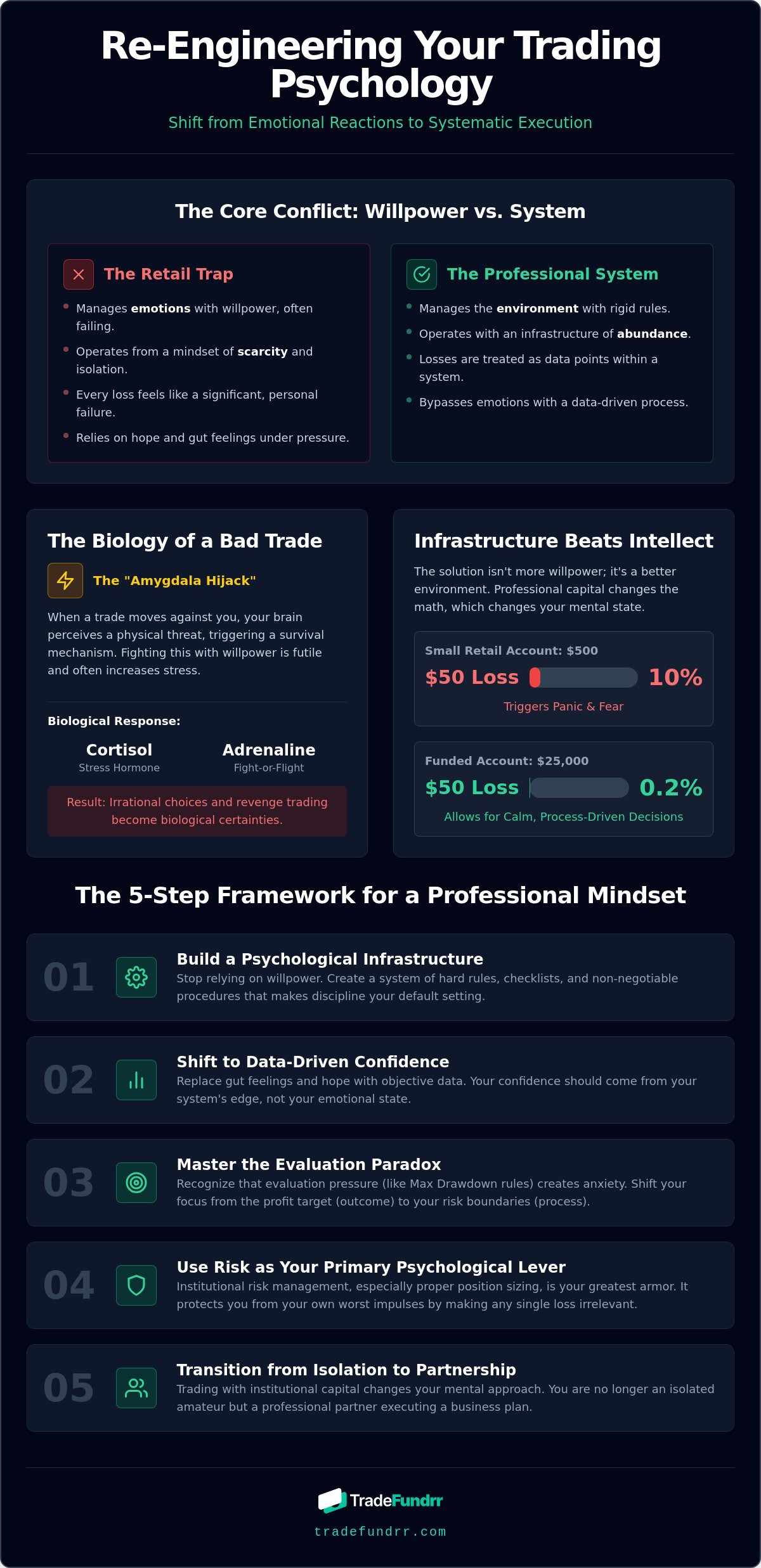
The Retail Trap is built on a foundation of scarcity and isolation. Amateurs try to manage their emotions while trading tiny accounts where every loss feels like a personal failure. They negotiate with stops and hope for reversals. This is a losing battle. Professional desks take a different route. They use rigid rules to bypass the human brain entirely. The distinction is simple: amateurs manage emotions; professionals manage environments. By shifting the focus from your internal feelings to your external infrastructure, you remove the burden of willpower.
The Biology of the "Bad Trade"
When a trade moves against you, your brain doesn't see a fluctuating number on a screen. It sees a physical threat. This triggers an "amygdala hijack," a survival mechanism that floods your system with cortisol and adrenaline. Fighting this with willpower is like trying to stop your heart from beating faster while running. It doesn't work. In fact, "trying harder" actually increases your stress levels, making revenge trading a biological certainty. In the context of 2026's market volatility, cognitive bias usually appears as an irrational refusal to adapt to the new risk-based margin requirements that replaced the old PDT rules. This intersection of psychology and finance is a core pillar of Behavioral Economics, which proves that humans are hardwired to make irrational choices under pressure.
Infrastructure vs. Intellect
Your brain is a calculator. When you trade a $500 retail account, a $50 loss is 10% of your capital. That triggers panic. When you step into a $25,000 Funded Account Evaluation, the math changes instantly. You finally have the room to breathe. You can focus on the process because the individual trade no longer threatens your survival. This is how to improve trading psychology without spending years in therapy. You change the math.
Institutional-grade tools don't make you smarter; they make the right decision easier to execute. If you're still wondering what is a funded trading account, it's essentially the professional infrastructure you need to remove execution friction. Whether you're targeting a $50,000 or $100,000 evaluation, the goal is the same. You're replacing a fragile retail setup with a robust system that protects you from your own worst impulses. Infrastructure beats intellect every single time.
The Anatomy of Evaluation Anxiety: Why Challenges Feel Different
Retail traders often wonder how to improve trading psychology when they hit their first professional roadblock. The answer isn't a new indicator. It's an understanding of the Evaluation Paradox. The more you covet the buying power, the more likely you are to freeze at the entry. You aren't trading the market anymore. You're trading your own desperation. Learning how to improve trading psychology means recognizing that anxiety is a symptom of systemic pressure, not a personal flaw.
The "Max Drawdown" rule is the specific mechanism that breaks most amateurs. It creates a shrinking floor. As the price moves against you, the psychological weight doubles. You aren't just losing dollars. You're losing the opportunity. This is where the fear of failing a professional audition takes root. If you want to master this environment, you need a strategy for overcoming trading anxiety in evaluations that focuses on process over outcome. Amateurs focus on the profit target; professionals focus on the risk boundary.
The Video-Game Trap
Demo accounts are for testing mechanics. Evaluations are for testing discipline. Many traders fall into the video-game trap, treating the challenge like a video game. They think they're playing with "house money." They aren't. They're playing with their time and their reputation. Bridging this gap requires treating the evaluation as a formal business contract from day one. Forbes highlights that discipline and focus are essential 3 Ways to Be a Better Trader, and this starts the moment you open the platform. If you wouldn't do it with $1M in buying power, don't do it in the evaluation.
Recovering from a "Blow Up"
Hitting a drawdown limit isn't a failure. It's a diagnostic report. Most retail traders quit after a blow-up. Professionals reboot. If you've hit a limit, you've simply found where your system or your mindset cracked under pressure. Use that data to refine your approach before your next attempt. Knowing what to do after failing a prop firm challenge separates the hobbyists from the future pros. One failed audition is just a data point; a stopped career is the only real loss. If you're ready to stop gambling and start auditioning for serious buying power, consider a funded account evaluation as your next professional milestone.
5 Steps to Re-Engineering Your Trading Mindset
Willpower is a finite resource. Systems are not. If you want to know how to improve trading psychology, stop trying to fix your personality and start fixing your protocol. Professional performance isn't about being a "better person." It's about being a better architect of your own environment. These five steps move you from emotional reacting to systematic execution.
- Step 1: Quantify Your Edge. Confidence isn't a feeling; it's a statistic. If you haven't backtested your strategy over 100 trades, your anxiety is actually a rational response to a lack of data.
- Step 2: Define "The Worst Case." Pre-accept the loss before you click the mouse. If the dollar amount of a stop-out makes your heart race, your position size is too large for your current psychological infrastructure.
- Step 3: Implement Hard Stops. Your discipline should be automated, not debated. Use platform-level hard stops to enforce the exit you agreed to when you were calm.
- Step 4: The 24-Hour Rule. Big wins breed euphoria; big losses breed despair. Both are chemically identical to intoxication. Step away for 24 hours after a significant P&L event to reset your nervous system.
- Step 5: Audit the Process, Not the P&L. A "good" trade can lose money. A "bad" trade can make money. This is how to improve trading psychology through structural design rather than mental effort. Judge your day by how well you followed the rules, not the final balance.
The Power of the Trading Journal
A professional journal doesn't read like a diary. It reads like an autopsy. Move beyond vague entries like "I felt bad today" and focus on granular data. Did you deviate from your entry trigger by 3 ticks? Did you hesitate for 10 seconds? A structured approach to daily reviews focuses on identifying the specific technical triggers that lead to psychological lapses. By spotting these patterns early, you can build rules to bypass them before they cost you an evaluation.
Visualizing Professional Execution
Visualization isn't about manifesting profits. It's about rehearsing reactions. Institutional traders "pre-play" their trades in their heads, specifically focusing on how they will react if the trade hits their stop. This builds the "Quiet Confidence" of a TradeFundrr partner. As noted in Forbes on Mastering Your Trading Psychology, this level of cognitive preparation turns high-stress moments into routine tasks. You don't rise to the level of your goals; you fall to the level of your systems.
Risk Management: The Ultimate Psychological Armor
Risk management isn't a technical chore. It's your mental health insurance. Most traders asking how to improve trading psychology are actually asking how to stop the physical symptoms of stress. They want the racing heart and the sweaty palms to disappear. You can't wish those away. You have to size them away. Position sizing is the primary lever of your psychology. If a single loss makes you feel sick, you aren't a bad trader; you're just oversized. It's that simple.
Institutional rules exist to protect the account, but they also protect the trader. Amateurs view rules as restrictions. Professionals view them as guardrails. When you trade within a $50,000 or $100,000 evaluation, the drawdown limits act as a cage for your inner retail gambler. They prevent you from making the "one big mistake" that ends a career. By aligning your execution with Mastering Prop Firm Risk Management Rules, you delegate your discipline to the system. You stop negotiating with yourself because the rules have already settled the debate.
The Math of Certainty
Fear thrives in the unknown. When you don't have a daily loss limit, your potential downside is infinite. That uncertainty paralyzes the brain. Knowing your "Max Loss per Day" eliminates the existential threat of a bad session. You know exactly when the day ends. You know the cost of being wrong. TradeFundrr's infrastructure enforces this discipline through automated liquidation and hard stops. We provide the structural integrity that most retail setups lack. This allows you to focus entirely on the chart because the "disaster scenario" is already mathematically capped.
Trailing Drawdown and Mental Flexibility
The trailing drawdown is the ultimate test of mental flexibility. It requires you to protect your gains as aggressively as you protect your starting balance. Amateurs get frustrated when the floor moves up. Professionals adapt. They understand that as the account grows, the responsibility grows with it. This is how to improve trading psychology in a professional environment. You stop fighting the parameters and start using them to sharpen your exits. If you're tired of the retail roller coaster and want to trade with a professional partner, start your funded account evaluation today and put these professional guardrails to work.
The TradeFundrr Environment: Building a Professional Future
Trading is often sold as a solo pursuit. This is the first lie of the retail industry. In the professional world, no one trades in a vacuum. If you're still searching for how to improve trading psychology, you need to look at who you're standing with. Isolation breeds anxiety. Partnership breeds performance. TradeFundrr isn't a retail broker. We're an institutional gateway. We provide the same stability used by professional desks.
The retail grind is a cycle of small accounts and high stress. The institutional path is a progression of increasing buying power and decreasing friction. By removing the burden of personal risk and replacing it with professional buying power, the psychological math changes. You stop worrying about your rent and start focusing on your edge. This is how to improve trading psychology at the source. You change the stakes. You move from a position of weakness to a position of institutional strength.
Human Support in a Digital Market
Most prop firms hide behind automated bots and "support tickets" that lead nowhere. We don't. Professional trading requires real human connection. When you hit a technical snag or a psychological wall, you don't need a script. You need an insider. This human element reduces the isolation that often leads to emotional spirals. We succeed when you succeed. That's not a marketing slogan; it's our business model. Providing institutional-grade stability to retail practitioners means giving you the tools, the buying power, and the team to execute at a high level.
Scaling to $1M+
Trading a $25,000 Funded Account Evaluation is your audition. Trading the $1M+ Scaling Path is your career. The psychological shift required to manage seven figures is massive, but you don't have to make it alone. Professional trading requires a commitment to rigorous training and institutional standards. We support your growth through every stage of the progression. As you prove your discipline, we provide the scale.
- Phase 1: Prove your process in the $50,000 or $100,000 evaluation.
- Phase 2: Master consistency with weekly payouts and professional oversight.
- Phase 3: Scale into institutional-grade buying power where your talent meets our resources.
The 2026 removal of the Pattern Day Trader rule has opened the doors for more traders, but it hasn't removed the need for professional discipline. Stop fighting your own biology with inadequate tools. Use a written review process to sharpen your execution and step into an environment designed for your success. Stop the retail struggle. Select your evaluation level today and start building your professional future with a partner that respects your skill.
Secure Your Professional Edge
Psychology isn't a character trait. It's a system choice. You've seen why willpower fails and why institutional risk rules act as your ultimate armor. Most traders fail because they fight their biology in a retail environment designed for loss. Professionals succeed because they trade within a structure that makes emotional deviation impossible. Understanding how to improve trading psychology requires a final shift from gut feelings to data-driven execution.
Stop trying to "think" your way out of fear. Use the infrastructure we've built to protect your capital and your mental health. With institutional-grade infrastructure, weekly payouts for funded traders, and real human support for every evaluation, we provide the stability you need to focus on the tape. We've removed the barriers; you just need to provide the talent. Your skill deserves a professional environment. It's time to stop the retail grind and start your institutional journey today.
Join the $25,000 Evaluation and Start Your Professional Path
Frequently Asked Questions
How can I stop revenge trading after a big loss?
Stop revenge trading by implementing a mandatory "cool-off" period after any loss exceeding your daily risk limit. Retail traders try to win it back immediately; professionals walk away to reset their nervous system. If you can't walk away on your own, use platform-level locks to force the break. Revenge trading is a biological response to a perceived threat. You can't think your way out of it. You have to lock the door.
Why do I freeze when it is time to enter a high-probability trade?
You freeze because your brain perceives the risk of being wrong as a threat to your survival. This is the Evaluation Paradox in action. To overcome this, shift your focus from the dollar outcome to the technical trigger. If the conditions of your edge are met, the trade is a mathematical necessity, not a choice. Pre-defining your exit before you enter removes the weight of the decision.
Can trading psychology be learned, or is it an innate trait?
Trading psychology is a learned skill built through systematic exposure and professional infrastructure. It isn't a personality trait you're born with. Most people asking how to improve trading psychology are actually looking for a way to manage their environment. By adopting institutional-grade rules and trading with significant buying power, you train your brain to prioritize process over emotion. Discipline is a muscle developed through repetition.
How does a funded account help improve my trading discipline?
A funded account improves discipline by providing a rigid framework of rules that you must follow to keep your account. These aren't restrictions; they're guardrails. When you trade a $50,000 or $100,000 evaluation, the max drawdown and daily loss limits force you to act like a professional. You learn how to improve trading psychology by operating in an environment where the cost of a mistake is a failed audition, not total financial ruin.
What is the best way to handle the pressure of a prop firm evaluation?
Handle evaluation pressure by treating the challenge as a professional audition rather than a gamble. Focus entirely on execution quality instead of the profit target. When you obsess over the finish line, you lose sight of the current candle. Trade at a size that allows you to remain calm during normal drawdowns. If the pressure is too high, your position size is likely too large for your current mindset.
How do I stop closing my winning trades too early?
Stop closing winners early by using "set and forget" targets or automated trailing stops. Fear of giving back gains is just as destructive as fear of loss. It stems from a scarcity mindset. Trust the data of your backtest. If your system requires a 2:1 reward-to-risk ratio to be profitable, closing at 1:1 is a mathematical error. Let the system work so your feelings don't have to.
What should I do if I keep hitting my daily drawdown limit?
If you keep hitting your daily drawdown limit, stop trading for at least 48 hours to conduct a full audit of your execution. You're either trading a strategy that doesn't fit the current market volatility or you're deviating from your plan. Use your trading journal to identify if these losses are technical or psychological. Pushing through a losing streak usually leads to a blown account. Reset first.
Build discipline into the system
Practice a rules-based process in a structured, simulated environment with clear risk limits.
Get Funded →