
Overcoming Trading Anxiety in Evaluations: The Professional Checklist
 July 9, 2026
14 min read
July 9, 2026
14 min read

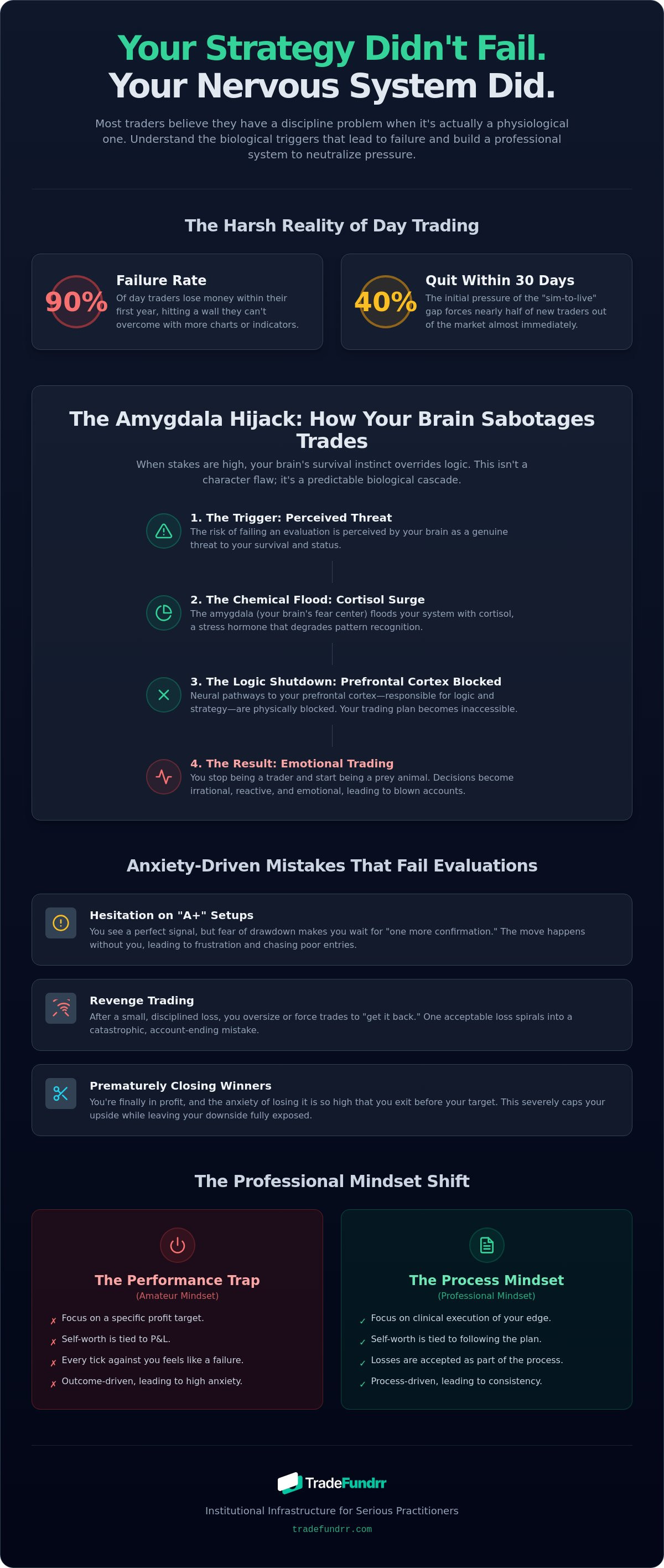
Your strategy didn't fail you; your nervous system did. Most traders believe they have a discipline problem when they actually have a structural one. It's a hard truth. Data shows that 90% of day traders lose money within their first year, and 40% quit within the first thirty days. These traders aren't failing because they lack charts or indicators. They're failing because they can't bridge the gap between a simulation and a high stakes environment.
We understand the frustration of performance paralysis. You know your risk rules, yet you watch yourself break them anyway. Overcoming trading anxiety in evaluations isn't about willpower. It's about engineering a professional environment where emotion is secondary to execution. This guide provides the psychological infrastructure you need to neutralize pressure and avoid the common mistakes that kill accounts before they even get started.
You'll learn how to identify the physiological roots of your anxiety and implement a repeatable system for professional discipline. We're moving past the demo-to-evaluation gap. It's time to pass your evaluation without the emotional exhaustion that usually follows. This is the professional path to getting funded.
Key Takeaways
- Understand that trading anxiety is a physiological response, not a personality flaw. Learn how to stop the Amygdala Hijack before it wipes your account.
- Shift your perspective on drawdown rules from hurdles to psychological safety nets. Professional infrastructure turns high-pressure rules into manageable risk protocols.
- Implement a repeatable checklist for overcoming trading anxiety in evaluations. Use physical state audits and fixed risk protocols to maintain discipline during active trades.
- Bridge the gap between practice and a funded account with institutional-grade tools. Move past the "Funding Trap" by using systems designed for consistency rather than luck.
- Learn why human-centric support beats bot-driven prop firms for serious practitioners. Real infrastructure provides the stability you need to scale toward $1M+ in buying power.
The Evaluation Wall: Why Anxiety Triggers Trading Mistakes
Trading anxiety isn't a personality flaw. It is a physiological cascade. When you enter an evaluation, your brain perceives the risk of failure as a threat to your survival. This triggers a "fight or flight" response. Your heart rate climbs. Your vision narrows. Your prefrontal cortex, the part of your brain responsible for logic and strategy, starts to shut down. Logic dies. Emotion takes the wheel. This is the wall. Most traders hit it and stop.
This internal friction is the foundation of behavioural finance. It explains why smart people make irrational choices under pressure. In your own retail account, you're the master of your domain. In a funded account evaluation, you're an applicant. The power dynamic shifts. You aren't just trading an account; you're trading for a future. The shift from "trading for profit" to "trading to pass" changes your psychology. It introduces a ticking clock that doesn't exist in your personal brokerage account.
Anxiety is a signal, not a weakness. Professionals interpret this signal as a warning that their focus has shifted from the chart to the dashboard. Overcoming trading anxiety in evaluations starts with recognizing that your body is trying to protect you from a perceived loss of status. It's about engineering a system where that signal doesn't lead to a blown account.
The Performance Trap vs. The Process Mindset
Focusing on a specific profit target is the fastest way to fail. That number is a distraction. It creates a "performance trap" where every tick against you feels like a personal failure. Institutional traders don't trade for a specific dollar amount today. They trade to execute their edge with clinical precision. It's about execution, not outcome. Stop looking at the equity curve. Start looking at your execution quality. Your self-worth isn't tied to the "Pass" or "Fail" status on a dashboard. It's tied to your ability to follow the plan when the pressure is on.
Anxiety-Driven Trading Mistakes That Fail Evaluations
Anxiety manifests in three specific ways that destroy evaluation accounts. These aren't strategy errors; they're emotional ones:
- Hesitation on "A+" setups. You see the signal. You know the edge is there. But fear of drawdown makes you wait for "one more confirmation." The move happens without you, leaving you frustrated and prone to chasing.
- Revenge trading. You take a small loss. To "get back to breakeven" before the session ends, you size up or force a trade. One disciplined loss becomes a catastrophic mistake.
- Prematurely closing winners. You're finally green. The anxiety of losing that small gain is so high that you exit before the target. You've capped your upside while keeping your downside wide.
Overcoming trading anxiety in evaluations requires moving past these reactive patterns. You need a checklist that keeps you grounded when the market moves against you.
The Physiology of a Failed Evaluation
When your account equity hits 50% of your maximum drawdown, something shifts in your biology. It isn't just stress; it's a chemical flood. Your brain enters a state known as the Amygdala Hijack. In this moment, the neural pathways to your prefrontal cortex are physically blocked. Your logical trading plan doesn't just feel difficult to follow; it becomes inaccessible. You stop being a trader and start being a prey animal trying to survive a perceived threat.
This biological response is fueled by cortisol. While a small amount of stress can sharpen focus, an evaluation environment often pushes levels into the red. High cortisol levels degrade your pattern recognition. You start seeing setups that aren't there, or worse, you miss the obvious ones because your decision-making speed has stalled. Overcoming trading anxiety in evaluations requires you to build a biological circuit breaker. This is a pre-set physical routine that forces your nervous system to downshift before you click the mouse. Professionals don't rely on willpower; they rely on chemistry.
The Demo-to-Evaluation Gap
Demo trading is a sterile environment. It teaches you the mechanics of the platform but fails to prepare you for the emotional weight of real skin in the game. This creates an illusion of competence. Many "demo gods" find themselves paralyzed when they transition to a 25k funded account challenge. The strategy is the same, but the stakes have changed. Bridging this gap isn't about more practice hours; it's about incremental risk exposure. You must train your brain to handle the physiological "noise" of a paid evaluation by treating every sim session with the same structural rigor as a live account.
Institutional Discipline vs. Retail Gambling
Professional floor traders at firms like T3 Global don't trade in a vacuum. They operate within a cage of institutional rules that prevent emotional meltdowns. When a pro hits a losing streak, they don't double down. They walk away. Retail traders often do the opposite, spiraling into hope-based strategies. The difference is the infrastructure. Professional environments provide "Real Human Support" to de-escalate stress before it turns into a blown account. This human connection acts as an external prefrontal cortex, keeping you grounded when your own biology is screaming for a fight. If you're ready to move from retail gambling to evidence-based protocols, consider starting with a 50,000 Funded Account Evaluation to test your systems in a professional framework.
Institutional discipline is about removing the burden of choice during high-stress moments. You don't decide to stop; the system stops you. This shift from internal willpower to external infrastructure is what separates the funded from the frustrated.
Analyzing the "Funding Trap": Rules vs. Reality
Most traders view evaluation rules as barriers. They aren't. They are filters. A trailing drawdown isn't designed to steal your fee; it's designed to measure your emotional elasticity. Retail prop firms often rely on a "churn" model where failure is the product. Institutional funding paths operate differently. We want you to pass because we want the talent. Professional firms reward your success; retail firms profit from your reset fees.
Think of the Daily Loss Limit as a safety net. It isn't a hurdle. It's a hard stop that prevents a bad afternoon from becoming a career-ending event. Overcoming trading anxiety in evaluations requires accepting these boundaries as allies. When you know the system will cut you off before you can do permanent damage, the pressure to be perfect disappears. Transparency in the payout structure further reduces the "shadow anxiety" of wondering if the firm will honor your profits. Real infrastructure provides real clarity.
The Drawdown Dilemma
When equity nears the limit, the "all or nothing" fallacy kicks in. You feel a sudden urge to over-leverage. It's a psychological escape hatch. Burning an account feels easier than the slow, disciplined grind of recovery. This is where the amateur quits and the professional resets. If you've already crossed that line, you must learn what to do after failing a prop firm challenge. Recovery isn't about one big trade. It's about returning to the process and accepting that equity fluctuates. The goal is to stay in the game, not to win it all by noon.
Time Pressure and the Evaluation Clock
The "30-day pass" is a marketing gimmick. It forces rushed decisions and leads to sloppy execution. Rushing is the primary driver of evaluation anxiety. At TradeFundrr, we prioritize consistency over luck. Our rule is specific: no single trading day can account for more than 30% of your total profits. This removes the pressure to hit a "home run." It encourages a steady, professional pace. By removing the artificial deadline, overcoming trading anxiety in evaluations becomes a matter of statistics rather than desperation. You aren't fighting a clock. You're executing an edge.
The Checklist: 5 Protocols to Overcome Trading Anxiety
Theory is useless without execution. You know the biology. You understand the rules. Now you need the hardware. Overcoming trading anxiety in evaluations is a matter of replacing erratic decisions with a standardized operating procedure. Professionals don't "feel" their way through a session. They follow a checklist. If the checklist isn't met, the trade doesn't happen. It's that simple.
- Protocol 1: The Pre-Flight Risk Check. Never trade a dollar amount. Trade an R-multiple. By fixing your risk at a constant percentage or dollar value per trade, you turn every outcome into a data point. One loss is just 1R. It isn't a disaster; it's the cost of doing business.
- Protocol 2: The Physical State Audit. Check your pulse. Monitor your breath. If your breathing is shallow or your heart is racing before you enter, you're already compromised. Step back. Reset your nervous system before you touch the keys.
- Protocol 3: The "Walk-Away" Trigger. Define your limit. If you hit two or three consecutive losses, the day is over. This isn't a suggestion; it's a hard stop. The market will be there tomorrow. Your account might not be if you spiral.
- Protocol 4: The Evaluation Journal. Track more than price. Record your emotional state at entry, during the hold, and at exit. You'll soon see patterns where anxiety leads to poor execution. Numbers don't lie, but your memory will.
- Protocol 5: The Post-Trade De-Brief. Grade your execution quality. Did you follow the plan? If you followed the plan and lost, that's a "good" trade. If you broke the plan and won, that's a "bad" trade. Reward the process, not the PnL.
If you're ready to put these protocols into practice with institutional-grade stability, start your $100,000 Funded Account Evaluation today and trade like a professional.
Implementing the Pre-Trade Protocol
Institutional discipline is a choice you make before the bell rings. You must define your "Stop Trading" criteria before you see a single candle. Visualize the loss. Ask yourself: if this trade hits my stop, am I still within my plan? If the answer is no, the size is too big. Your environment must match your goals. Clear the distractions. Silence the phone. Overcoming trading anxiety in evaluations requires a workspace that signals professional intent, not retail chaos.
Mid-Trade Management for High-Stress Moments
Meddling is the enemy of the edge. Once the trade is live, the "Hands-Off" rule applies. Most mid-trade adjustments are fear-based responses to noise. Use hard stops and hard targets to remove decision fatigue. If you're constantly moving your stop to breakeven too early, you're suffocating your edge. Learn to distinguish "Microstructure Signals" from simple market noise. If the trend hasn't changed, your position shouldn't either. Set the trade. Trust the math. Walk away from the screen if you have to.
Institutional Infrastructure: The TradeFundrr Solution
Anxiety thrives in isolation. Most prop firms are digital ghost towns run by bots and automated help desks. When your account is at risk and your heart rate is climbing, a chatbot cannot help you find your center. We provide real human support because we understand the stakes. This isn't about hand-holding; it's about institutional-grade stability. Having a seasoned pro in your corner is the ultimate tool for overcoming trading anxiety in evaluations. It turns a lonely gamble into a professional partnership. You provide the talent; we provide the backbone.
We don't just give you a login. We give you an ecosystem. You get access to professional trading infrastructure across stocks, options, and futures. This is a professional-grade environment, not a stripped-down retail platform. To guide your journey, we publish our risk rules in advance. They are your blueprint for professional risk management. They are not a collection of "secret indicators" or "get rich quick" schemes. They are a structural guide to surviving the markets. By providing the architecture, we allow you to focus entirely on your execution. We remove the mechanical barriers so you can master the psychological ones.
The goal is a long-term professional career, not a single payout. Overcoming trading anxiety in evaluations requires you to stop viewing the challenge as a test and start viewing it as an audition. Professional firms want you to succeed because your success is our success. We succeed when you are consistent, not when you fail. This alignment of interests is the foundation of institutional funding.
Beyond the Evaluation: Scaling to $1M+
Passing the challenge is just the entry fee. Professional firms don't look for "one-hit wonders" who got lucky on a single volatile session. They look for repeatable edges. The path from a funded stock trading account to our $1M+ Scaling Path is paved with disciplined execution. We use weekly payouts as a psychological reward for that discipline. It reinforces the right behaviors. It proves that your process has tangible value. This shift in perspective is the final step in mastering your mindset. You aren't fighting for a "pass" anymore; you're building a scalable business.
Join a Community of Professional Traders
You aren't on your own here. Our partnership with T3 Global provides a level of legitimacy and resource access that retail-only firms simply can't match. We value radical honesty in our community. If you blow an account, we analyze the "why" with clinical precision. We don't hide behind fine print or aggressive marketing. We provide the path, the buying power, and the community. The rest is up to you. If you're ready to stop gambling and start performing like an insider, the next step is clear. Apply for your evaluation challenge today and join the ranks of the funded.
Take Command of Your Trading Future
Anxiety isn't a character flaw; it's a signal that your environment lacks structure. You've seen the biological reality of the amygdala hijack and why the "funding trap" exists. Now you have the protocols to dismantle it. Overcoming trading anxiety in evaluations requires a decisive shift from retail hope to institutional rigor. You don't need more luck. You need a better system.
We provide institutional-grade infrastructure and the real human support that automated bots can't replicate. Our funded traders benefit from weekly payouts that reward consistent discipline over reckless gambling. It's time to stop fighting your own biology and start leveraging professional tools designed for the long game. You don't have to navigate this pressure alone.
Start Your Evaluation and Master Your Psychology
The path to professional buying power is open. We provide the stability and the resources you need to succeed. You provide the execution and the talent. The market is moving. It's time to trade like you belong here.
Frequently Asked Questions
Is trading anxiety normal during a prop firm evaluation?
Trading anxiety is a standard physiological response to financial risk. It's not a sign of weakness; it's a sign of a functioning nervous system. Most retail traders fail because they try to suppress this feeling instead of building a system to contain it. Institutional traders accept the adrenaline and use hard rules to keep it from affecting execution. You don't eliminate the feeling; you out-structure it.
How do I stop revenge trading after a loss in my funded account?
Stop revenge trading by implementing a mandatory "Stop Trading" limit for the day. Once you reach two or three consecutive losses, your session is over. Revenge trading is a biological drive to recover lost status. You can't out-think it in the heat of the moment. You must remove the opportunity to trade before the emotional spiral starts. Professionalism is knowing when to walk away.
What is the best way to manage a trailing drawdown without getting anxious?
Manage a trailing drawdown by focusing on your risk-to-reward ratio rather than your equity curve. Treat the drawdown limit as a fixed floor that never moves. When you stop obsessing over the "ticking" nature of the rule and focus on executing 1R or 2R trades, the anxiety of the boundary fades. Overcoming trading anxiety in evaluations requires shifting your focus from the dashboard back to the chart.
Can I use automated trading bots to help with my evaluation anxiety?
TradeFundrr does not offer or endorse automated trading bots for evaluations. Relying on a bot to bypass anxiety is a temporary fix for a structural problem. It prevents you from developing the psychological infrastructure required for institutional-grade buying power. True professional growth comes from mastering your own execution within a supported framework, not delegating your edge to a script. We value human skill over algorithms.
Why do I trade better on demo than in a paid evaluation?
You trade better on demo because there is no consequence for failure. Demo trading lacks the skin in the game that triggers the amygdala hijack. In a paid evaluation, your brain perceives the fee and the potential funding as survival-level stakes. Overcoming trading anxiety in evaluations requires treating the demo with the same clinical rigor you would apply to a live account. Practice how you play.
How does TradeFundrr support traders struggling with psychology?
We provide real human support and institutional-grade infrastructure to help you stay grounded. Unlike bot-driven firms, our team understands the psychological toll of the markets. We provide a clear structure, giving you access to professional risk management tools and limits published in advance. This human connection acts as an external prefrontal cortex when your own biology is under pressure.
What happens if I fail my evaluation due to an emotional mistake?
If you fail, you treat it as a clinical data point rather than a personal defeat. Most traders who fail due to emotional mistakes do so because they lack a repeatable system. You can reset and try again, but only after you've identified the specific trigger that led to the breach. Radical honesty about your mistakes is the only way to eventually reach the $1M+ Scaling Path.
Does having a larger account size reduce trading anxiety?
A larger account size, like a $100,000 Funded Account Evaluation, can actually increase anxiety if your psychological infrastructure isn't ready. The dollar amounts are higher, which can amplify the fear of loss. You should trade the size that matches your current emotional elasticity. Professionalism isn't about the size of the account; it's about the consistency of the execution across any account size. Master the process first.
Trade with structure, not adrenaline
Practice a calm, checklist-driven process in a structured, simulated environment.
Get Funded →