
What to Do After Failing a Prop Firm Challenge: The Professional Path Forward
 July 8, 2026
13 min read
July 8, 2026
13 min read

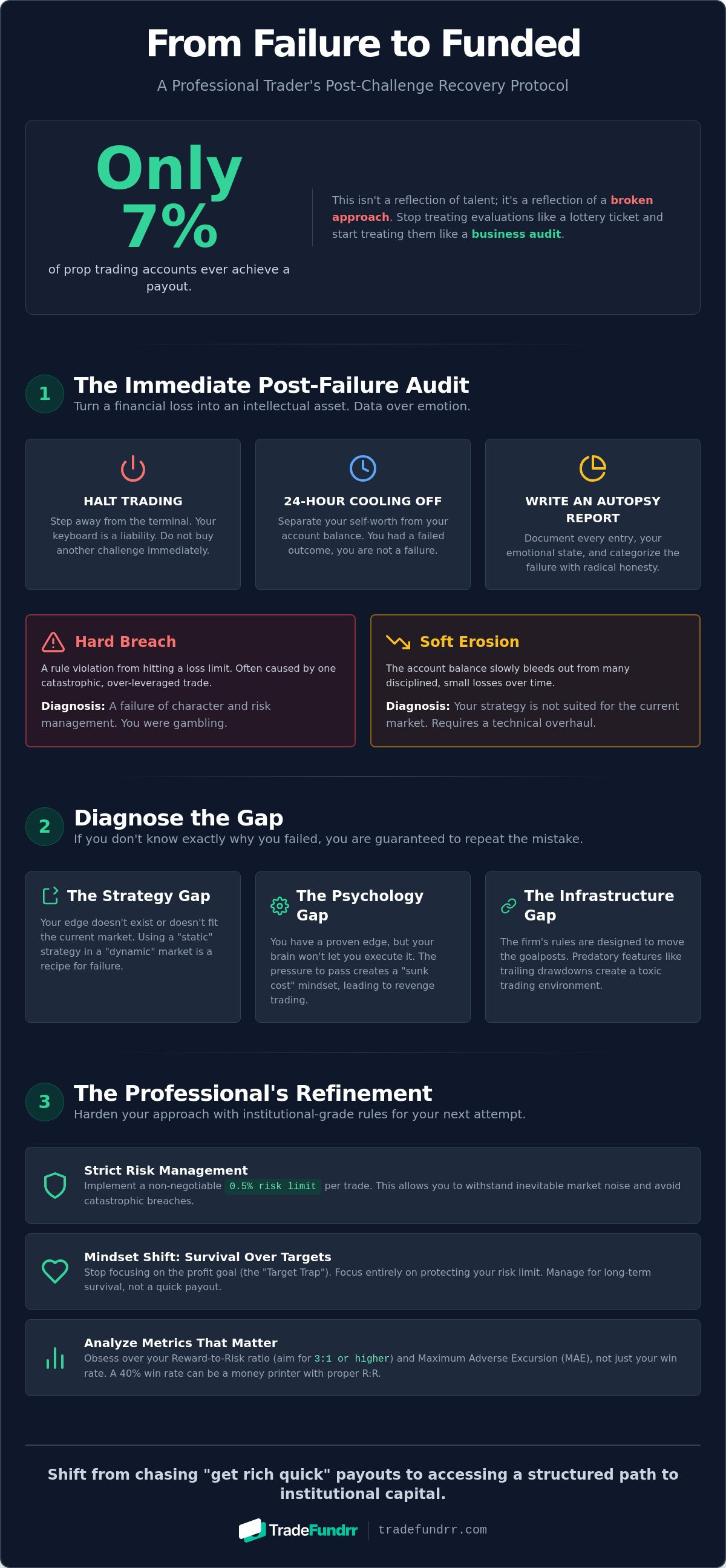
Only 7% of 300,000 prop trading accounts ever achieve an actual payout. That isn't a reflection of your talent; it's a reflection of a broken approach. Most traders treat evaluations like a lottery ticket instead of a business audit. You've felt the sting of a blown account, the loss of your evaluation fee, and the confusion of complex drawdown rules that seem designed to catch you out. It's a cycle of frustration that ends today.
Knowing exactly what to do after failing a prop firm challenge is the difference between a retail gambler and an institutional practitioner. We're moving past the bruised ego and the "get rich quick" mentality. This guide provides a concrete plan to transform your failure into an institutional-grade strategy. We'll show you how to manage drawdown professionally and transition from the evaluation to a funded account. Stop trading for targets. Start managing for survival.
Key Takeaways
- Halt the emotional spiral by stepping away from the terminal and conducting a cold, data-driven audit of your trade logs.
- Master exactly what to do after failing a prop firm challenge by diagnosing whether the gap lies in your strategy or your psychological execution.
- Spot predatory firm rules like trailing drawdowns that are designed to move the goalposts and keep you trapped in the evaluation cycle.
- Harden your approach with a professional refinement process, including a strict 0.5% risk limit to withstand inevitable market noise.
- Shift your focus toward long-term growth by accessing a structured path to institutional-grade buying power rather than chasing "get rich quick" payouts.
The Immediate Post-Failure Audit: Data Over Emotion
Stop. Step away from the terminal. The most critical step in knowing what to do after failing a prop firm challenge is recognizing that your keyboard is currently a liability. Most retail traders fail and immediately reach for their credit card. They want redemption. They get more debt instead. A professional treats a failed evaluation like a failed product launch. You don't double down on a flawed prototype. You audit the data. You find the leak. You fix the structure before you ever risk another dollar. The goal of this audit is simple: turn a financial loss into an intellectual asset.
Hard Breaches vs. Strategy Failure
You need to categorize your failure with radical honesty. Was it a "Hard Breach" or a "Soft Erosion"? A hard breach is a rule violation. You hit a daily loss limit or a max drawdown cap. Analyze the trade logs. Did one catastrophic trade kill the account, or did twenty disciplined losses add up? If you blew the account in a single afternoon, your risk per trade was too high for the volatility. You weren't trading; you were gambling. This is a failure of character, not a failure of edge.
In the professional world of Proprietary Trading, firms provide the buying power while you provide the discipline. If your strategy works in backtesting but fails in the evaluation, you likely suffered from "Gambler Creep." This happens when your rules become suggestions because of the pressure to hit a target. A soft erosion, however, suggests your strategy isn't suited for the current market regime. One requires a mindset shift; the other requires a technical overhaul. Know which one you're dealing with before you try again.
The 24-Hour Cooling Off Protocol
The "buy again" button is your greatest enemy after a loss. It promises a quick fix for a bruised ego. It's a trap. Professionals implement a mandatory 24-hour cooling off period. During this time, your only job is to separate your self-worth from your account balance. You aren't a failure; you simply had a failed outcome. Use these hours to write a formal Autopsy Report. Document every entry that led to the breach. Note your emotional state. Were you tired? Angry? Desperate? If you can't explain the failure in cold, mathematical terms, you aren't ready for the next account. When you understand what to do after failing a prop firm challenge, you stop chasing payouts and start building a career.
Diagnosing the Gap: Why You Actually Failed
You have the data from your audit. Now you need a diagnosis. Retail traders blame "market manipulation" or bad luck when they lose. Professionals blame the process. Determining what to do after failing a prop firm challenge requires identifying which specific gap led to the breach. If you don't know why you failed, you're guaranteed to repeat the mistake. Most failures fall into three categories: strategy, psychology, or infrastructure. You must be clinical in your assessment.
The Strategy Gap is simple: your edge doesn't exist or doesn't fit the current market. Many traders use "static" strategies in "dynamic" markets. If your system relies on mean reversion during a parabolic trend, you will hit your drawdown limit every time. The Psychology Gap is more common. You have a proven edge, but your brain won't let you execute it. The pressure of the evaluation fee creates a "sunk cost" mindset. Research on how trading impacts psychology shows that our actions and our mindset are a two-way street. If your execution is sloppy, your confidence erodes, leading to more sloppy execution.
Finally, there is the Infrastructure Gap. Many firms design rules like trailing drawdowns to move the goalposts mid-trade. If you are fighting high commissions and artificial slippage on top of that, your strategy might be fine while your environment is toxic. You might just need a professional funding partner that aligns with your growth rather than your failure.
The Psychology of the Evaluation Environment
The "Target Trap" is the primary killer of accounts. You focus on the 8% profit goal instead of the 5% risk limit. You start "trading to pass" rather than trading for profit. This shift in focus leads to over-leveraging and revenge trading. To fix this, you must simulate evaluation pressure in a demo environment. Set a real-world penalty for failing a demo session. If you can't follow rules when nothing is on the line, you'll never follow them during a challenge.
Technical Metrics That Matter
Stop obsessing over win rates. A 40% win rate with a 3:1 reward-to-risk ratio is an institutional money printer. Analyze your Maximum Adverse Excursion (MAE). This metric tracks how far a trade goes against you before it turns profitable. If your MAE is consistently near your stop loss, your entries are late or your stops are too tight. Refine the math behind the blowout. If your average loser is larger than your average winner, you don't have a strategy; you have a countdown to zero.
Escaping the Churn Trap: Is the Firm the Problem?
You've audited your trades. You've checked your psychology. But what if the game was rigged before you placed the first order? Part of knowing what to do after failing a prop firm challenge is evaluating your partner. Many firms operate on a "churn and burn" model. They don't want you to succeed; they want your evaluation fee. Research shows that only 7% of 300,000 prop trading accounts ever achieve an actual payout. The business model relies on the other 93% failing. If your firm provides a flashy dashboard but zero path to real payouts, you aren't a trader. You're a customer.
The most predatory tool in the retail space is the trailing drawdown. It moves the goalposts mid-trade. You make a profit, and your drawdown limit follows you up. You hit a small dip, and you're out. This isn't how institutional risk management works. Real firms care about your total equity and your ability to manage a drawdown, not how close you are to an arbitrary, moving line. Professional infrastructure provides stability; retail gadgets provide obstacles. Industry data suggests that 90% of free prop firms have hidden costs or required deposits before payouts. If the rules feel designed to make you fail, they probably are.
Gamified Rules vs. Institutional Reality
Institutional trading is about longevity. Retail challenges are about speed. Time limits are the first red flag. No real fund manager is forced to hit a specific percentage in thirty days or lose their job. It's an artificial constraint designed to force over-leverage. Consistency rules are the second trap. These are often used as a "gotcha" to deny payouts after you've already done the hard work. When deciding what to do after failing a prop firm challenge, look for a firm that values your skill over your ability to navigate a complex rulebook. Transition to a partner that prioritizes your survival over your speed.
The Value of Human Support
Serious traders need serious infrastructure. If your firm's support is a bot that recites a FAQ, they aren't your partner. They are your gatekeeper. A real partner helps you navigate a drawdown. They provide feedback instead of just closing your account. Understanding The Value of Human Support in Proprietary Trading is vital for your long-term success. Don't settle for an environment that profits from your mistakes. Find a firm that treats you like a professional practitioner and provides the human connection necessary for high-level performance.
The Professional Refinement: 5 Steps to Your Next Challenge
Building a professional trading plan isn't about finding a new indicator. It's about building an architecture that survives your worst days. When considering what to do after failing a prop firm challenge, your focus must shift from "passing" to "performing." Professionals don't guess. They verify. They don't gamble. They manage. If you want to stop the cycle of failed evaluations, you must move from a retail mindset to an institutional one. This requires a systematic refinement of your entire process.
- Step 1: Re-validate your edge. Execute a minimum of 100 backtested trades in current market conditions. If the math doesn't work on paper, it won't work in the evaluation.
- Step 2: Fix your risk-per-trade. Set your risk at 0.5% or less. This allows you to withstand the statistical noise of a losing streak without breaching drawdown limits.
- Step 3: Build a Rules Checklist. Create a physical list of criteria that must be met before every execution. Sign it off. No exceptions.
- Step 4: Practice Defensive Trading. Prioritize capital preservation over profit targets. Survival is the only way to reach the payout phase.
- Step 5: Match the challenge size to your psychology. Don't buy a $100,000 account if a $500 loss makes you panic. Start where you are comfortable.
If you're ready to apply these professional standards to a structured environment, explore our $50,000 Funded Account Evaluation and start your path to getting funded.
Refining Your Risk Management
Retailers focus on the upside. Professionals focus on the math of recovery. A 5% loss requires a 5.26% gain to break even. A 10% loss requires an 11.1% gain. The deeper the hole, the harder it is to climb out. You must implement "Soft Stops" to reduce size during a slump and "Hard Stops" to protect your daily limit. Understanding prop firm risk management rules is the first step toward building a resilient account. You aren't just trading price; you're trading the rules of the firm.
Psychological Hardening
Your brain is your greatest asset or your biggest liability. Use a written pre-trade routine to master the discipline required for high-level execution. Develop a "Pre-Flight" routine to ensure emotional neutrality before you ever touch the charts. Your trading journal must track your emotional state alongside your entry price. If you were angry or tired during a loss, that's a data point. Knowing exactly what to do after failing a prop firm challenge means fixing the human behind the screen as much as the strategy on it.
Transitioning to a Funded Account with TradeFundrr
You've audited the data. You've hardened your psychology. Now you need a partner that doesn't profit from your failure. Most firms want you to fail. We want you to trade. Understanding what to do after failing a prop firm challenge involves shifting your environment from a casino to an institution. TradeFundrr isn't a "challenge" site. It's a funding gatekeeper. We provide the infrastructure. You provide the talent.
We offer a structured path that moves you from retail evaluations to a funded account. Our systems are built for practitioners, not gamblers. We provide weekly payouts because professionals deserve to be paid for their performance, not made to wait for arbitrary milestones. We offer real human support because markets are complex and bots don't understand the nuances of a drawdown. This is institutional-grade stability. You're moving beyond the retail cycle. You're building a career with a partner that values longevity over high-frequency turnover.
The $25,000 Entry Point
Don't let the size fool you. This isn't a toy account. It's a professional entry point. Most traders fail because they start too big. They can't handle the heat of a larger balance, so they crack under the pressure. The $25, 000 Funded Account Challenge is your proving ground. It's where you harden your rules and demonstrate that you can manage risk under pressure without risking your life savings. It's the first step on a ladder that leads to significant buying power.
The Path to $1M+
Consistency is rewarded with scale. We don't just give you an account and hope you blow it. We partner with you for the long term. As your performance matures, your buying power grows. This is the ultimate answer to what to do after failing a prop firm challenge: find a firm that scales with you. Our $1M+ scaling path is designed for those who have mastered their edge and their emotions. Stop being a customer for firms that sell hope. Become a practitioner for a firm that provides real payouts. Apply for an evaluation today and leave the retail trap behind.
Build Your Career on Institutional Foundations
Failure isn't the end of your career; it's the beginning of your professional audit. You've learned that most traders fail because of broken processes or predatory firm rules, not a lack of talent. By diagnosing your specific gaps and implementing a strict 0.5% risk limit, you've already separated yourself from the retail crowd. Knowing exactly what to do after failing a prop firm challenge means choosing a partner that aligns with your success rather than your liquidation.
Stop chasing flashy dashboards. Start building a career with institutional-grade infrastructure. TradeFundrr provides the stability you need to grow. We offer weekly payouts with real human support and a clear path to $1M+ in buying power. Whether you're starting with a $25,000 evaluation or scaling to institutional levels, the focus remains on your professional growth and long-term survival.
Trade for Real Payouts: Start Your TradeFundrr Evaluation Now
The markets don't care about your ego, but they respect your discipline. Take the data from your failure and use it to build your future. We provide the buying power; you provide the skill. It's time to get to work.
Frequently Asked Questions
How many times can I fail a prop firm challenge?
You can fail as many times as you are willing to pay the evaluation fee. There is no technical limit on attempts. However, professional discipline suggests that if you fail three times in a row, you don't have a bad week; you have a bad system. Each failure should be treated as a data point for refinement rather than a reason to keep gambling with your capital.
Should I buy another challenge immediately after failing?
No. You should never buy another challenge immediately after a breach. This is "revenge evaluation," a form of emotional tilt that leads to rushed decisions and repeated errors. Wait at least 24 to 48 hours to complete a full trade audit and emotional reset. Professional traders step back when they hit a wall. Retail gamblers double down. Don't be the gambler.
Is it possible to get a refund after failing a challenge?
Refunds are generally not available once an account has been breached. The fee covers the operational costs of the evaluation and the simulated environment provided by the firm. Some firms offer to refund the challenge fee only after you pass and reach your first or second payout milestone. Always read the terms of service before you commit your capital to an evaluation.
What is the most common reason traders fail evaluations?
The most common reason for failure is breaching the daily loss limit or maximum drawdown rule. Most traders focus on profit targets while ignoring the mathematical reality of their risk. When determining what to do after failing a prop firm challenge, look at your position sizing before your entry signals. You aren't failing because you can't predict the market. You're failing because you can't manage the math.
How do I know if my strategy is actually the problem?
Your strategy is the problem if its win rate and expectancy in live markets significantly deviate from your backtested data over 100 trades. If the math holds but you still fail, the problem is your execution. Differentiate between a broken system and a broken practitioner. A strategy that works in a trending market will often fail in a range. Know your regime before you trade.
Can I use a different strategy for my next challenge?
You can use a different strategy, but only after it has been rigorously backtested and forward-tested for consistency. Jumping from strategy to strategy after a single loss is called "system hopping." It prevents you from ever developing a true edge in a specific market regime. Fix the strategy you have before you go hunting for a magic indicator that doesn't exist.
How long should I wait before trying again?
Wait until you've identified the exact cause of your failure and verified the fix in a demo environment. This might take a week of reviewing logs or a month of forward-testing to regain confidence. The right time for what to do after failing a prop firm challenge is whenever your data confirms you've fixed the leak. The market isn't going anywhere; your capital is. Don't rush.
Do prop firms want you to fail?
Retail firms that profit solely from evaluation fees benefit when you fail. They rely on "churn and burn" cycles to stay profitable. Partners like TradeFundrr are built around your success, not your failure. We provide the infrastructure and expect you to provide the talent. This creates a partnership of mutual respect and professional rigor. We want you funded because that's how we grow.
Refine, then go again
Turn a failed evaluation into a sharper process and practice it in a structured, simulated environment.
Get Funded →