
How to Get a Funded Trading Account: The Institutional Insider’s Path in 2026
 July 14, 2026
12 min read
July 14, 2026
12 min read

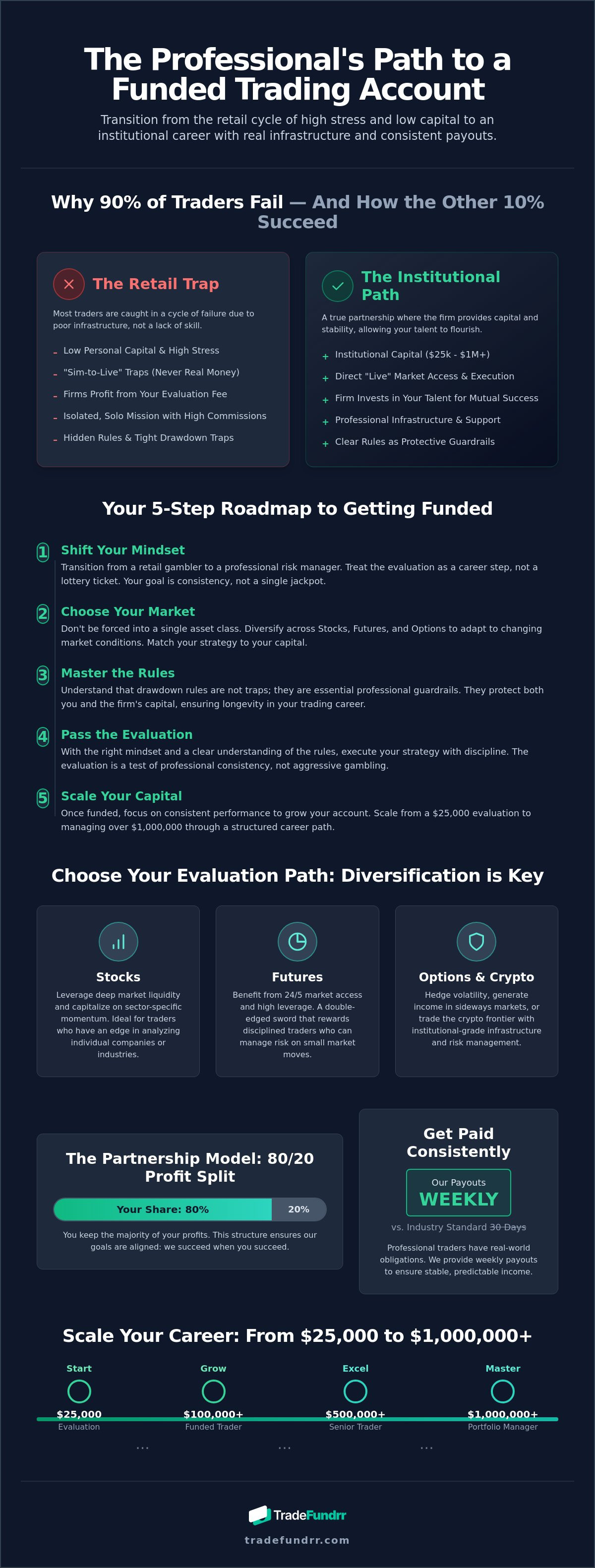
90% of traders fail their evaluations. It isn't a lack of skill that kills them. It is a lack of infrastructure. Most retail traders are stuck in a cycle of low capital and high stress. They want to know how to get a funded trading account that actually pays out. Instead, they fall for "easy funding" traps where firms never pay them real money. Most firms want your evaluation fee. We want your talent. You need institutional-grade stability, not a hidden rule trap.
You have the skill. Your account balance just doesn't reflect your potential. It is exhausting to manage tight drawdown rules while isolated from professional support. This guide changes your trajectory. You will master the exact steps to secure between $25,000 and $1,000,000 in buying power. We'll strip away the complexity and show you how to transition from a retail hobbyist to a professional trader with weekly profit payouts. We are moving past the hype and focusing on the structural integrity of your trading career.
Key Takeaways
- Learn how to get a funded trading account by treating the evaluation as a professional transition instead of a high-stakes gamble.
- Discover why moving beyond futures into stocks and options provides the market diversification necessary for a real trading career.
- Shift your perspective on drawdown rules from "hidden traps" to essential professional guardrails that protect your longevity.
- Master the five-step roadmap to select the right account size and prepare for the discipline required by institutional partners.
- Explore the scaling plan that allows consistent traders to grow from a $25,000 evaluation to managing over $1,000,000 in buying power.
What is a Funded Trading Account and Why Does It Matter?
A funded trading account isn't a prize you win. It's a partnership you earn. In the retail world, you are the one holding the bag. You risk your own capital, pay high commissions, and fight for scraps. In the professional world, the firm takes the risk. You provide the skill. This is the core of What is a Funded Trading Account; a symbiotic relationship where buying power meets talent. One side provides the fuel. The other provides the engine.
If you want to know how to get a funded trading account, you have to stop thinking like a gambler. Retail trading is often a solo mission with limited upside. Funded trading is an institutional career path. Most prop firms are just evaluation-fee factories. They hope you fail so they can keep your evaluation fee. The institutional model is different. It is built on getting you funded and paid. It is about understanding what is a funded trading account as a long-term professional vehicle, not a weekend lottery ticket.
The Mechanics of Institutional Infrastructure
Professional firms don't just give you a login to a website. They provide an infrastructure. TradeFundrr gives traders professional-grade tools. Most firms keep you in evaluations forever. They pay your profits out of other traders' losses. That is a marketing loop, not a business. We focus on live market data. Real-time data means better decisions. You see real quotes and real price action. When you trade on live data, your practice reflects the real market. When you trade on a fake server, you are just playing a video game. To learn how to get a funded trading account that lasts, you must look for real market data.
The Profit Split: How You Actually Get Paid
The math is simple. You keep the majority of what you earn, typically through an 80/20 split of simulated profits. But the split is only half the story. The frequency matters more. Most firms make you wait thirty days for a payout. We don't. We offer weekly payouts because we know professional traders have real-world obligations. This isn't about "getting rich quick." It is about "getting paid consistently." Having skin in the game through an evaluation ensures you have the discipline to survive. It's the difference between a retail hobbyist and a funded professional. You bring the talent. We provide the stability.
Choosing Your Evaluation Path: Stocks, Futures, or Options?
Most prop firms have a narrow vision. They funnel everyone into high-leverage futures or forex. Why? Because high leverage leads to quick mistakes. Quick mistakes lead to failed evaluations. It is a business model built on your turnover. We believe in a different approach. If you want to know how to get a funded trading account that actually builds a career, you need choices. You need diversification. Retail platforms want you to gamble. Professional firms want you to manage.
Real institutional trading isn't limited to one asset class. When futures markets are range-bound, equity momentum often provides the alpha. This is why we focus on funded stock trading accounts alongside other assets. Diversification isn't just a buzzword; it's a survival strategy. TradeFundrr provides a multi-asset roof where you can pivot based on market conditions, not firm limitations. You shouldn't be forced to trade a market that isn't moving.
Futures vs. Stocks: Which is Right for You?
Futures offer 24/5 access and extreme leverage. This is a double-edged sword. It allows gains on small moves but accelerates drawdown. Stocks offer deeper liquidity and sector precision. If tech is surging but energy is dragging, a stock trader has an edge that index traders lack. Mastering the Rules of risk is easier when you aren't forced into a high-leverage corner. Options allow you to hedge volatility or generate income during sideways markets. Match your strategy to your account size. A $25,000 account fits a focused options approach, while $100,000 provides room for a diversified stock portfolio.
The Crypto Frontier in Funded Trading
2026 has seen a massive shift toward institutional crypto access. Traders are tired of offshore exchanges with questionable liquidity. They want professional infrastructure. Trading crypto within a funded environment requires discipline. The volatility is real. The drawdowns can be swift. We provide the institutional rails to trade these markets safely. If you are ready to stop gambling and start trading with professional support, you can explore our evaluation tiers to find your fit. We provide the keys to the entire market.
The 5-Step Roadmap to Getting Your Account Funded
Getting funded isn't a sprint. It's a structured ascent. If you are looking for how to get a funded trading account, you need a map that accounts for institutional reality, not just marketing hype. Most traders treat the evaluation like a slot machine. Professionals treat it like a job interview. You aren't just trying to hit a profit target. You are trying to prove you are a reliable funded trader.
- Step 1: Selection. Don't overreach. Pick an account size that matches your current psychological risk tolerance.
- Step 2: Preparation. Read the fine print. You must internalize the drawdown and consistency rules before the first tick.
- Step 3: Evaluation. Execute your edge. This phase is about showing discipline in a monitored environment.
- Step 4: Verification. The transition from proving skill to signing the contract. This involves confirming your identity and professional status.
- Step 5: Funding. The goal. You move to a funded account and establish your weekly payout schedule.
Step 1: Picking Your Entry Point
Many beginners aim for the largest account immediately. They think more buying power equals more profit. Often, it just equals more pressure. The 25k funded account challenge is a superior entry point for most serious practitioners. It allows you to build professional habits without the psychological weight of a massive contract. Starting smaller often leads to faster long-term scaling because you focus on the process rather than the P&L. View the evaluation fee as an institutional gatekeeping tool. It ensures only those with skin in the game and a serious mindset get access to the firm's resources.
Step 3: Navigating the Evaluation Phase
Confusion kills more accounts than bad trades. You must distinguish between daily loss limits and total drawdown. A daily loss limit is a hard stop for the day to prevent emotional spiraling. Total drawdown is the maximum the account can lose from its peak. If you don't know the difference, you will fail. Consistency rules are equally vital. We don't want "one-hit wonders" who got lucky on a single earnings gap. The consistency rule is a filter for professional-grade repeatability that ensures your profits come from a strategy rather than a gamble. This is how to get a funded trading account that stays funded. Professionalism is about doing the same thing every day, not doing something spectacular once.
Mastering the Rules: Why Most Traders Fail and How to Avoid It
"The rules are too hard." You've heard this a thousand times. It's the standard refrain on forums when an account gets blown. Here is the truth: rules aren't traps. They are guardrails. If you want to know how to get a funded trading account, you have to stop viewing risk limits as an obstacle. They are the only thing standing between you and professional longevity. A firm that doesn't have strict rules isn't a firm; it's a casino. We don't run a casino.
Many traders are lured in by flashy ads. They ignore the funded account trading reality vs marketing myths. The myth is that you can trade like a cowboy and get paid like a hedge fund manager. The reality is that funding firms value consistency over brilliance. This philosophy is baked into how our rules are written. They prioritize capital preservation above all else. When you hit a snag, you need a partner, not a script. Most firms hide behind automated bots. We provide real human support because professional trading is a human endeavor.
The Drawdown Trap: Static vs. Trailing
Trailing drawdown is a retail-killer. It moves with your account high. If you are up $2,000 and the trade reverses, your "allowable loss" doesn't move back down. It stays pinned to that peak. This creates a shrinking window of survival. Static drawdown is different. It provides a fixed floor. It offers stability. To survive, you must trade away from your drawdown line. Take partials. Lower your size as you approach your daily limit. If you want a fair shake at getting funded, start your evaluation with a firm that values transparency over technicalities.
Psychology: Trading a Funded Account vs. "Your" Money
The "fear of loss" changes when you are funded. You aren't just protecting a balance; you are protecting a career. This pressure leads to overtrading. It is the number one cause of evaluation failure. You try to "make back" a loss immediately to stay above the line. This is retail behavior. Institutional infrastructure is designed to reduce this emotional burden. By providing clear limits, the system makes the hard decisions for you. You don't have to wonder when to stop. The guardrails tell you. This clarity is what separates a professional practitioner from a retail hobbyist.
Scaling to $1 Million: The Institutional Career Path
Passing an evaluation is a milestone. It is not the finish line. If you want to know how to get a funded trading account that sustains a lifestyle, you have to look past the first payout. Most retail prop firms cap your growth at a few hundred thousand dollars. They don't offer a path to real scale. We do. Through our $1M+ scaling path, we provide a ceiling-free environment where your only limit is your performance. The path from a $25,000 account to managing over $1,000,000 is a matter of consistent risk-adjusted returns, not luck.
Institutional scaling is methodical. You don't double your size overnight. You earn more buying power by proving you can handle the current account. This is the "$1M+ Scaling Path." It moves you from a retail mindset into a professional structure where $1M+ in buying power is a standard tool for the job. We aren't looking for gamblers who can flip an account once. We are looking for practitioners who can manage institutional-grade buying power over the long haul. This is how to get a funded trading account that evolves into a genuine career.
The Transition to a Funded Account
Moving from the evaluation to a funded account is a shift in stakes. In the evaluation, you are proving your process. In the funded account, your results can earn real payouts. TradeFundrr ensures this transition is seamless by providing professional infrastructure that mirrors the institutional world. Weekly payouts play a critical role here. They provide the cash flow needed to treat your trading as a business rather than a hobby. Receiving your first professional payout is the moment trading stops being a theory and starts being a legitimate business. It validates your discipline and provides the momentum needed to reach the next tier of buying power.
Why Human Support is Your Secret Weapon
Trading is an isolated profession. When you hit a drawdown or a technical glitch, a bot-driven support ticket is useless. You need a real human who understands the market and the platform. Professional feedback can save an account during a rough patch. Our team acts as a partner, providing the institutional perspective you need to stay in the game. We provide the guardrails and the buying power. You provide the talent. If you are tired of the "easy funding" traps and ready for a professional environment, the next step is clear.
Ready to start? Secure your $25k Evaluation here.
Step Into the Institutional Arena
The choice is binary. You can keep fighting the tape with insufficient capital and high stress. Or you can join an environment built for your success. We've shown you the roadmap. You understand that rules are guardrails, not traps. You know that market diversification across stocks, options, and futures is the only way to build a real career. Mastering the steps of how to get a funded trading account is the first move toward a career that doesn't have a ceiling.
TradeFundrr isn't a churn-driven prop firm. It's a gateway to professional infrastructure. You get access to professional-grade tools and live market data. We process weekly payouts every Friday because we respect your time and your talent. Whether you start with a $25,000 evaluation or aim for the $1M+ scaling path, the goal remains the same: professional-grade stability.
Stop trading like a hobbyist. Start trading like an insider. Start your TradeFundrr evaluation today. Your talent deserves the right buying power. We provide the tools; you provide the discipline. The markets are waiting.
Frequently Asked Questions
How much does it cost to get a funded trading account in 2026?
Industry evaluation fees for 2026 typically range from under $50 for entry-level accounts to over $600 for larger institutional-style evaluations. These costs act as a professional barrier to entry. They ensure that only traders with skin in the game and a serious mindset gain access to firm resources. Some firms use monthly subscriptions, while others favor a one-time fee model.
Can I really trade stocks and options in a funded account?
Yes, you can trade stocks and options alongside futures and crypto. Most prop firms limit you to high-leverage futures because they want you to make quick mistakes. We don't. We provide a multi-asset environment. This allows you to pivot your strategy based on where the actual market momentum is, rather than being forced into a single, volatile asset class.
What is the fastest way to pass a prop firm evaluation?
The fastest way to pass is to slow down and execute a disciplined risk plan. There are no shortcuts to getting funded. Traders who try to "speed run" an evaluation usually hit their daily loss limit within 48 hours. Focus on consistency and repeatable setups. This is the only reliable way to learn how to get a funded trading account that you actually keep over the long term.
How do weekly payouts work at TradeFundrr?
We process profit payouts every Friday to provide our traders with consistent cash flow. Most of the industry makes you wait thirty days to see your money. We believe professional performance deserves professional compensation. If you are profitable during the week, you get paid. This structure helps you treat your trading as a legitimate business rather than a monthly gamble.
What happens if I break a rule during the evaluation phase?
Breaking a hard rule like a maximum drawdown limit usually results in an immediate account termination. Rules are guardrails designed to protect the account from emotional or undisciplined trading. If you hit a limit, it's a signal that your risk management has failed. You can often reset the evaluation, but the goal is to internalize the discipline required to avoid the breach entirely.
Do I need to be a professional trader to apply for funding?
You don't need a professional license or a finance degree, but you do need professional discipline. The evaluation phase is specifically designed to identify retail traders with the skill to handle institutional-grade buying power. We provide the infrastructure and the human support. You provide the strategy and the execution. It's a partnership based on your ability to manage risk, not your past resume.
Is the capital in my funded account real or simulated?
Most evaluations begin in a simulated environment to verify your skill. Once you prove your consistency, the path leads to a simulated funded account that runs on live market data. This transition is critical. It is where your results become eligible for real payouts. We focus on the move to a funded account as the ultimate professional milestone.
What mindset does getting a funded trading account actually require?
It requires thinking like a capital allocator instead of a gambler. The written rules of a funded account are built around preserving capital first so you have the opportunity to harvest profits later, which is why consistency matters more than any single winning trade when you are working out how to get a funded trading account.
Trade with institutional structure
Develop your edge in a structured, simulated environment with clear rules and a defined path.
Get Funded →