
What is a Funded Trading Account? The Institutional Insider's Guide


Most retail traders believe they need a massive personal bank account to trade like a professional. They're wrong. To truly understand what is a funded trading account, you must look past the flashy marketing and see the institutional reality. You've likely spent years refining your strategy only to be held back by a small balance or the constant fear of losing your own savings. The industry offers you a demo login; we provide you with a professional environment. You have the skill. You just lack the fuel.
We agree that the current retail landscape is often a lonely, high-risk game. This guide promises to show you how to access $25,000 to $1M+ in institutional capital while protecting your personal wealth. You'll learn to distinguish genuine professional infrastructure from the simulation traps that dominate the industry. We're pulling back the curtain on how real payouts work, the metrics that actually matter to backers, and how to build a career with institutional-grade stability. It's time to stop playing small and start trading with the resources your talent deserves.
Key Takeaways
- Define what is a funded trading account as a professional partnership where the firm provides the capital and you provide the execution.
- Learn why evaluations and drawdown limits are necessary guardrails that protect the capital and validate your risk management.
- Spot the "sim-to-live" traps that keep traders on demo accounts while the firm profits from evaluation fees alone.
- Understand the value of institutional-grade infrastructure and real human support over basic retail platforms and support bots.
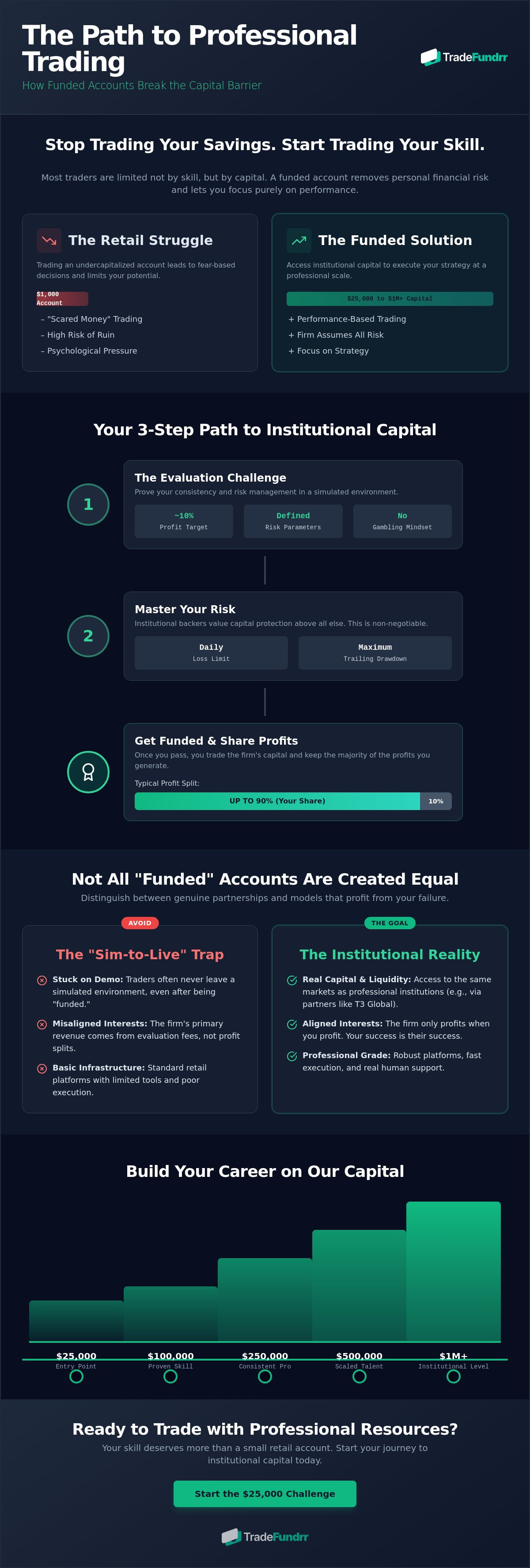
- Map your career progression from a $25,000 evaluation to the $1M+ institutional capital path through a structured framework.
Breaking the Capital Barrier: What is a Funded Trading Account?
The retail trading industry loves to sell the dream of turning a few hundred dollars into a fortune. It's a lie. The math doesn't work; the psychology doesn't hold. If you want to trade like a professional, you need professional resources. This is where the concept of a funded account changes the game. Essentially, what is a funded trading account? It is an arrangement where a firm provides capital to a trader in exchange for a profit split. We provide the fuel. You provide the engine.
In this model, the firm assumes all the financial risk. If a trade goes south, it's our capital on the line, not your personal savings. This structure bridges the gap between retail skill and institutional-scale buying power. It turns trading from a desperate gamble into a performance-based partnership backed by professional capital providers. You aren't just a customer; you're an operator within a larger ecosystem.
The Core Philosophy: Skill vs. Capital
Most retail traders fail because they are undercapitalized. It's that simple. When you're trading a $1,000 account, a single drawdown period can wipe you out. This leads to "scared money" trading. You hesitate on entries. You exit winners too early. You let losers run because you can't afford the hit. Funded accounts solve this by removing the personal risk element. When your rent money isn't on the line, your focus shifts. You stop worrying about survival and start focusing on professional risk management. It's about trading the chart, not your bank balance.
Proprietary Trading vs. Retail Brokerage
There's a fundamental difference between a broker and a prop firm. A retail broker is a service provider. They make money on your volume, whether you're a genius or a disaster. Their interests aren't aligned with your success. A proprietary trading firm is a partner. We provide the capital, the tools, and the infrastructure because we want a piece of your success. We only profit when you generate profit.
This alignment is why we lean on institutional partners like T3 Global. They provide the real-world liquidity and professional execution platforms that retail brokers simply can't match. You aren't shouting into the void of a retail "bucket shop." You're accessing the same markets and liquidity pools used by the world's largest banks. It's the difference between playing a video game and operating in the real world.
The Mechanics of Funding: Evaluations, Drawdown, and Profit Splits
Understanding the mechanics is the difference between a professional and an amateur. It's not just about "winning" a challenge; it's about demonstrating that you can protect the firm's capital under real market conditions. When people ask what is a funded trading account, they're really asking about the ecosystem of rules that governs the partnership. This includes the evaluation filter, the drawdown guardrails, and the final payout structure. These aren't obstacles. They're the standards of the professional world.
Step 1: The Evaluation Challenge
The evaluation isn't a hurdle to trip you up. It's a filter to find talent. Most firms want you to fail to keep your fee; we want you to pass so we can scale your talent. You start with a specific profit target, typically around 10%, while adhering to strict risk parameters. For those looking to start without overextending, the $25,000 Funded Account Challenge offers the perfect entry point to prove your strategy. It forces you to shed the gambler's mindset. You stop chasing "home runs" and start focusing on the consistency required by institutional backers.
Step 2: Managing the Max Drawdown
Institutional providers don't care about your win rate. They care about your drawdown. We use two primary metrics: daily loss limits and maximum trailing drawdown. These are the guardrails. They prevent a single bad day or an emotional spiral from liquidating an entire account. Drawdown is a measure of a trader’s discipline, not just their losses. If you can't manage the downside, you'll never be trusted with the upside. Professional trading is a game of survival first and profit second.
Step 3: Receiving Your Profit Share
Once you pass, the relationship shifts to a profit split. Industry standards typically range from 70/30 to 90/10 in favor of the trader. You keep the lion's share because you're the one doing the work. The Evolving Landscape Of Proprietary Trading shows that firms are moving toward more trader-centric models that focus on long-term retention rather than one-off fees.
We prioritize weekly payouts. Waiting a month for your earnings is for retail employees. Professional traders need liquidity to manage their lives and build a consistent "salary" from the markets. We back this with real human support because we know that when you're managing professional capital, you need a partner, not a bot. If you're ready to move beyond demo accounts, you can explore our funded account evaluations to start your professional path today.
The Sim-to-Live Trap: Why ‘Funded’ Doesn’t Always Mean Real Capital
The term "funded" is the most abused word in the modern trading industry. To most, it implies a vault of cash waiting for a skilled operator. In reality, it's often just a marketing label for a demo account. When you ask what is a funded trading account, you have to look at the plumbing. Is there real money in the pipes, or just pixels on a screen? Many firms operate on a "demo-only" model. They don't have a liquidity provider. They don't have a brokerage partner. They simply pay the winners using the fees collected from the losers. It's a house of cards, and you're the one holding the deck.
This creates the "Sim-to-Live" trap. You pass the evaluation. You expect to trade real markets. Instead, the firm keeps you on a simulated server indefinitely. They claim it's for "risk monitoring," but the truth is simpler: they don't have the capital to back you. This delay is a massive red flag. A genuine capital partner wants you in the live market as soon as possible because that's where the real profit is generated. If a firm keeps you in a simulator, they aren't your partner. They're a fee-collector waiting for you to fail.
The Economics of Demo-Only Firms
If a firm doesn’t want you to trade live, their interests are not aligned with yours. In a demo-only model, your profit is their direct loss. This conflict of interest is why "payout denials" and moving goalposts are so common in the retail prop space. Official research into the risks of retail trading often highlights how volatility can wipe out undercapitalized players, but it rarely mentions the structural risk of the firm itself. A reliable firm must have an institutional parent company. Without that backing, they’re just a website with a checkout page. You need a partner with deep pockets, not a middleman with a demo server.
The Path to Real Money
TradeFundrr operates differently. We provide a clear, documented path from evaluation to live institutional execution. The difference is felt the moment you place a trade. Demo accounts have perfect fills and zero slippage; real markets have friction. You need to experience that friction to build a sustainable career. We transition successful traders into live environments where their orders hit actual exchanges. This is the only way to move beyond the retail "hobbyist" phase. Real capital provides the stability you need to scale. It turns a side hustle into a professional career. Don't settle for a simulation when you've put in the work to trade the reality.
Institutional Infrastructure: Why Your Trading Environment Matters
Retail trading is often marketed as a laptop-on-the-beach lifestyle. Professional trading is a high-performance infrastructure game. When you investigate what is a funded trading account, don't just look at the capital; look at the pipes. A flashy web dashboard might look good on social media, but it's useless if it freezes during a market flush. Professional execution requires institutional-grade stability. If your firm provides a basic web platform, they're treating you like a retail customer. If they provide direct market access and low-latency execution, they're treating you like a partner.
The environment you trade in dictates your ceiling. Most retail setups are limited to a single asset class, usually Forex. We provide access to Stocks, Options, Futures, and Crypto because a professional needs a broad toolkit. You shouldn't be forced to trade a dead market just because your platform can't handle anything else. True institutional infrastructure offers risk management tools that go beyond simple stop-losses. It includes hard-coded daily limits and position-sizing guardrails that protect the firm's capital and your career. We even publish our full risk rules in advance to give our traders the psychological edge needed to handle six and seven-figure balances.
Trading Multiple Asset Classes
FX is a fine starting point, but it's only one piece of the puzzle. A professional firm supports diversification. You need the ability to pivot to Stocks or Options when volatility regimes shift. If the currency markets are flat, but tech stocks are moving, you need the infrastructure to follow the flow. Understanding institutional flow is about seeing where the "big money" is moving in real-time. We don't just give you a demo login; we give you the keys to the same markets used by global hedge funds. This versatility is essential for surviving different market cycles over a multi-year career.
The Human Element in a Digital Market
Automated support is the industry standard for retail firms. It's also the first thing to fail during a high-volatility event. When the market is moving fast and your orders are on the line, talking to a support bot is a liability. You need a real person who understands the markets. Our "straight-shooting" culture means you get direct answers from experienced traders, not a scripted response from a call center. We're building a community of serious practitioners, not a "churn-and-burn" user base. Integrity matters. If you're ready to step into a professional environment, you can explore our institutional funding paths and leave the retail limitations behind.
Starting Your Professional Career: The Path to Institutional Funding
Trading is a business, not a hobby. When you first investigate what is a funded trading account, you are looking for a way to break through the capital barrier. But a professional doesn't just look at the entry point; they look at the entire career trajectory. Choosing the right account size is your first major strategic decision as an operator. We provide a structured ladder, offering evaluations for $25,000, $50,000, and $100,000 accounts, leading all the way to a $1M+ institutional capital path. Start where your skill can handle the pressure. A smaller account is a proving ground; the institutional path is the destination.
Preparation is the difference between a payout and a reset. You need a strategy that doesn't rely on market miracles. It requires a mindset that values capital preservation over ego. Most traders rush to the finish line and trip over their own leverage. Professionals wait for the right setup and execute with clinical precision. The first payout is the most significant milestone you'll reach. It marks the definitive shift from "proving yourself" to "professional execution." It is the moment you stop being a retail dreamer and start being a paid operator in the global markets.
Evaluating the Evaluation
The biggest mistake in an evaluation is trying to pass in a single day. Don’t over-leverage. Slow and steady passes the test; high-risk gambling leads to a blown account. Transparency is our standard, but your diligence is your responsibility. Review every rule before you click "buy" on an evaluation fee. We expect you to know the boundaries of the partnership. We recommend keeping a detailed trading journal to identify your personal trading leaks. If you don't find your weaknesses, the market will find them for you and charge you a high price for the lesson.
Your First 90 Days as a Funded Trader
The transition from simulation to live capital is a psychological hurdle. On a demo server, a loss is just a number. On a funded account, a loss is a drawdown on professional capital. This shift requires a disciplined approach to your daily routine. Set a consistent payout schedule to pay yourself for your work. This reinforces the professional habit and removes the "gambling" feel from your trading. Once you demonstrate consistency, we help you scale. Moving from a $25k account to institutional-level funding is a logical progression, not a lucky break. We provide the capital; you provide the performance.
Ready to prove your skill? Start your evaluation with TradeFundrr today.
Step Into the Institutional Arena
The retail dream is often a simulation. The institutional reality is a partnership. You've seen the difference between a demo trap and a genuine capital provider. You know that success isn't about a lucky trade; it's about professional risk management and institutional-grade infrastructure. Now that you understand what is a funded trading account, the choice is clear. You can keep trading "scared money" on a retail platform, or you can leverage the same systems used by the pros. The gap between where you are and where you want to be is simply a matter of resource allocation.
We provide the backing of T3 Global and the stability of weekly payouts handled by real human support. Our accounts don't just stop at the evaluation phase; they scale with your talent up to $1M+ in institutional capital. It's time to stop proving your worth to a bot and start executing like an insider. You have the strategy. We have the capital. It's time to merge the two. Start your evaluation today. The markets are moving. Your infrastructure should be ready. We've built the bridge; you just need to cross it.
Frequently Asked Questions
Is a funded trading account real money?
Yes, but the transition to live capital typically happens after you prove your consistency. Most firms start you in a professional simulation environment to verify your risk management skills. Once you pass the evaluation, the firm either provides direct access to institutional capital or mirrors your trades in live markets to pay out your profit share in real currency.
Can I lose my own money with a funded account?
You cannot lose your personal savings through trading losses on a funded account. Your financial risk is strictly limited to the initial evaluation fee you pay to access the firm's capital. If you hit a drawdown limit, the firm closes the account and absorbs the trading losses. You're never on the hook for the firm's capital.
How do funded trading accounts make money?
Firms generate revenue through a mix of evaluation fees and profit splits. When you understand what is a funded trading account, you see it's a partnership. The firm only makes significant money when you're profitable. They take a small percentage of your gains, typically 10% to 20%, while you keep the majority of the profit you generate.
What happens if I fail a funded account evaluation?
If you breach a risk rule or hit a drawdown limit, your access to that specific evaluation account is terminated. You don't owe the firm for the losses incurred during the challenge. You can choose to walk away or purchase a new evaluation once you've refined your strategy and identified your personal trading leaks.
How long does it take to get a funded trading account?
The timeline depends entirely on your performance and the firm's specific rules. Some traders hit their profit targets in a few days; others take several weeks of disciplined execution. Once you hit the target and follow the rules, the verification and onboarding process usually takes between two and five business days before you're active.
Are funded trading accounts legal in the US?
Yes, proprietary trading is completely legal in the United States. Because you're trading the firm's capital as an independent contractor rather than managing third-party client funds, the firm doesn't operate as a retail brokerage. This structure allows skilled individuals to access high-level capital without the regulatory hurdles of traditional retail trading.
Do I need a specific degree or license to get funded?
You don't need a finance degree, a Series 7 license, or any formal credentials to get started. Proprietary firms are the ultimate meritocracy. We don't care about your resume; we care about your equity curve. If you can demonstrate that you can follow a plan and manage risk, the doors to institutional capital are open.
What is the best funded account for beginners?
The best entry point is a balance that allows you to learn professional habits without excessive pressure. A $25,000 Funded Account Evaluation is often the ideal choice. It provides enough capital to generate meaningful payouts while keeping the risk parameters tight enough to force you to trade with the discipline required for long-term success.
Start your evaluation
Explore TradeFundrr funding programs in a structured environment with clear rules.
Get Funded →