
Funded Account Trading: Reality vs. Marketing Myths in 2026
 July 13, 2026
12 min read
July 13, 2026
12 min read

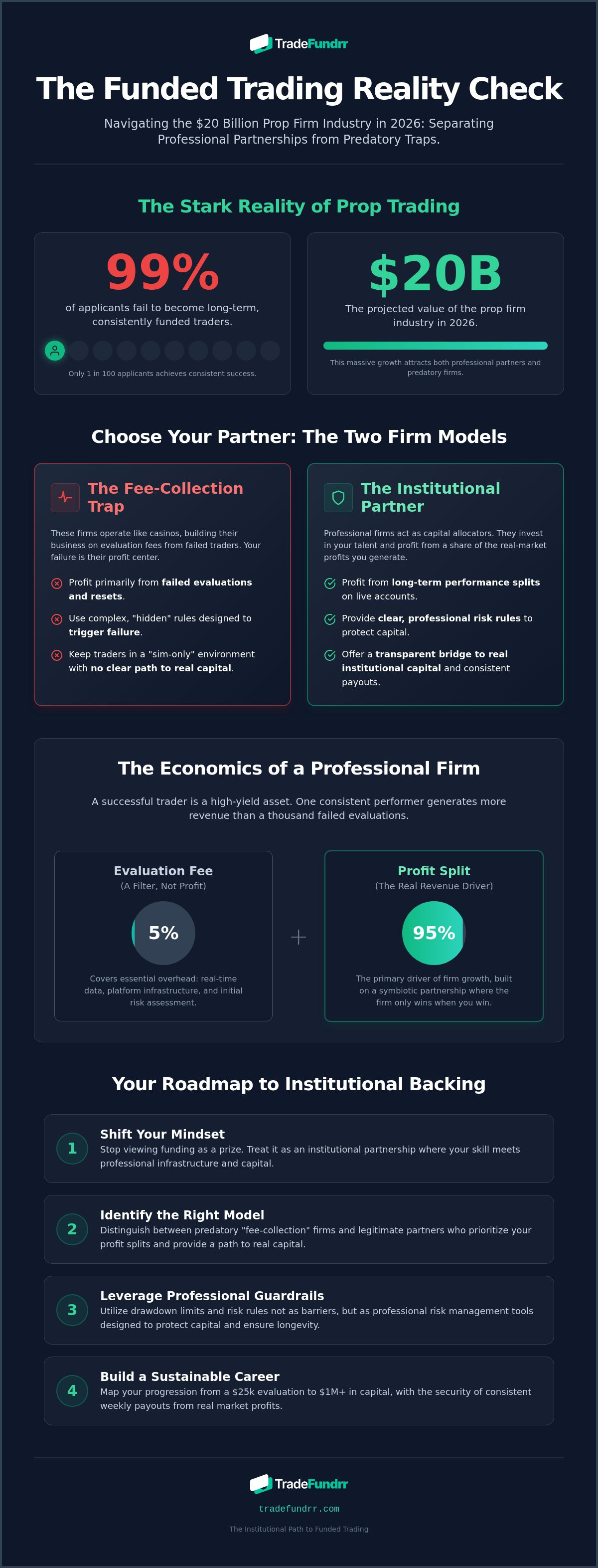
Recent data reveals a harsh truth. While the prop firm industry has exploded to nearly $20 billion in 2026, only about 1% of applicants become long-term, consistently funded traders. Most firms don't want you to win. They want your evaluation fee. This is the reality of funded account trading today. It's a landscape filled with "no-payout" environments and complex drawdown rules designed to trigger failure. You want a professional edge. They offer a lottery ticket.
It's frustrating to have the skill but lack the capital to make it meaningful. You've likely felt the sting of "hidden" rules or the fear that a firm won't actually pay out when you finally hit your targets. We get it. You're looking for a partnership built on transparency and institutional-grade stability, not a cycle of endless resets. This article promises to expose the marketing myths and reveal the mechanics of a true institutional partnership. You'll learn how to distinguish between fee-collection traps and legitimate paths to $1M in buying power. We'll break down the 2026 regulatory landscape and provide a clear roadmap for securing consistent, weekly payouts.
Key Takeaways
- Stop viewing funding as a prize; treat it as an institutional partnership where your skill meets professional infrastructure.
- Distinguish between predatory "fee-collection" models and legitimate funded account trading structures that prioritize your profit splits.
- Avoid the no-payout dead-end by choosing firms that provide a transparent bridge to real payouts.
- Utilize drawdown limits as professional risk management tools rather than viewing them as arbitrary barriers to your success.
- Map out your progression from a $25k evaluation to $1M+ paths with the security of consistent weekly payouts.
Table of Contents
- Funded Account Trading: Separating Reality from Marketing Hype
- The Fee Collection Myth: How Professional Prop Firms Actually Profit
- The No-Payout Trap: Why Most Traders Never Reach Real Payouts
- Rules Aren't Barriers: Using Institutional Guardrails to Protect Your Capital
- Beyond the Evaluation: Building a Sustainable Career with Institutional Infrastructure
Funded Account Trading: Separating Reality from Marketing Hype
Social media wants you to believe funded account trading is a shortcut to a private jet. It isn't. It's a job. Most influencers sell a dream of easy money; we offer a professional infrastructure. In 2026, the industry is shedding its skin. The "get rich quick" firms are collapsing. The professionals are staying. This isn't about winning a prize. It's about securing a seat at the table. You provide the talent. We provide the buying power. It's a simple exchange that most people overcomplicate with hype.
The reality is quiet. It doesn't involve neon lights or rented Lamborghinis. It involves risk management, discipline, and the right partnership. The industry is currently worth nearly $20 billion, but that growth has brought noise. You need to cut through it. This need for professional networking is universal, and a prop firm provides the foundation for a trading career. 2026 is the year of professionalization. The market is moving away from predatory "game" mechanics and toward legitimate payouts. If you're looking for a lottery, look elsewhere. If you're looking for a career, you're in the right place.
The Definition: What is a Funded Trading Account?
A funded account isn't a personal loan. It's a performance-based partnership. You provide the strategy and the execution; the firm provides the buying power. This model takes its name from Proprietary trading, where a firm invests its own capital for gain; a funded account uses simulated buying power instead. You aren't a customer. You're an asset. The firm takes the financial risk, and you take a share of the profits you generate. It's a clean, binary relationship. For a deeper look at these mechanics, read our guide: What is a Funded Trading Account? The Institutional Insider's Guide.
The 2026 Landscape: Why Traditional Retail Trading is Failing
Retail trading is getting expensive. Data fees are rising. Professional-grade infrastructure is becoming a requirement, not an option. By 2026, the gap between retail and institutional tools has widened significantly. Solo traders are fighting a losing battle against latency and high costs. Institutional infrastructure levels the field. It gives you the same tools the big players use without the crushing overhead. We've moved past the era of "gambling" firms that profit from your failure. The industry is shifting toward "infrastructure" firms. These firms win only when you win. They provide the guardrails you need to survive. You provide the skill to thrive.
The Fee Collection Myth: How Professional Prop Firms Actually Profit
Skeptics call it a scam. They claim firms want you to blow your account just to keep the fee. In the bottom tier of the industry, they're right. Some firms operate as "Fee-Collection" machines, profiting only when traders fail. Professional firms operate as "Profit-Split" partners. We don't build businesses on failed evaluations. We build them on funded traders who earn payouts. A failed trader is a dead end. A successful trader is a long-term partner. One consistent performer is worth more to us than a thousand failed evaluations. This is the binary reality of funded account trading in 2026.
Professional firms operate within a framework of proprietary trading regulations to ensure they remain sustainable funding partners. They don't want your fee; they want your talent. When you win, the firm wins. It's a symbiotic relationship where the firm provides the fuel and you provide the engine. If a firm's primary revenue comes from failed resets, they aren't a partner. They're a casino. Start building your track record with an institutional-grade evaluation that prioritizes your success.
Evaluation Fees vs. Performance Splits
The evaluation fee isn't a profit center. It's a filter. It covers the cost of real-time data, infrastructure, and the risk of funding an unproven trader. Most of that fee is consumed by the overhead required to maintain a professional environment. TradeFundrr prioritizes long-term trader success because that's where true scale exists. We aren't looking for one-time fees; we're looking for lifetime partners. The Profit Split is the primary driver of your growth.
The Cost of Infrastructure
Professional-grade platforms aren't free. Neither is real human support. Bot-led firms can afford to be cheap because they offer generic helpdesk tickets and automated responses. They don't invest in you because they don't expect you to last. Professional firms invest in human connection and institutional-grade support. We provide the guardrails and the resources you need to survive a volatile market. You aren't just a number in a database. You're a practitioner in a high-performance environment that requires real infrastructure to function.
The No-Payout Trap: Why Most Traders Never Reach Real Payouts
The industry has a dirty secret. Many firms that offer funded account trading never actually pay you. You pass the evaluation, you see the "Funded" badge, but the payout never arrives. You're stuck in a loop. Forever. The firm isn't rewarding your talent; they're betting you'll eventually blow up before they have to pay out. This is the "No-Payout" trap. It's a closed loop where payouts are funded by the next trader's evaluation fee. When the fees dry up, the payouts stop. It's a fragile model that collapses under the weight of real success.
Paper profits are easy. Getting paid is a different beast. At a firm that never pays, nothing is at stake. In a funded account that earns real payouts, every tick matters. Traders who spend years on "never-pay" accounts develop bad habits because they never feel real consequences. They're playing a video game, not building a career. Real payouts are the only sustainable path for a professional. If your firm doesn't have a clear bridge to real payouts, you aren't a trader. You're a gamer.
The Danger of Never-Pay Accounts
Some firms build their model around denied payouts. If you win, they look for a reason not to pay. If you lose, it costs them nothing. This creates a massive conflict of interest. They don't want you to be too successful because a large payout hurts their bottom line. This leads to arbitrary rule changes, "technical errors" during high-volatility events, and denied payouts. Professionalism requires clear, written payout rules. Without it, you're at the mercy of the firm's cash flow, not your own performance.
Institutional Infrastructure: The TradeFundrr Difference
TradeFundrr isn't a retail app. We provide access to Stocks, Options, Futures, and Crypto. This is institutional-grade infrastructure. Your simulated account runs on live market data and real-time quotes. This matters because you need to know how your strategy performs against real price action. Taking the first step shouldn't be a gamble on a firm's solvency. Start your journey with the 25k funded account challenge and move toward real payouts.
Rules Aren't Barriers: Using Institutional Guardrails to Protect Your Capital
Amateur traders complain about rules. Professionals rely on them. In funded account trading, rules aren't designed to make you fail; they're designed to keep you from blowing up. Retail trading is often a slow bleed of capital because there are no boundaries. You have one bad day, you move your stop, and suddenly half your account is gone. Institutional trading is a disciplined execution of a plan within strict limits. If you can't handle a drawdown limit, you can't handle $1M in buying power. It's that simple. We don't want you to fail. We want you to survive long enough to become a high-yield partner.
The myth that rules are traps is a retail misconception. In reality, these constraints are what separate a career trader from a gambler. Without a hard stop, the human brain is wired to "hope" a losing trade turns around. The firm provides the objective "no" that your emotions can't. This isn't about restriction. It's about longevity. By enforcing professional standards from day one, we ensure that when you finally reach the seven-figure level, you have the habits to stay there. Stop fighting the system and start using it. Secure your funded account with a firm that values professional risk management.
The Logic of Drawdown and Risk Management
In 2026, the distinction between trailing and daily drawdown is critical. Trailing drawdown moves with your profit; daily drawdown resets every evening. Retailers often hate trailing drawdown because it feels like it's "chasing" their profits. Institutional risk desks use it for a different reason. It prevents you from giving back hard-earned gains. It forces you to bank profit and reset your expectations. Professional traders view rules as safety nets, not hurdles. If you don't have a risk desk watching your back, you're just gambling in the dark. These limits mirror the actual requirements of institutional desks at firms like T3 Global. They aren't arbitrary. They are the industry standard for survival.
Discipline as a Service
The evaluation isn't just a test of your strategy. It's a test of your character. Passing a $50,000 or $100,000 evaluation builds the psychological "muscles" required for the $1M+ Scaling Path. You're learning to trade a funded account, which requires a higher level of accountability. You need more than just a chart. You need a written plan and an honest review process to master the mental game of professional risk. When you hit a limit, you don't need a bot to send you a generic error message. You need human support to help you navigate the breach and understand the "why" behind the "what." Discipline isn't a hurdle. It's a service we provide to ensure you stay in the game long enough to win.
Beyond the Evaluation: Building a Sustainable Career with Institutional Infrastructure
Passing an evaluation is not the finish line. It is the start of a business. Most retail traders treat funded account trading like a video game level they need to beat. Professional traders treat it like a launchpad for their business, often sharpening their analytical skills through advanced training that supports institutional-level performance. In 2026, the industry is moving away from "one-and-done" challenges and toward long-term institutional partnerships. You don't just want a payout; you want a career. This requires a shift from a gambling mindset to a professional scaling strategy. We provide the ladder. You provide the climb.
The transition from a $25,000 evaluation to the $1M+ Scaling Path is a journey of disciplined scaling. It isn't about hitting home runs. It's about hitting singles consistently. With TradeFundrr, you gain access to a professional environment that retail prop firms simply cannot match. You aren't just clicking buttons in a vacuum; you're building a track record that matters in the real world of finance. Stop playing with "no-payout" toys and start partnering with a firm that actually pays out.
Weekly Payouts: The Professional Standard
Waiting thirty days for a payout is a relic of the past. In 2026, professional traders demand liquidity. Monthly payout cycles are for employees; weekly payouts are for partners. This frequency does more than just provide cash flow; it validates your status as a professional. Consistent withdrawals prove that your strategy works in live market conditions. For a deep dive into how this affects your trading psychology, see our guide on prop firm weekly payouts. Frequent payouts reinforce the "this is real" mental state that keeps you disciplined.
The Path to $1 Million and Beyond
Most firms trap you in a futures-only bubble. We offer a wider lens. Building a career means having the flexibility to trade what the market gives you. This includes moving into funded stock trading accounts, options, and crypto. Diversification isn't just for investors; it's for practitioners who want to survive different market cycles. TradeFundrr facilitates the move from retail prop limits to professional-tier buying power. We expect you to outgrow the $25k level. Our system is designed to scale with you, not hold you back.
Your 5-Step Roadmap to Professional Status:
- Select Your Entry: Choose an evaluation size ($25k, $50k, or $100k) that matches your current skill level.
- Master the Guardrails: Internalize the drawdown rules as risk management tools, not barriers.
- Secure Consistency: Focus on achieving your first three weekly payouts to establish a "real-world" rhythm.
- Scale via Performance: Use your profit splits to move toward the $1M+ scaling path.
- Diversify Your Edge: Expand your strategy across stocks, options, and futures to ensure long-term stability.
The era of the retail "gamer" is over. The era of the institutional practitioner is here. Stop playing for badges and start trading for a career.
Step Into the Institutional Arena
The industry has reached a crossroads. You can continue chasing digital trophies in no-payout traps, or you can step into a professional environment. We've dismantled the marketing myths and provided the roadmap for 2026. True funded account trading is a partnership, not a prize. It's about leveraging institutional-grade infrastructure to scale your skill into a career. You've seen how rules act as guardrails and why the path to $1M requires more than just a lucky trade.
Weekly payouts and real human support aren't luxury perks; they're the professional standard for sustainable cash flow. You provide the talent. We provide the infrastructure. It's time to move beyond the retail noise and join a firm that only wins when you win. Your seat at the institutional table is waiting. Don't let your skill go to waste at a firm that never pays. Stop playing the retail game and start trading with the pros.
Stop Gambling and Start Partnering: Join the $25,000 Evaluation Now
Frequently Asked Questions
Is funded account trading actually profitable for retail traders?
Yes, but the success rate is narrow. Statistics from 2026 show that only about 1% to 3% of applicants become long-term, consistently funded traders. Profitability isn't about luck; it's about treating funded account trading as a professional partnership. Most traders fail because they treat evaluations like lottery tickets rather than institutional-grade tests of skill and risk management.
Why do most traders fail their prop firm evaluation challenges?
Most traders fail because they lack the psychological discipline to handle drawdown limits. Research indicates average pass rates are between 5% and 10%, with many traders making two to four attempts before succeeding. They often over-leverage to hit profit targets quickly, which triggers trailing drawdown rules. Success requires building the mental discipline that a written plan and consistent review develop.
What is the difference between a simulated and a live funded account?
A simulated account keeps your orders on a demo server, while a live account involves real market liquidity. TradeFundrr funded accounts are simulated and run on live market data, and the profit share is paid in real money. Many firms never pay out at all. Real payouts are the only sustainable path for a practitioner seeking long-term career growth.
How do weekly payouts work in a funded trading program?
Weekly payouts allow you to withdraw your profit share every seven days once you meet minimum trading requirements. This model replaces the outdated monthly cycles that used to be the industry standard. It provides consistent cash flow and validates your status as a professional partner. By receiving frequent payouts, you reinforce the disciplined habits needed to manage larger funded accounts.
Are there hidden rules that cause payout denials in 2026?
Denials usually stem from "fine print" regarding news trading, copy trading, or consistency requirements. While predatory firms use these as traps to avoid paying out, professional firms use them as objective guardrails. You must understand how your firm calculates drawdown, whether it is equity-based or balance-based. Transparency is the difference between a fee-collection machine and a legitimate funding partner.
Can I trade stocks, options, and crypto in a single funded account?
Yes, if you choose an institutional-grade provider. Most generic prop firms limit you to futures, but TradeFundrr provides access to Stocks, Options, and Crypto. This flexibility is essential for a sustainable career. It allows you to pivot your strategy to whichever asset class offers the best opportunity, rather than being trapped in a single, volatile futures market.
How does TradeFundrr differ from generic futures-only prop firms?
TradeFundrr acts as an institutional insider, not a retail app. We provide real human support instead of automated bots and offer a clear path to $1M+ in buying power. Generic firms often profit from your failure via reset fees; we win when you earn payouts. We provide the infrastructure, the diversified asset classes, and the stability you need to trade professionally.
What happens if I hit my maximum drawdown limit?
Your account is closed immediately to prevent further loss. This rule mirrors the risk desk requirements of institutional firms. It isn't a punishment; it's a professional safety net that prevents a "one bad day" catastrophe. You can typically attempt a new evaluation to refine your strategy, but the goal is to use these limits to develop permanent discipline.
Trade with institutional structure
Develop your edge in a structured, simulated environment with clear rules and a defined path.
Get Funded →