
Funded Trader Payout Structure: Institutional Reality vs. Retail Marketing
 July 23, 2026
13 min read
July 23, 2026
13 min read

Most retail prop firms are designed to keep your profits on their balance sheet, not yours. They distract you with 90% or 100% profit splits while burying the actual funded trader payout structure in a mountain of fine print. You've likely felt the frustration of waiting 30 days for a withdrawal, only to have it voided by a "consistency rule" you didn't know existed. It's a rigged game that prioritizes marketing hype over your actual success.
We're here to change that perspective. This guide strips away the retail fluff to show you how professional institutions actually handle capital and risk. You'll learn how to identify firms that pay out real capital rather than just simulation credits. We'll break down the mechanics of weekly cash flow, the importance of profit buffers, and the clear path to $1M+ in institutional capital. It's time to stop chasing empty percentages and start building a professional trading career based on transparency and performance.
Key Takeaways
- Identify the three non-negotiable variables of a professional funded trader payout structure that separate real capital providers from marketing-heavy retail firms.
- Discover how weekly payout cycles eliminate the psychological pressure to over-trade and turn screen numbers into tangible income.
- Learn the 50/30/20 Rule for managing payouts as a professional stop loss, ensuring long-term capital preservation and business stability.
- Map out your trajectory from a standard evaluation to $1M+ in institutional capital through a transparent, merit-based scaling plan.
The Anatomy of a Funded Trader Payout Structure
The funded trader payout structure is the contractual agreement governing how trading profits are divided between the trader and the capital provider. It is the blueprint for your professional career. In traditional proprietary trading (prop trading), this structure ensures both parties have skin in the game. Retail marketing often hides the complexity behind a single, high number. Real institutional reality is different.
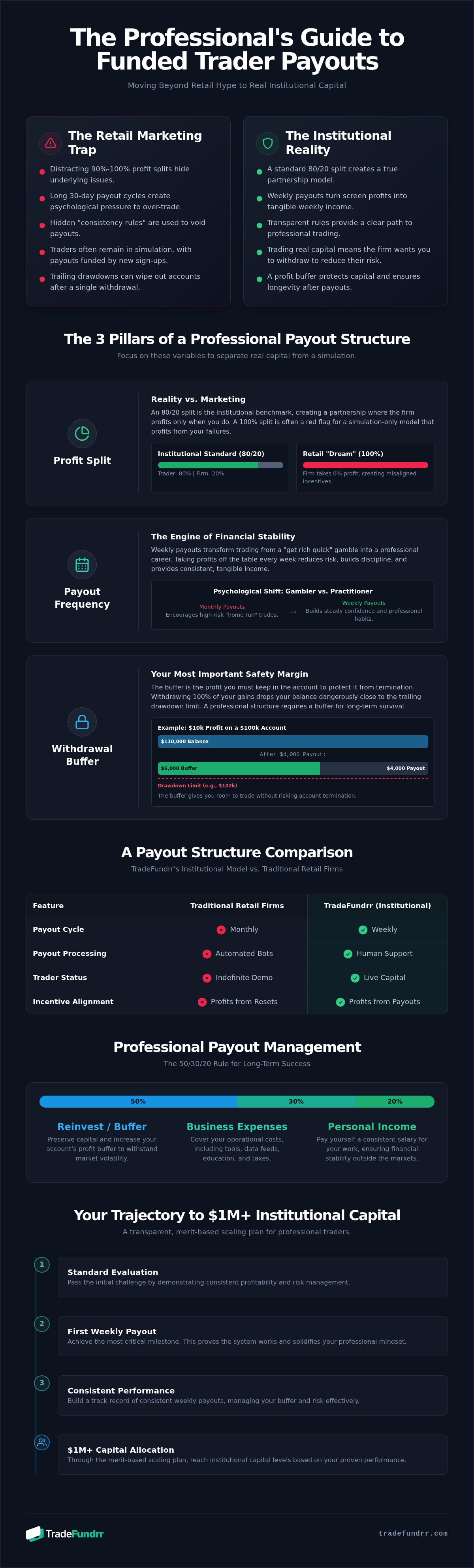
A professional structure relies on three core variables: profit split percentage, payout frequency, and the withdrawal buffer. Marketing firms focus on the first. Professionals focus on the last two. If you can't get your money out every week, the percentage doesn't matter. You are just playing with house points on a screen that will never hit your bank account.
Most retail traders never see a dime because of the "Sim-to-Live" trap. Many firms keep traders on demo servers indefinitely. They pay withdrawals out of evaluation fees from new sign-ups. This is a "bucket shop" model. Institutional firms operate differently. They want you trading live capital. They want you to withdraw frequently because it reduces their risk exposure. Every dollar in your bank account is one less dollar they have at risk in the market.
Profit Splits: Reality vs. Marketing
Retail firms often advertise a 100% profit split. It sounds like a dream. In reality, it's often a red flag for a sim-only operation. If a firm takes 0% of the profit, they aren't your partner. They are a service provider selling a dream. They make their money when you fail and pay for a reset. A standard 80/20 split is the institutional benchmark. It creates a partnership where the firm only profits when you do. TradeFundrr uses this 80/20 structure for live futures accounts to ensure incentives are aligned for long-term growth and professional sustainability.
The Role of the Withdrawal Buffer
The withdrawal buffer is the most misunderstood part of any funded trader payout structure. The buffer is the safety margin between your current balance and account termination. Most firms use a trailing drawdown that moves up with your profit. If you withdraw all your gains, your balance drops right to your drawdown limit. One losing trade and the account is gone. Professional structures require a buffer to stay in the account. This ensures you have room to breathe after a withdrawal. In your first 30 days, you must know exactly how much of your profit is actually "liquid" and how much must stay to protect your capital from the trailing drawdown trap.
Weekly vs. Monthly Payouts: Why Timing Is Everything
Timing isn't just a factor in your entries and exits. It's the engine of your financial stability. In a traditional retail funded trader payout structure, you're often forced to wait 30 days for your first withdrawal. This delay isn't an accident. It's a psychological trap. Monthly cycles encourage traders to swing for the fences to make the month-long wait worthwhile. If you're up $2,000 on day ten, but can't touch it until day thirty, you're more likely to over-leverage to turn that $2,000 into $10,000. Usually, you end up at zero instead.
Professional trading requires a different rhythm. Weekly payouts act as a natural risk management tool. By taking money off the table every Friday, you reduce the capital at risk in the account. You're paying yourself for the work done, not gambling on what might happen three weeks from now. At TradeFundrr, we've structured our system to prioritize this weekly cash flow. It shifts your focus from how much you can make this month to how much you can bank this week. This consistency is what builds a career.
The Psychology of Frequent Withdrawals
Waiting a month to get paid keeps you in a gambler's mindset. You see the balance as a score rather than capital. When you receive a payout every week, that mindset shifts. You start seeing the connection between disciplined trading risk management for prop firms and your actual bank balance. The First Payout milestone is the most critical moment in a trader's journey. It proves the system works. It proves you're a professional. Once that first check clears, the pressure to get rich quick evaporates, replaced by the steady confidence of a practitioner.
Operational Logistics: Human Support vs. Bots
Many retail firms rely on automated bots to process withdrawals. These bots are programmed to flag suspicious activity during market volatility, often leading to delayed or denied payouts when you need them most. We don't hide behind algorithms. TradeFundrr uses real human support to review and approve institutional-grade payouts. This ensures that skilled traders aren't penalized for navigating complex market conditions. If you're ready to start your journey toward that first Friday withdrawal, you can explore a $50,000 Funded Account Evaluation to test your discipline in a professional environment. Our payouts are processed through Rise, ensuring you get your capital efficiently and transparently.
TradeFundrr vs. Traditional Prop Firms: A Payout Comparison
Most retail prop firms operate on a "Retail Sim Loop." They profit from your evaluation fees and account resets, not your market performance. Their funded trader payout structure is designed to keep you on a demo server as long as possible. If you make money, they pay you from the fees of the next trader in line. This model is fragile. It relies on a constant stream of new losers to pay the few winners. When the stream dries up, the payouts stop.
The institutional path is different. Real firms want you off the simulator and into the live market. At TradeFundrr, we prioritize a transition to live trading because that is where sustainable profit lives. While the industry standard for payouts is bi-weekly or even monthly, we process payouts every single week. This frequency forces a professional rhythm. It moves you away from the "all or nothing" mentality of retail gambling and toward the steady cash flow of a professional practitioner.
Asset classes also dictate how these structures function. Futures programs often have rigid daily loss limits but offer faster payout cycles. Stocks and options programs might offer higher profit splits, sometimes reaching 100%, but require more sophisticated risk management. Whether you are trading the NQ or Apple, the goal remains the same: move from a $25k evaluation to $1M+ in institutional capital through a proven, transparent scaling plan.
The Institutional Infrastructure Advantage
We don't just provide a platform; we provide a bridge. By leveraging our partnership with T3 Global, we provide institutional capital for retail traders who have the skill but lack the backing. This infrastructure allows you to trade on professional-grade systems rather than laggy retail interfaces. Payouts are backed by real market profits. This makes your income sustainable. It means your funded trader payout structure is built on the bedrock of the financial markets, not a pool of evaluation fees.
Choosing Your Starting Point
Your journey starts with a choice of scale. For many, the $25,000 Funded Account Evaluation is the most logical entry point. It offers the lowest barrier to your first weekly payout. For those with more experience, the $100k path offers faster scaling, though it requires a more disciplined approach to profit buffers. If you are unsure which structure fits your style, our transparent breakdown of each program serves as the definitive roadmap for navigating these professional waters. It strips away the marketing hype and gives you the raw data you need to succeed.
How to Manage Your Payouts for Long-Term Success
Getting the payout is only half the battle. Managing that capital is where most traders fail. Retail traders often fall for the "compounding myth." They believe they should leave their profits inside the firm's account to trade larger sizes as quickly as possible. This is a strategic mistake. A professional funded trader payout structure is a tool for extraction, not a savings account. Every dollar you leave in the account is capital you are risking for the firm's benefit. Take it out. Put it in your bank. Real wealth is built on your balance sheet, not theirs.
Adopt the 50/30/20 rule to manage your trading business. Withdraw 50% of your profits immediately. Allocate 30% to your account buffer to protect against future drawdowns. Set aside 20% for taxes and business expenses. This structure turns a trading account into a predictable income stream. Taking a payout is the ultimate stop loss for your career. It ensures that even if you hit a rough patch and lose the account next week, you've already secured your profit in a personal account. You can't lose money that's already in your bank.
Managing the transition from sim to live trading accounts requires a shift in perspective. In simulation, numbers are just pixels. In live trading, those numbers represent your real-world stability. Extracting capital early and often bridges the psychological gap between the two environments. It makes the gains feel real. It reinforces the discipline required to trade at an institutional level.
The Buffer Building Strategy
Your "Survival Buffer" is the distance between your current balance and the max drawdown limit. To survive a red week, you need a cushion. Never withdraw your entire profit if it leaves you sitting on the drawdown line. One bad morning could end your account. To calculate your "Withdrawable Profit" accurately, take your total profit, subtract the required firm buffer, and subtract an additional 20% for your own safety margin. What remains is your actual paycheck. This discipline prevents account termination during periods of high volatility.
Scaling vs. Extracting
Pay yourself first. Your first $5,000 in payouts should go straight to your bank account. No exceptions. This builds the payout muscle and validates your skill. Once you've secured your initial stake and built a comfortable buffer, you can shift your focus to scaling toward a $1 million dollar trading account. Use your payouts to fund your own independent retail brokerage account over time. Diversification is the mark of a professional. If you're ready to start building your own capital base, choose your evaluation size and start the path to your first weekly payout.
Get Started: The Path to Your First Weekly Payout
The road to a professional funded trader payout structure isn't a sprint. It's a methodical process. Most retail traders fail because they treat evaluations like a video game. They over-leverage, blow accounts, and feed the "reset loop" that keeps firms in business. To reach the institutional level, you must treat your trading like a business from day one. This means following a structured path that prioritizes capital preservation over ego.
- Step 1: Choose your evaluation size. We offer evaluations at $25,000, $50,000, and $100,000. Don't pick based on the largest number. Pick based on your current skill level and risk tolerance. It's better to master a smaller account and scale than to choke under the pressure of a larger one.
- Step 2: Master the risk management rules. This is the ultimate filter. Our rules are designed to protect our capital and your career. Focus on protecting your drawdown. If you can't manage risk, the profit target doesn't matter.
- Step 3: Move to Funded status. Once you hit your target without breaching risk limits, our human support team reviews your performance. We don't use bots to find excuses to fail you. We look for the discipline required to trade live capital.
- Step 4: Execute and request your payout. Once funded, trade your plan. When Friday arrives, request your profit split. We process payouts through Rise to ensure you get your money efficiently and transparently.
Why TradeFundrr is the Final Destination for Serious Traders
We aren't a marketing firm that happens to offer trading accounts. We are an institutional bridge. Our partnership with T3 Global provides the real-world weight that retail "bucket shops" can't match. We provide the infrastructure; you provide the talent. This partnership is built on radical honesty. We don't coddle traders with unrealistic promises. We provide a professional environment where your skill is the only variable. Our human support team understands the nuances of the markets because they live them. We are here to help you navigate the complexities of a professional funded trader payout structure so you can focus on what matters: the tape.
Your Next Move
Preparation is the difference between a payout and a reset. Study the mechanics of our institutional path before you risk a single dollar. If you're ready to prove your edge, sign up for the $25,000 Funded Account Evaluation to begin your journey. Join a community of practitioners who have stopped asking is prop trading worth it and started banking weekly results. The infrastructure is ready. The capital is waiting. The rest is up to you.
Transition to Professional Capital
The retail prop industry is built on complexity. The institutional world is built on clarity. You now understand that a professional funded trader payout structure isn't about chasing 100% splits. It's about securing weekly cash flow and building a sustainable withdrawal buffer. Stop focusing on the "sim loop" and start building a real-world track record. Taking regular payouts is the only way to turn trading skill into personal wealth.
We provide the bridge to the professional level. With institutional backing from T3 Global and real human support, we remove the barriers that retail firms use to trap traders. You bring the talent. We provide the infrastructure. It's time to stop waiting 30 days for your money and start banking your wins every Friday. This is the difference between playing a game and running a business.
Secure your path to weekly payouts. Start your TradeFundrr evaluation now.
Your professional career starts with a single, disciplined decision. We're ready to back your talent when you are.
Frequently Asked Questions
How often can I request a payout from TradeFundrr?
You can request a payout every single week. Most retail firms trap you in monthly cycles that encourage over-trading and risky behavior. We prioritize consistent cash flow to keep your trading psychology stable. Payouts are processed through Rise, ensuring you see your capital quickly. This frequency turns "screen numbers" into real-world utility without the month-long wait common in the industry.
What is the profit split for a funded trader in 2026?
The profit split for live futures accounts is 80/20. Stocks and options programs offer a 100% profit split. This funded trader payout structure is designed to align our institutional interests with your long-term performance. We don't rely on a cycle of evaluation fees to survive. We rely on your ability to extract profit from the real market alongside our professional partners.
Is there a minimum profit required before my first withdrawal?
You must exceed your account's required survival buffer before making your first withdrawal. This buffer isn't an arbitrary hurdle; it is your safety margin against account termination. If you withdraw every dollar of profit, you leave yourself with zero room for error. We require this margin to ensure you stay in the game even after taking a payout.
What happens to my drawdown limit when I take a payout?
Your drawdown limit stays at its high-water mark or trailing limit when you take a payout. It does not reset. If you withdraw your entire profit balance, your account balance will sit directly on your drawdown line. One losing trade will then end the account. Always leave a portion of your gains as a "capital cushion" to protect your funded status.
Are payouts made in crypto, bank wire, or other methods?
Payouts are processed through Rise, a professional contractor payments platform. This infrastructure allows you to receive your capital via bank transfer, PayPal, or cryptocurrency like USDT and USDC. It is fast, compliant, and transparent. We don't use the slow, manual processing methods that retail firms often use to delay your access to earned capital.
Does the payout structure change as I scale to a $1M account?
The funded trader payout structure evolves as you move toward the $1M+ Institutional Capital Path. Scaling is a merit-based transition. As you demonstrate consistency, you move from simulation environments to live institutional accounts via T3 Global. The structure shifts from a retail evaluation to a professional partnership with significant backing and much higher capital limits.
What are the common reasons a payout request might be denied?
Payouts are usually denied due to risk management breaches or failing to meet professional consistency standards. If your profits come from a single "gambled" trade rather than a repeatable strategy, the request will be flagged. We use real human support to review your trades. We want to see professional execution, not lucky outliers that put the capital at risk.
Do I need to pay taxes on my prop firm payouts?
You are responsible for your own taxes as an independent contractor. You are not an employee of the firm. You will receive the required tax documentation through the Rise platform at the end of the year. We recommend consulting a qualified tax professional to manage your liabilities and business expenses. Professional trading is a business; your tax strategy should reflect that reality.
Start your path to weekly payouts
Prove your edge in a structured, simulated environment with clear rules and a transparent payout structure.
Get Funded →