
Sim to Live Trading Account: The Professional Transition Guide for 2026


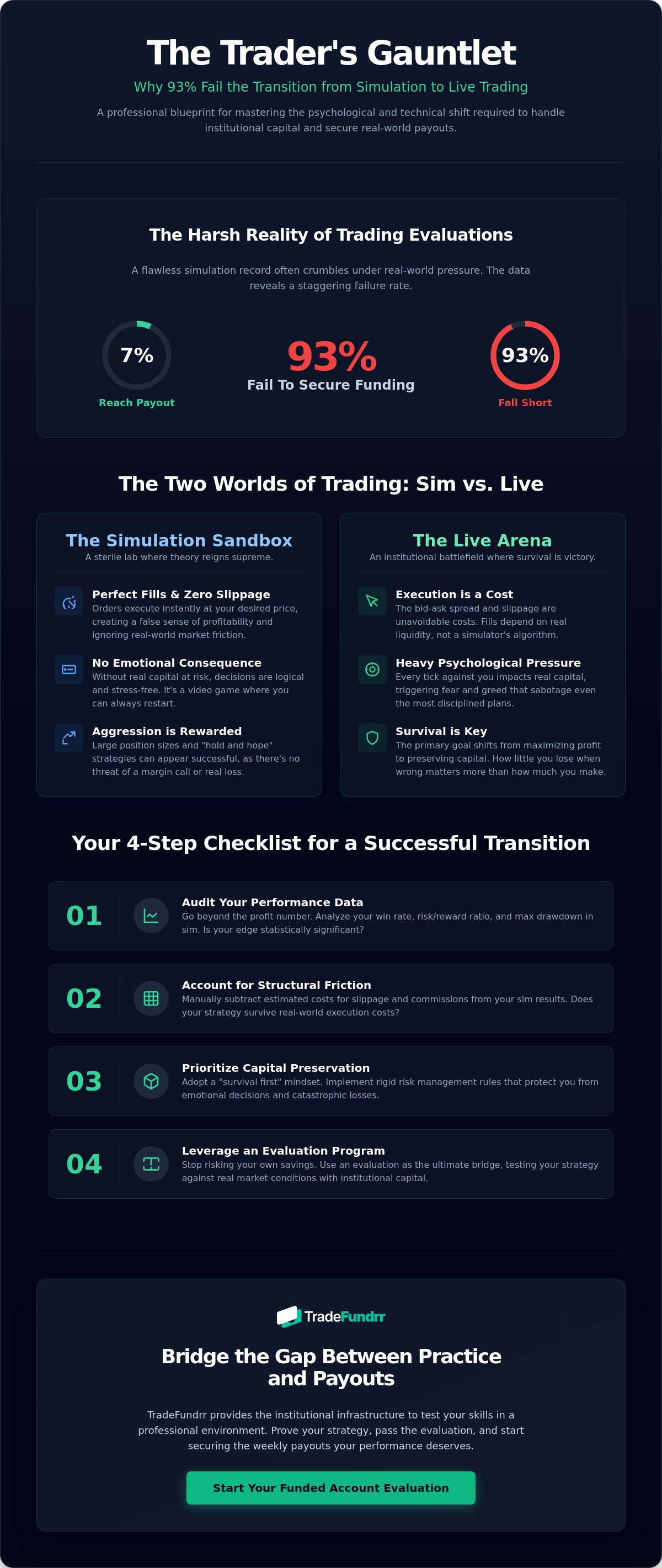
Only 7% of traders who start an evaluation ever reach a payout. It is a staggering figure that highlights a brutal truth: being a hero on a demo screen does not mean you are ready for the big leagues. You have likely spent months refining a strategy that looks flawless in a vacuum. Then you make the move from a sim to live trading account and everything falls apart. The slippage is real. The fills are slower. The psychological pressure of losing actual capital turns a disciplined professional into a hesitant amateur.
We understand the frustration of seeing profitable sim results fail to translate into live cash. It is not a lack of talent; it is a lack of structure. This guide provides the professional blueprint to master the psychological and technical shift required to handle institutional capital without blowing your account. We are moving past the noise to focus on what actually works in the 2026 market. By following this professional blueprint step by step, you will learn a repeatable process for transitioning to live funding, navigating institutional execution, and finally securing the weekly payouts your performance deserves.
Key Takeaways
- Sim tests your math, but live trading tests your nerves. Understand the structural friction of slippage and liquidity before you commit.
- Aggression wins in sim, but survival wins in live. Learn why you must prioritize capital preservation over theoretical gains.
- Follow a professional 4-step checklist to audit your performance data before moving from a sim to live trading account.
- Stop risking your own savings. Leverage evaluation programs to bridge the gap between practice and institutional-grade capital.
- Transition to a professional payout structure that rewards consistency with weekly liquidity and real-world support.
The Reality of the Sim to Live Trading Account Transition
Simulated trading is a sandbox. It allows you to test technical mechanics and build muscle memory without the immediate sting of financial loss. Most traders start with a stock market simulator to refine their entries and exits. It feels productive. It looks profitable. But do not confuse a high score in a simulation with a paycheck in the real world. The transition from a sim to live trading account is where most retail traders meet their end. It is not because their strategy suddenly stopped working. It is because the environment changed while their mindset stayed the same.
The "Sim-to-Live Trap" is a common industry pitfall. Many retail platforms offer perfect execution in their demo environments to make trading look easy. They want you to feel invincible so you will fund a live account. This creates a false sense of security. In a sim environment, you are trading against a computer. In a live environment, you are trading against the world’s most sophisticated algorithms and institutional players. They do not give away fills for free.
Perfect Fills vs. Real-World Execution
Sim accounts are sterile. They almost always give you the exact price you want the moment you click the button. This is a fantasy. In a live institutional environment, you must navigate the bid-ask spread. If you want to buy, you are buying at the offer. If you want to sell, you are selling at the bid. This cost of doing business is often ignored by simulators.
Order book depth is another factor that sim accounts fail to replicate. If you trade ten contracts on sim, you get filled instantly at one price. In reality, those ten contracts might require three different price levels to fill the entire order. This is slippage. It is the silent killer of strategies that look flawless on paper. Your sim to live trading account transition will fail if you do not account for the friction of real liquidity.
The Emotional Weight of Real Capital
Trading sim is a video game. Trading live is a profession. When the money isn't real, your brain stays calm. You follow your rules because there is no consequence for failure. The moment you move to a live account, the psychological pressure shifts. Every tick against you feels like a personal attack on your bank account.
This is why 90% of traders fail the transition despite being profitable on sim. They lack the institutional infrastructure to manage their own emotions. Professional traders do not rely on "willpower" to stay disciplined. They rely on rigid risk management systems and structured environments that remove the opportunity for emotional errors. Transitioning successfully requires you to stop thinking about "winning" and start thinking about surviving the friction of the real market.
Why Sim Profits Do Not Always Equal Live Payouts
Simulated trading is a world of theory. Live trading is a world of execution. In a simulation, you are operating in a vacuum where every order is filled and every exit is clean. It is a world of "could have." When you move from a sim to live trading account, you enter the world of "did." Results on paper are meaningless if they cannot be replicated under the weight of real capital and market friction.
The contrast is binary. Sim rewards aggression. Live rewards survival. In a demo account, a trader can "hold and hope" through a massive drawdown because there is no actual risk. They eventually see the price return and book a profit. In a live environment, that same drawdown triggers a margin call or a total account wipeout. Professional trading is not about how much you can make when you are right. It is about how little you lose when you are wrong.
The Liquidity Gap: Small Cap vs. Large Cap
Sim accounts are notorious for being liquidity-blind. They hide the difficulty of exiting large positions during high volatility. You might see a profit target hit on your screen, but in a live market, that price might only exist for a fraction of a second. If there is no one on the other side of your trade, your order won't fill. Institutional flow is heavy and deliberate. It does not care about your sim-only spikes. TradeFundrr provides the structural integrity needed to navigate these real-world variables in both stock and crypto markets. If you are ready to test your skills against real market depth, consider starting a Funded Account Evaluation to see how your strategy holds up.
Psychological Sabotage and the "Sim Ghost"
The "Sim Ghost" is the version of you that trades perfectly when the money isn't real. The moment you switch to a live account, that ghost vanishes. You start to deviate from your plan. You hesitate on entries. You exit winners too early out of fear. These are "Sim-only" habits that will kill a live account if left unchecked. You must bridge the gap between your technical skill and your emotional maturity.
Using resources like A structured evaluation path allows you to manage the psychological friction of trading institutional capital. It provides the framework to treat every trade as a business decision rather than a gamble. Stop trading like a hobbyist and start operating like a professional. The transition is not just about changing your account type. It is about changing your entire approach to risk.
A 4-Step Checklist for Moving to a Live Trading Account
Confidence is not a metric. Data is. Many traders attempt the jump from a sim to live trading account because they "feel" ready after a few green days. This is a trap. The market does not care about your feelings; it only cares about your execution under pressure. To survive the transition, you need a cold, hard audit of your performance. If your sim results cannot withstand a rigorous structural review, your live account will not last a week.
Professionalism starts before the first live dollar is at risk. It begins with a commitment to treating the simulator like a high-stakes environment. You are not just practicing entries. You are practicing the discipline required to manage institutional capital. Follow this 4-step checklist to ensure your transition is a calculated move, not a blind gamble.
Step 1: Mechanical Consistency Audit
Verify a minimum of 30 days of consistent sim profitability. A lucky week is not a strategy. You need to see how your system handles a full market cycle, including low-volatility grinds and high-impact news events. During this phase, you must log every trade as if it were live. Ask yourself: am I following my rules, or just chasing numbers because the money isn't real?
Identify and remove "unrealistic" sim wins. If you took a trade during a news spike that filled at a perfect price on sim, discard it. In a live market, that trade would have suffered massive slippage or failed to fill entirely. If your profitability depends on "perfect" sim fills, your strategy is broken. Real-world execution is messy. Your data must reflect that reality.
Step 2: Structural Risk Alignment
Match your sim position sizing to your funded account reality. If you plan to trade a $50,000 Funded Account Evaluation, do not practice on a $1M sim account. The math changes when the leverage changes. You must understand the specific max drawdown rules of your target account before you go live. Over-leveraging on sim builds dangerous habits that lead to immediate failure in a professional environment.
Establish a hard daily loss limit. If you lose a specific amount on sim, you must walk away. If you find yourself "resetting" the sim account to keep trading, you are failing the discipline test. TradeFundrr emphasizes human support during this critical phase because we know that technical skill is only half the battle. You need a structure that holds you accountable to your own risk parameters.
- Audit fills for slippage: Manually adjust your sim profit targets by 1-2 ticks to account for real-world friction.
- Daily Loss Limits: Set a hard cap that matches your live account’s liquidation threshold.
- Evaluation Phase: Use a $25,000 or $100,000 evaluation as a "semi-live" bridge to cap your personal capital risk.
- Rule Adherence: If you break a rule on sim, treat it as a failed evaluation. No excuses.
Using Evaluation Programs as Your Bridge to Real Capital
Retail brokers often suggest starting with a small personal account to "feel the market." This is reckless advice. They want you to risk your savings so they can collect commissions on your struggle. Transitioning from a sim to live trading account using your own capital creates a level of emotional friction that most beginners cannot handle. If you blow a personal account, you lose your savings. If you fail an evaluation, you lose a registration fee. The choice is clear.
Evaluation programs act as a "semi-live" environment. They provide the necessary pressure of real-world rules without the risk of personal financial ruin. You are trading in a professional framework where every move is measured. This structure forces you to abandon the "video game" habits of the simulator. It prepares you for the reality of institutional-grade execution and the responsibility of managing significant capital.
Proving Your Edge in a Measured Environment
The 25k funded account challenge is the ideal starting point for this transition. It is small enough to be approachable but rigorous enough to demand professional discipline. You aren't just trying to make money; you are proving to institutional partners that you can manage risk. These partners do not care about your winning percentage. They care about your consistency and your ability to respect a hard daily loss limit.
Evaluation rules are not barriers. They are blueprints. They teach you how to operate within the same constraints as a professional desk trader. By the time you pass, you have already developed the habits required for a sim to live trading account success story. You have moved from the "hope and pray" phase of retail trading into a data-driven business model.
Scaling from Evaluation to $1M+ Path
Success in an evaluation is just the beginning. The roadmap at TradeFundrr leads toward the $1M+ Institutional Capital Path. This is where you stop "passing a test" and start managing a business. Most prop firms use automated bots to monitor their traders. They want you to trip over a technicality. We use human support because we understand that scaling requires a partnership between the firm and the practitioner.
This professional transition is designed to lead to weekly payouts. You are no longer waiting for a monthly check or hoping your retail broker processes a withdrawal. You are getting paid for your performance in a real-world environment. If you are ready to stop practicing and start performing, apply for a Funded Account Evaluation today and secure your path to institutional capital.
TradeFundrr: Institutional Infrastructure for Real-World Payouts
Most prop firms are marketing companies first and trading firms second. They prioritize flash over function. They want your registration fee, but they don't necessarily want your performance. The transition from a sim to live trading account requires more than just a login; it requires a partnership. At TradeFundrr, we have stripped away the artificial barriers found in retail prop trading to provide a straight-shooting, institutional environment where your skill is the only limit.
The proprietary trading sector is valued at nearly $20 billion as of 2026. Search volume for this industry has increased by 5,525% since 2020. This growth has attracted many "bot-driven" firms that use automated algorithms to find reasons to fail you. We take the opposite approach. We provide real human support from seasoned trading professionals who have seen every market cycle. We succeed only when you are profitable. This is not a zero-sum game; it is a professional alliance.
The TradeFundrr Advantage
We provide the infrastructure. You provide the talent. Through our partnership with T3 Global, we offer traders access to institutional capital providers and high-performance technology. This is not a retail brokerage setup with delayed data and poor fills. It is an elite gateway to stocks, options, futures, and crypto markets. We focus on radical transparency. You won't find marketing hype here, just a clear path to professional funding.
You can start your journey with a $25,000, $50,000, or $100,000 Funded Account Evaluation. Each path is designed to test your discipline while preparing you for our $1M+ Institutional Capital Path. Unlike competitors who make you wait 30 days for a check, we offer weekly payouts. We believe that if you perform, you should get paid. Liquidity is the lifeblood of a professional trader, and we ensure you have access to yours without unnecessary delays.
Your Next Steps to Professional Funding
Stop "playing" in a simulator and start building a professional track record. Simulation is a tool for learning, but it is not a career. To master the sim to live trading account shift, you must move into an environment that respects your performance. If you are serious about this profession, you need a written process. Refine your strategy and align your risk management with professional standards.
The bridge to professional trading is open. We have provided the capital, the human support, and the weekly liquidity. The only variable left is your execution. It is time to leave the sandbox behind and step onto the professional floor. Join TradeFundrr and start your evaluation today.
Master the Professional Shift to Institutional Capital
The simulator is a sandbox. The live market is a profession. You have seen why "perfect" sim fills are a fantasy and why emotional discipline is the only true edge. Moving from a sim to live trading account is not a matter of luck; it is a matter of structure. By following a data-driven checklist and using evaluations as your bridge, you remove the risk of personal ruin and replace it with institutional-grade stability.
We provide the tools. You provide the talent. Through our partnership with T3 Global, we offer you direct access to institutional capital and real human support. You aren't just another number in a database. You are a practitioner on a path to weekly payouts. Stop practicing for a future that never arrives and start building a track record that pays.
Start your journey from sim to live with a TradeFundrr evaluation.
Your skills deserve a professional stage. We are ready to open the doors when you are ready to walk through them.
Frequently Asked Questions
What is the main difference between sim and live trading?
The primary difference is the presence of market friction and psychological consequence. Simulated environments provide perfect fills and zero financial risk, while live accounts introduce slippage, liquidity gaps, and the emotional weight of real capital. Sim is a laboratory; live is the battlefield. You must account for the structural differences in execution before your performance can translate to a professional environment.
How long should I stay on a sim account before going live?
You should stay on a sim account until you have verified at least 30 days of consistent profitability and rule adherence. Time is less important than data. If you cannot follow your plan for a full month in a risk-free environment, you will certainly fail under pressure. Use this period to audit your strategy against realistic slippage expectations and mechanical consistency.
Why do I lose money on live accounts when I was profitable on sim?
Most traders fail the move from a sim to live trading account because their strategy relied on the "perfect fills" of a simulator. Real markets have bid-ask spreads and limited order book depth. Additionally, the psychological pressure of losing real dollars often causes traders to hesitate on entries or exit winners too early. You aren't losing because the market changed; you're losing because your execution environment did.
Can I use the same strategy on a live account as I did on sim?
You can use the same core strategy, but you must adjust your expectations for execution speed and slippage. A strategy that requires high-frequency entries and exits may work on sim but fail in a live market due to transaction costs. Audit your sim data to ensure your edge is large enough to absorb the friction of institutional liquidity and real-world order book depth.
Is it better to start with a small live account or a funded evaluation?
A funded evaluation is the professional choice because it caps your personal risk while providing access to significant capital. Starting a small live account often leads to over-leveraging and emotional trading. Evaluations provide a structured framework that rewards discipline and prepares you for managing institutional-grade size without risking your personal savings. It is about protecting your capital while proving your skill.
How does TradeFundrr handle the transition from evaluation to funded status?
TradeFundrr moves traders from an evaluation phase into a funded status once performance targets and risk parameters are met. This transition is supported by real human experts who review your data to ensure you are ready for live capital. Once funded, you move into a professional environment designed for consistency. This process ensures you are prepared for the structural shift from a sim to live trading account.
What markets can I trade on a live TradeFundrr account?
You can trade a diverse range of liquid markets including stocks, options, futures, and crypto. We provide access to the same high-performance infrastructure used by institutional desks. This variety allows you to apply your edge where the liquidity is highest and the execution is most reliable. You are not limited to retail-only instruments; you trade where the professionals trade.
Does a live trading account have more slippage than a sim account?
Live trading accounts always experience more slippage than sim accounts because they interact with real market depth. In a simulated environment, the software assumes there is always a buyer or seller at your price. In reality, your order must find a counterparty. During high volatility, this search for liquidity results in price gaps that sim simply cannot replicate. Professionalism requires accounting for this friction.
Bridge the gap in a structured, simulated environment
Practice the discipline the transition demands with clear rules and human support.
Get Funded →