
Day Trading Strategies: Institutional-Grade Frameworks for Prop Firm Challenges in 2026
 TradeFundrr
July 19, 2026
14 min read
TradeFundrr
July 19, 2026
14 min read

Most traders who attempt a funded evaluation do not pass it, and the reason is rarely a lack of talent. It is usually a lack of process. Many treat an evaluation like a lottery instead of a professional audition, and the strict rules find them out. You have felt the sting of small-account limits and the frustration of watching a good idea unravel under pressure. The fix is not a secret indicator. It is trading with structure, which is what day trading strategies for prop firm challenges are really about.
We know the get-rich-quick noise is loud, and this is the opposite of that. What you actually want is a repeatable plan you can run inside a structured, simulated environment with clear rules, so the habits you build hold up if you ever trade live capital. This article lays out the frameworks, the infrastructure that matters, and the risk discipline that keeps an account alive. You bring the skill; the structure does the rest. Here is how you close the gap from unstructured retail trading to disciplined, funded-style execution.
Key Takeaways
- Understand the execution gap between retail order routing and institutional Direct Market Access so you learn to respect fill quality, even while practicing in a simulated account.
- Execute professional day trading strategies for prop firm challenges built on institutional momentum and value-area analysis rather than tired retail patterns.
- Implement the 1% risk rule to manage maximum drawdown, so you stay in the game long enough for your edge to show.
- Move from small-account constraints to institutional-grade simulated capital paths ranging from $25,000 to over $1,000,000.
- Replace emotional decision-making with the disciplined mindset that a rules-based evaluation demands.
Why Most Day Trading Strategies Fail in the Prop Firm Environment
Most traders fail long before they reach a profit target, and it is usually the process, not the effort. Retail trading often happens in a vacuum of lagging indicators and vague plans, which quietly taxes every decision. You see a setup, you act, and by the time you commit the move has already matured. A simulated funded account does not remove that problem for you. It demands the same real discipline, just without your own money in the market while you learn.
Traditional day trading strategies for prop firm challenges also ignore the capital problem. On a tiny personal account, you are tempted into reckless size just to make a return feel worthwhile, which breeds emotional decisions, over-leverage, and revenge trading. Simulated funding removes the personal-capital pressure, but it also exposes weak execution quickly, because the drawdown rules of an evaluation are strict. If a method leans on luck instead of logic, those rules surface it fast.
The Liquidity and Execution Trap
Slippage and poor fills are a quiet drag on live-market performance. A winning idea can become a break-even exit simply because the fill was worse than the price you saw. This is why professional traders care so much about execution quality and Direct Market Access, where in live markets orders route straight to the exchange rather than being internalized by a broker. A TradeFundrr account is simulated, so your orders are not sent to a live exchange; what you are building is the discipline to respect execution, spreads, and speed, so that if you ever trade real capital the habit is already there. FINRA's investor education on frequent intraday trading is candid that liquidity and execution risk rise in fast markets, and learning to account for that in a sim is exactly where it is cheapest.
Over-Complication vs. Professional Clarity
The retail market thrives on the myth of the "perfect" setup, and traders chase complex indicator combinations like they are holy grails. Professionals ignore the noise and focus on market structure. You do not need five oscillators to find a high-probability trade; you need to see where liquidity is resting and where price has been accepted or rejected. An edge is a statistical advantage validated over many trades, not a gut feeling on a 5-minute chart. If you cannot explain your trade in two sentences of market logic, you do not have a strategy; you have a gamble.
Core Professional Day Trading Strategies for 2026
Professional trading is not about guessing direction. It is about identifying where the larger flow is moving and positioning alongside it. When developing day trading strategies for prop firm challenges, you have to choose a framework that matches the liquidity of your chosen asset class. A strategy that works for equities can fail in futures because of different order-book dynamics, so a methodical approach to each asset class matters.
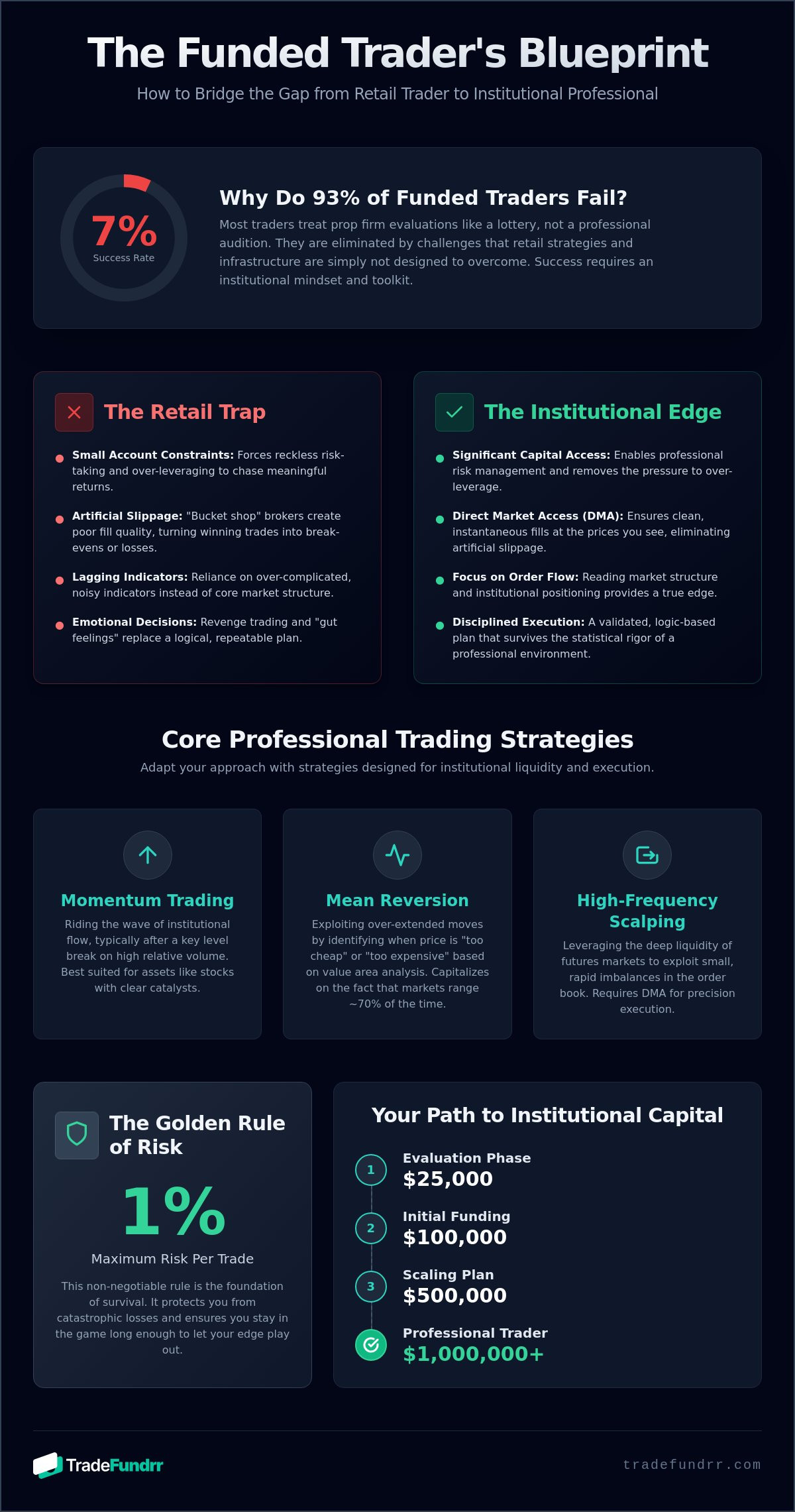
Momentum trading is a primary driver in funded stock trading accounts. It relies on participation and flow. When a stock breaks a key level on high relative volume, it can be the start of a multi-hour trend, so you are riding the move rather than scalping a few cents. Similarly, scalping in a funded futures trading account uses the liquidity of those markets for rapid execution. It is high-frequency logic, exploiting small imbalances in the order book and getting in and out quickly.
Mean reversion is the counter-strategy, and it exploits over-extended moves. Markets spend much of their time ranging rather than trending, and professionals use value-area analysis to find where price is stretched relative to its recent average. It is a high-probability approach that demands discipline: you are not simply fading a move, you are looking for signs of exhaustion in order flow. Rather than worrying about personal-account mechanics, this approach keeps the focus on the math of the range and on preserving your capital buffer, which makes mean-reversion day trading strategies for prop firm challenges useful for staying inside your limits.
Gap trading rounds out the toolkit by capturing overnight sentiment shifts. When the market opens with a gap, it creates immediate opportunity, and you are trading the reaction: does it fill, or does it continue? Rather than guessing, many traders wait for the first 15-minute range to break for confirmation. If you are ready to move beyond retail limitations, choosing a simulated evaluation path is a sensible first step.
Momentum and Trend Following
Success here means distinguishing a true breakout from a trap. Retailers buy the line on the chart; professionals want the volume behind it. Use order-flow and volume data to confirm that real size is behind the move, and if the tape does not support the price action, treat the move as suspect. Exit when momentum fades, not when you "feel" it is over.
Mean Reversion and Range Trading
Define value with standard-deviation filters. When price moves two or three deviations from the mean, the probability of a snapback tends to rise, though it is never a certainty. This is a real test of drawdown management: enter with small size and add only when your thesis is confirmed. Balancing a reasonable win rate with a strict risk-reward ratio is how you survive range-bound conditions.
Infrastructure: The Hidden Variable in Strategy Success
Your strategy is only as good as the environment you run it in. Retail traders often spend months on entries and seconds on execution, and that is backwards. In live markets, some brokers internalize order flow, which can put their incentives at odds with your fills, and Direct Market Access is the institutional answer to that. In a simulated funded account the point is related but different: you practice on real market data inside one stable, professional-grade platform, so you build execution habits that will transfer if you ever trade live. Because it is simulated, your orders are not routed to a live exchange, but the discipline you build around timing and fills is real.
Latency and hesitation punish high-volatility strategies in live markets. If you trade news catalysts, a delay can mean a far worse price, so learning to prepare and act decisively matters. We provide a single environment for stocks, options, futures, and crypto, so you are not juggling four different logins, and real human support when something goes wrong. We understand the day-trading risks tied to technical failure and slippage, and we would rather put a person on a problem than a script.
Execution Speed and Slippage Control
Expectancy is the math of your edge, and hidden costs like slippage can turn a winning approach into a losing one in live markets. Practicing on a professional-grade simulated platform on real data lets you build a feel for those costs before they are real money. Speed and clean execution matter, and getting into the habit of respecting them now is part of the preparation for trading live capital later.
Accessing Institutional Capital
Size changes how you think. Trading a 25k funded account challenge is an entry point, and the larger goal for proven traders is the $1M+ simulated funding path. Scaling up requires a shift in mindset: you stop chasing home runs and start thinking in risk-adjusted returns. With more simulated size, you can execute day trading strategies for prop firm challenges with the patience they require, without the pressure to over-leverage a small account.
Risk Management: The Strategy Behind the Strategy
You can have the best entry in the world and still lose an account. Most struggling traders gamble; the disciplined ones manage risk. The 1% rule is not a suggestion, it is a survival tool. If you risk 5% per trade, a short run of losses can put a real dent in your buffer, and in a prop environment you are often closer to the ceiling than you think. Capital preservation is how you survive an evaluation. You do not trade to get rich on one play; you trade to stay in the game long enough for your edge to manifest. This is the first hurdle in mastering day trading strategies for prop firm challenges.
Understanding the math of your account is critical. Drawdown is a decline from a peak equity point, and if you do not respect that number, the rules close the position for you. This is where many strategies fall apart, because they focus on the profit target and ignore the floor. Managing max drawdown takes disciplined frameworks and a professional process built on tactical retreats, not just aggressive advances. Turning skill into prop firm weekly payouts is a process that rewards focus on the trade rather than the dollar signs.
Professional Drawdown Controls
Trailing drawdown follows your profit up but does not move back down, while static drawdown is a fixed floor. You should know which one applies to your account before you place a single order. Daily loss limits are your emergency brake, stopping the bleeding when emotions and "tilt" cloud your judgment. Treat them as a mandatory tool: if you hit your limit, you walk away, with no "one last trade" to get back to even. That discipline is what separates the funded from the forgotten.
Psychology and the Professional Approach
The danger is often not the first day, when you are cautious and alert, but the sessions after, when overconfidence or revenge trading can creep in. Managing a rules-based account takes a no-nonsense mindset that unstructured retail trading rarely teaches. This is why we provide real human support throughout your journey. When you hit a psychological slump, a bot will not help you navigate the pressure, but a person who has been through it can. Stop gambling with your progress and start executing with discipline. See the TradeFundrr funding programs.
Executing Your Strategy with TradeFundrr
Knowledge is not much use without a venue to apply it. You have the frameworks and you understand the risk; now you need a structured place to build the record. We aim to provide a professional home rather than a playground, with clear rules instead of shifting ones. Applying day trading strategies for prop firm challenges takes more than a chart. It takes a stable environment that respects your skill and gives you an institutional backbone through the T3 foundation stack. The account is simulated; the discipline it builds and the path it can open are real.
Choosing the right evaluation path is your first decision. We offer entry points at the $25,000, $50,000, and $100,000 levels, and your choice should reflect your current edge and your comfort zone. A $25k account is a solid entry, while a $100k account gives more room for complex, multi-asset approaches. Whatever the level, the goal is the same: consistency over gambling. We provide real human support during your evaluation because we want you to have a fair shot, and the terms that govern your account are always in your written agreement.
The Path to Funded Status
The transition from unstructured trader to funded-style trader follows a logical roadmap. It starts with clarity and ends with a track record.
- Step 1: Selecting your starting capital level. Choose between a $25,000 Funded Account Evaluation, a $50,000 Funded Account Evaluation, or a $100,000 Funded Account Evaluation based on your strategy requirements.
- Step 2: Proving your strategy. Execute your plan within the evaluation-phase rules. We look for disciplined risk management and repeatable logic, not lucky windfalls.
- Step 3: Reaching a profit split. Once funded and meeting your account's conditions, you can request a payout on the stated schedule. The account is simulated, and only breaking a rule in your agreement would stop a payout.
Why TradeFundrr is Worth a Look
The industry has its share of unclear rules and hidden hurdles. We aim for straight talk instead. The T3 foundation stack provides a bridge toward a professional trading structure and a $1M+ simulated capital path for top performers. You are a professional retail practitioner operating under a global institutional umbrella. We provide the infrastructure and the simulated capital; you provide the talent. It is time to stop chasing retail patterns and start executing day trading strategies for prop firm challenges with structure. Start a simulated evaluation and build your track record.
Transition to Professional Execution
Success in 2026 is not about magic indicators. It is about structure and discipline. You have seen how slippage and small-account limits erode an edge, and how the answer is a rules-based process practiced where mistakes are cheap. Stop gambling and start executing, because a track record is built on repeatable decisions, not lucky ones.
Mastering day trading strategies for prop firm challenges takes a shift in mindset. You provide the skill; we provide the simulated capital and the structured environment. Built on the T3 foundation stack, you gain access to institutional-grade simulated capital for stocks, options, futures, and crypto. We do not use bots. We provide real human support, and once you are funded and meet your account's conditions, you can request payouts on the stated schedule. The barrier between you and a professional-style record is no longer capital; it is execution.
Stop playing the unstructured game and start trading with discipline. Apply for a Funded Account Evaluation and trade with simulated capital.
Frequently Asked Questions
What are the best day trading strategies for beginners in 2026?
Momentum trading is a sensible entry point for beginners. It relies on identifying clear, high-volume moves and staying with the trend until the volume fades. Beginners are usually better off avoiding complex scalping and focusing on high-probability breakouts with defined risk. This builds the discipline needed for day trading strategies for prop firm challenges without the noise of the lowest timeframes.
How much capital do I need to start day trading professionally?
You do not need a large personal account to practice professional strategies. A simulated Funded Account Evaluation provides institutional-grade simulated capital to trade, so you can work on size and structure without putting your own savings in the market. The cost to participate is the evaluation fee; confirm the current fees and terms in your written account agreement before you start.
Can I use automated trading bots for TradeFundrr evaluations?
We do not allow automated trading bots for our evaluations. Our model is built on individual skill and discretionary decision-making. We look for real traders who can demonstrate logic and emotional control rather than a bot-driven shortcut. Confirm the current automation and strategy rules in your written account agreement.
What is the difference between retail and institutional trading infrastructure?
In live markets, retail routing often internalizes order flow, while institutional Direct Market Access sends orders straight to the exchange for a fill. A TradeFundrr account is simulated, so your orders are not routed to a live exchange. The value is practicing on real market data with clear rules, so the execution habits you build transfer if you ever trade live capital.
How do weekly payouts work for funded traders at TradeFundrr?
Once you reach funded status and meet your account's profit and consistency conditions, you can request a payout on the stated schedule. TradeFundrr does not withhold payouts; only breaking a rule in your account agreement would stop one. Confirm the exact eligibility, timing, split, and any minimums in your written account rules, since those terms govern your account.
What happens if I hit my max drawdown during a prop firm challenge?
Hitting your max drawdown ends the evaluation. It is a hard stop designed to protect the simulated capital from outsized losses. This is why day trading strategies for prop firm challenges must be built on capital preservation first. You cannot reach the payout phase if you do not respect the floor beneath your account.
Do I need to trade every day to be a successful funded trader?
No. Over-trading is a common trap that leads to burnout and unnecessary losses. Waiting for the market to offer a high-probability setup is usually the better path, and many consistent traders execute only a few high-conviction trades per week. Quality of decisions tends to matter more than quantity in a rules-based environment.
Is day trading with a prop firm better than using my own personal money?
A simulated account means your own savings are not exposed to market losses while you build skills, and the cost to participate is the evaluation fee, which you should confirm in the written terms. That removes some of the scared-money pressure so you can focus on the logic of the trade. It is not a guarantee of profit and it does not remove trading risk itself.
Trade with professional-grade simulated capital
Put these frameworks to work in a structured, simulated evaluation with clear rules.
Get Funded →